


Introduction
Language is what we are born with, and we live through. It is embedded into our culture and grows as we grow exposed to numerous external realities. It is simply, therefore, dynamic. It is not only a medium of communication but it is repository of our culture, shared legacy, social relationships and worldview. In the Bharatiya context, languages have long been shaped by historical interactions, borrowings and cultural exchanges. Colonialism left a deep imprint on the linguistic landscapes of the natives. In Bharat like many countries of the world Colonialism imposed English as the language of power, education, and administration, neglecting indigenous languages like Hindi, Tamil, Bengali, Marathi and tribal dialects. This created hierarchy where English fluency equated with elite status, marginalizing over 90 percent of Indians who primarily speak native languages. Bharatiya languages evolved through a shared history, culture, common linguistic patterns over centuries. Decolonising Indian languages is not simply about rejecting foreign impacts but about restoring dignity, originality, and authenticity to indigenous modes of expression. The colonial masters not only negated native languages but dubbed these as barbaric, unscientific and unstructured grammatically and semantically. They experimented it in Carrabian islands, Latin America, South Africa, Asia and other counties to superimpose English over native languages. The process and policies applied by them were not transactional but imposing in nature. Language is evolutionary in nature and historical encounters brought many foreign words to the dictionary of the natives. Accepting, absorbing and assimilating these words is a natural process. But colonizers brought these to dilute the culture of the natives. This triggered the process of hybridization affecting the mainstream languages. Bharatiya languages due to social and cultural interactions with the successive foreign invaders developed a corpus of language by assimilating many words and making these own. This may sound natural so far enrichment of vocabulary is concerned but foreign languages influenced the linguistic landscapes of India undermining the growth of other languages.
Colonial Hegemony and Linguistic Bias
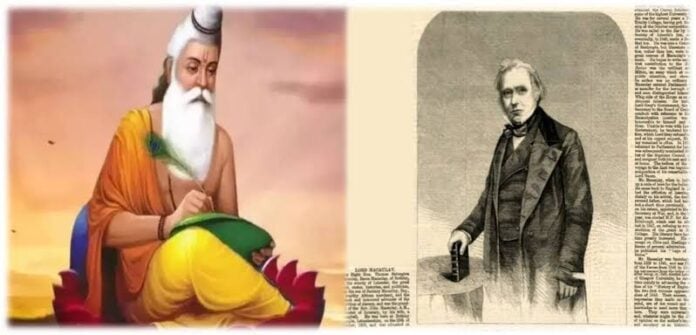
The colonial period under British rule fundamentally changed Bharat’s linguistic landscape. English was institutionalized as the language of administration, education, and intellectual discourse. Indigenous languages were often relegated to the margins, perceived as inadequate for modern sciences and knowledge system. This apparently created a hierarchy where fluency in English became synonymous with power, privilege, and progress. Macaulay’s doctrine further perpetuated this crisis. English became the language of workings in the
offices, courts and institutions which further attracted students and professionals to learn it for getting jobs and social prestige. As a result, Indian languages got infiltrated with code mixing, code switching and hybridity. Colonization systematically disrupted the hierarchy of Bharatiya languages by placing English on the top.
Even after independence, this hierarchy persisted. English continues to dominate higher education, legal systems, and the elite communication, while many Bharatiya languages struggle for recognition and functional expansion. This imbalance doesn’t reflect merely linguistic preference, but a lingering colonial mindset.
Decolonising Indian Linguistic Landscape
What does Decolonising Language mean? Decolonising marks a departure from Euro-centric languages to native languages, a shift from linguistic imperialism to indigenous culture and languages, and attitudinal shift from colonial mindset to national mindset. It also requires fundamental shift in societal attitudes towards indigenous languages. Ngugi wa Thiong’o’s “Decolonising the Mind: The Politics of Language in African Literature” (Ngugi, James Carrey, London, 1986). Ngugi argues that linguistic imperialism is the primary tool of colonial alienation detaching Africans from their culture. He advocated for writing in mother tongues, not European languages, to decolonize African literature and thought, marking a crucial “farewell to English” in his creative works. Ngugi’ theory can be applied to deconstruct decolonization of Indian languages, Namvar Singh’s “Decolonising the Bharatiya Mind” argues that true independence requires dismantling the internalized cultural, literary, and psychological hegemony of British colonialism. He emphasizes shifting the center of literary creation away from Western hegemony towards Bharatiya, Bharatiya, Asian and African languages. He further argues shifting the focus from western approach to Indian socio-cultural context. (Namvar Singh, Bharatiya, Asian and African Literature, V35, N5, Issue 151, 1992).
Decolonising Bharatiya languages involves a multi-layered process. Some of these include reclaiming epistemic space, allowing Bharatiya languages to be vehicles of knowledge production in fields like science, philosophy, technology and revitalizing indigenous vocabularies. It becomes imperative to encourage the use of native expressions rather than over-reliance on borrowed or translated terminology. The basic ethos and spirit of native languages suffered grievously, dismantling the cultural fabric of the Bharatiya languages. It is this sense of loss that process of decolonization addresses. Decolonisation further challenges the so-called linguistic elitism, breaking the myth of associating English with intelligence and social prestige. Decolonisation helps us in restoring oral traditions, recognizing folk narratives, dialects, and oral histories as legitimate knowledge systems. Research works, field
studies, survey reports of folk studies in Bharat over last decades have accelerated the growth of Indian knowledge system remarkably. These exercises further mobilized the process of acceptability and acknowledgement of linguistic diversity. Languages like Santhali, Munda, Meiti became the carriers of rich cultural heritage of the tribal people erstwhile confined to British civil servants and researchers during the colonial period. Translations from these languages by Bharatiya authors and researchers, whereas enriched the Bharatiya linguistic landscapes, these also had a cascading effect on the process of Decolonisation. V.M. Subramanya Sharma and Purnendu Bikas Debnath are of the opinion that recognizing Bharatiya languages, promoting multilingualism in Education are integral to Decolonising Bharat’s linguistic landscape. To quote them “Decolonising Bharat’s linguistic landscape involves more than just policy changes; it requires a fundamental shift in societal attitude towards Indigenous languages. Recognizing and valuing the intrinsic worth of these languages is crucial for preserving cultural diversity and promoting inclusive development.” (Bharatiya Bhasha Pariwar, National Book Trust, New Delhi, 2025, p95).
It is not about rejecting English entirely, but about dismantling its monopoly, and creating a more equitable multilingual environment. There is need to decolonize Indian the Bharatiya minds by dispelling the ghosts of Macaulay, and filling them with a sense of pride and privilege to be Indian first.
Role of Education and Policies
Education plays a crucial role in Decolonisation. The National Education Policy (NEP) 2020’s commitment to multilingualism and education in the mother tongue aligns with decolonising the Bharatiya linguistic landscape. The emphasis on mother tongue education in the earlier stage is a step in the right direction. When learners engage with knowledge in their own language, comprehension deepens and cultural connection strengthens. Policy reforms such as enforcing the three-language formula equitably and elevating languages in governance, media and technology. There is plethora of examples such as Google’s Bhasha Hub for 22 languages and AI backed media, advertisements in regional languages, regional TV shows and News have been also instrumental in the process of decolonisation of Indian languages to a great extent. However, implementation remains uneven and inconsistent. Many institutions still priorities English medium instruction, often at the cost of conceptual clarity and inclusivity. This is further made worse by the parents, who endorse English medium education for their children as a matter of pride. The colonial mind set that English medium schools alone can ensure future of their children a good future is misleading. A decolonized approach would involve developing high-quality academic resources, textbooks, and research in Indian languages, ensuring they are not seen as secondary alternatives.
“ By integrating inclusive language policies, multilingual narrative frameworks, and community-driven initiatives, Bharat can foster a renewed appreciation for its linguistic heritage while countering the enduring efforts of colonial legacies”’(Bharatiya Bhasha Pariwar, 2025, p.97).
Digital Humanities and Language Revival
The digital age offers unprecedented opportunities for linguistic empowerment. Digitization of manuscripts, creation of online dictionaries, and development of language technologies such as speech recognition and translation tools, can significantly enhance accessibility and usage of Bharatiya languages. Social media and digital platforms have also democratized language use. Young writers, poets and content creators are increasingly expressing themselves in Hindi, Tamil, Bengali, Marathi and Odiya, and other languages challenging the dominance of English in the public discourse. Ai can be used to create, preserve and restore lost languages and scripts. Making dictionaries of administrative, scientific and technological terms in 22 Bharatiya languages is already in progress.
Cultural Identity and Linguistic Pride
Decolonising language is deeply related to identity. When people speak, write, and think in their own languages without any hesitation or inferiority, it fosters self-respect and cultural continuity. Literature, cinema, and local media play a vital role in nurturing this pride. At the same time, Bharat’s linguistic diversity must be preserved. Decolonisation should not lead to dominance of a few major languages over smaller languages. Rather it should realize the plurality, celebrate and promote linguistic coexistence. People should realize that plurality and diversity of languages is our strength and not weakness.
Challenges and Resolution
Decolonisation of Bharatiya languages is not without challenges. Some of these challenges include lack of standardized terminology in technical fields, limited institutional support, societal preference for English due to economic opportunities. Besides, these generic challenges, are politicization of language debates, interstate disputes spoiling the social harmony and integrity. Of late many incidents leading to skirmishes in Maharashtra and Karnataka were reported. Addressing these requires policy support, community participation, and shift in societal attitudes. Let’s not get bogged down by these challenges but unitedly strive for amicable solutions.
Conclusion
Decolonising Indian languages is ultimately about reclaiming intellectual sovereignty. It is a journey toward recognizing that knowledge, creativity, and innovation are not bound by any single language. By empowering Indian languages, we not only preserve cultural heritage but also create a more inclusive and equitable knowledge society. The future of India lies not in choosing between English and indigenous languages, but harmonizing them-where every language has a space to flourish, and every voice is heard with equal respect. Decolonising Bharatiya languages offers a transformative framework for understating Bharat’s linguistic landscape, diversity and shared history of centuries. This perspective conflates the colonial mentality to divide the Bharatiya languages in categories and hierarchies. It is also reassertion of our multilingual identity, mutual commonalities and insight to all languages of one Bhasha Pariwar.
— Chandra Shekhar Dubey
