


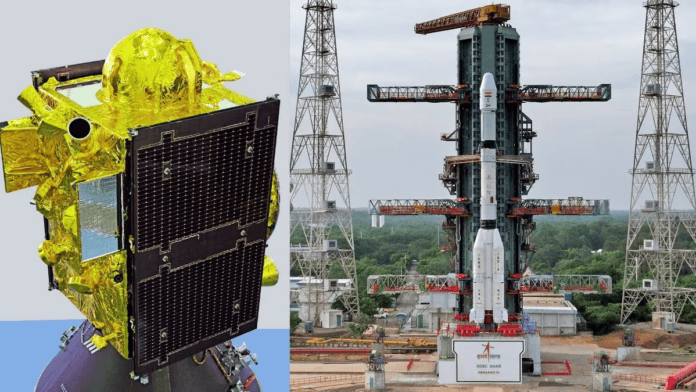
Summary: Bharat's GSLV-F18 has placed the NVS-03 navigation satellite into transfer orbit, restoring the NavIC constellation to its minimum operational configuration of four satellites. The article examines whether this is a true recovery or a reprieve, given that repeated atomic clock failures plagued the first-generation satellites. It highlights the first indigenous rubidium atomic clock, developed by the Space Applications Centre in Ahmedabad, now flying alongside imported clocks. The piece notes that the satellite must still complete orbit-raising burns, that four satellites leave no margin, and that the launch rate limits how quickly NVS-04 and NVS-05 can follow.
Why it matters: NavIC is Bharat's own navigation system, meant to reduce dependence on foreign signals for position and timing, so its health bears directly on strategic autonomy. The story also shows an indigenous space-technology achievement being built step by step.
“Time in the Sky: Can India’s Home-Built Atomic Clocks Keep NavIC Alive?” — TFIPost, 31 Oct 2026
On Friday night, a rocket carrying a 2,250 kg satellite lifted off from Sriharikota’s second launch pad. The GSLV-F18 placed NVS-03 into geosynchronous transfer orbit after a flight of about 18 minutes. ISRO chairman V. Narayanan said the launch has restored the NavIC constellation to its minimum operational configuration of four satellites. A system that had slipped into disrepair has been brought back to the edge of working order. Is that a recovery, or only a reprieve?
NavIC is India’s own regional navigation system, built so that the country does not depend on foreign signals for position and time. It is designed to give users position accuracy better than 20 metres and timing accuracy better than 50 nanoseconds. Its first-generation satellites, launched between 2013 and 2016, ran into a recurring fault: repeated atomic clock failures, and several satellites outlived their intended operational lives.
A navigation satellite is, at heart, a clock in the sky. Receivers calculate position by measuring tiny differences in signal timing, so a failed clock makes the satellite useless for ranging however healthy the rest of the spacecraft is. Why did so many clocks fail on one fleet? And why did it take until 2026 to replace enough of them?…
Read the full article at TFIPost →
