


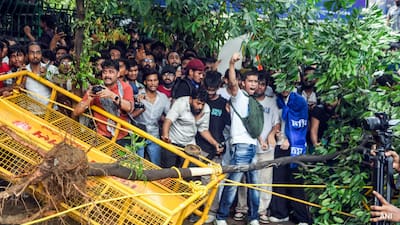
Last week, the 20th July 2026 belonged to the anarchy and anarchists in Bharat and especially so in the Delhi region. The heart of the Delhi city comprising the busiest areas in and around Jantar-Mantar, Janpath, Connaught Place, Lutyens New Delhi, Parliament surroundings and even the Prime Minister’s residential areas were targeted specifically. All these were brought into the purview of chaos, violence, stone-pelting, attack on men and women in police uniform, retaliatory police action, damage of police and private vehicles and properties, detentions and petty political battles on roads and in the parliament.
The opposition parties and particularly the Congress didn’t lag behind in encashing the volatile situation notwithstanding their constitutional and socio-political responsibilities and accountability towards the parliament the monsoon session of which also started on 20th July 2026. Their demonstrations in the highly sensitive area of the Prime Minister’s residence under Rahul Gandhi and Kharge followed by typical tantrums were an absolute political mockery reflecting their immaturity and irresponsible attitude. Same is the position of those public figures who have a number of times in the past supported anarchy and anarchists openly and publicly. It included people like Akhilesh Yadav, Arvind Kejriwal, Yogendra Yadav and many of their ilks.
There is a perception among a large segment of the population that PM Narendra Modi is the only best solution to any attempt of anarchy in the country at the hands of those who want Bharat to follow Pakistan, Sri Lanka, Bangladesh and Nepal in this context. He is perceived as the biggest guarantee against such a situation. His government is supposed to be stable, responsive, accountable, transparent and strong. Any concession to violence, anarchy and damage to public order is not in its syllabus. People of the country see the current Modi government in the light of its previous two incarnations and as the biggest tool for transforming India.
In regard to the unfortunate happenings, there are various views and opinions in public and all hold water to some extent. It all started with the announcement of a sit-in-protest by a known activist of Ladakh, Sonam Wangchuk at Jantar-Mantar on the issue of NEET paper leak followed by his indefinite hunger strike at the same venue. Consequently, his hunger strike evoked interest and follow up among the students and youth of the country. He was later joined by the activists of a newly formed social media group called ‘Cockroach Janta Party’ led by one Abhijeet Dipkey living in Boston US.
The founder of Cockroach Janta Party (CJP) Abhijeet Dipke ‘thanked’ Chief Justice of India Surya Kant, saying the CJI’s earlier “cockroaches” remark about unemployed youth became the trigger for a movement that eventually led to Jantar-Mantar agitation and pressure upon the government of India to initiate dialogue with it and eventually making the Union Education Minister Dharmendra Pradhan resign. He also said that had the remark not been made, he might not have returned to India and the youth-led agitation may not have taken shape in that manner. The CJI, Surya Kant had later clarified that his comments were taken out of context and were actually aimed at individuals with fake or bogus degrees, not unemployed youth in general.
The CJP ended its 36-day agitation on 25 July, 2026 after the government accepted its remaining demands, including compensation for families of students who allegedly died by suicide following the NEET paper leak controversy and withdrawal of FIRs against protesters. However, there is no clarity about the withdrawal of cases about the people against whom there are serious charges of violence, arson and attack on policemen in uniform on duty. The time frame for reforms in the education system have also been discussed but details have not been made public as yet. It becomes important in the foregoing to have more discussion about the whole issue in order to arrive at a convincing conclusion.
The government of India seems to have taken a huge risk while considering the demands of the agitating students and youth led by Sonam Wangchuk and the CJP leaders and entering into a truce with them officially. On the face of it, the whole exercise is based upon reposing trust in the people who were in the lead of the agitation. The declarations and other details on behalf of the government are reminiscent of the farmer’s agitation way back in 2020-21. As has been communicated by the government and the party in power -the BJP, the whole issue was dealt with by the government keeping in view the national interests and peace in the country, interests of the students and youth in general and the possible reformation process in the educational sector.
However, these clarifications haven’t convinced a large segment of the supporters of the BJP and the government. They view it as a ‘surrender’ before the anarchists and anarchy. They view the whole issue in a chronological order. Sonam Wangchuk, who runs a number of NGOs, was accused of anti-national activities in 2007 in an official government communique when there was UPA government at the centre. He was the person who issued a public statement only a few years back that ‘in case China would advance towards India, they would welcome them in Ladakh and also show them the way’. There were also a number of cases related to foreign funding against him.
He was the same person who was held responsible for violence and arson in Leh in September 2025 in which four persons were killed. A number of public properties were burnt by the agitating crowds there. The government of India blamed Wangchuk for the events and detained him under NSA and put him in Jodhpur jail. He was consequently released in March-2026 enabling him to enter into a dialogue with the Ministry of Home Affairs along with the other Ladakh activists for a democratic set-up in Ladakh. There was an agreement to this effect between the two sides that has seen an implementation process on the ground recently.
When Wangchuk decided to go for the sit-in-protest at Jantar-Mantar, New Delhi on the NEET issue, he received a meager support from the youth. However, he continued with his mission in hand and decided to go for the indefinite hunger strike on the issue from the same venue. That decision charged the atmosphere and it started building pressure on the government. Later on, it was joined by the CJP activists who made it known from the very beginning that they wouldn’t end the stir before the resignation of the Education Minister, Dharmendra Pradhan as he was morally held responsible for the paper leak though he had no direct hand in it.
The movement gained strength with a few opposition leaders lending support to it, some celebrities joining it physically and a few ‘andolan-jeevies’ becoming a part of it. It was a situation similar to the farmer’s agitation and Shaheen Bagh. Forces opposite to BJP, Modi, NDA, Hindutva, RSS and even some anti-national groups joined the agitation publicly and started speaking venom against everyone and every institution and organisation they traditionally opposed. It was virtually a free for all at the venue of the agitation. Naked abuses against the Prime Minister, BJP, RSS and Hindutva were made at the Jantar-Mantar. The situation eased a bit when Wangchuk was shifted to the hospital on 18 July, 2026 by the police on the directions of the court.
On the fateful day of 20 July 2026, the parliament was to begin its monsoon session. The CJP and others chose the same day for the parliament siege. The situation had become very tense and the government decided to declare Section 163 of the BNSS at Jantar-Mantar. Assembly of more than five was declared illegal. People gathered there despite heavy police ‘bandobast’ around the venue. All sorts of people besides the agitators included history-sheeters, criminals, communal elements and people belonging to certain opposition parties joined the ‘Sansad-Chalo march’. What happened thereafter is well known and recorded. The agitators attacked even the media men and women covering the event. There are wide coverages available on public domain and also with the police depicting truthful facts about the mayhem on that day in Delhi.
Despite what unfortunate developments took place on 20 July 2026, the government went ahead with the dialogue process in order to end the agitation and its possible outbreak at a national level. The Prime Minister deputed two ministers to negotiate with the agitators. Prime Minister Narendra Modi in a midnight video broadcast communicated about his concerns with the youth of the country and assured about the reforming process in the education sector. He also assured strong action against the people responsible for paper leaks. His message on social media broke all records of the past and its viewership went into hundreds of millions. His number of followers were swollen to a further more than one million. This surely testifies the fact that he remains the star attraction and the leader of the masses and particularly of the youth in any sort of situation.
In the developing scenario, it is now to be seen whether the government took a wise decision or not. The whole issue is of the trust that the government reposed in the agitating leaders and also about the implementation of the agreement that was reached between the two sides. Keeping in view the latest statements of the leaders of the CJP that it shouldn’t be seen as an end in itself, anything is possible in near future. It is only the time that will determine whether it was a risk worth taking for the government of Bharat…!
