


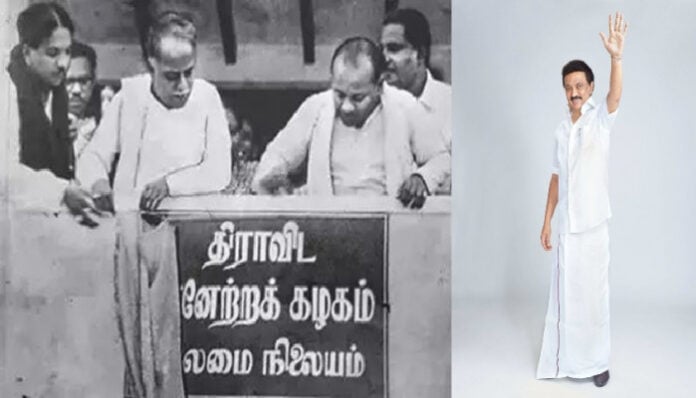
“The Unbeatable Pole: Why the 2026 Election is the DMK’s to Lose”, My Ind Maker, February 13, 2026
“The Dravida Munnetra Kazhagam (DMK) occupies the central position in the current political landscape of Tamil Nadu, acting as the gravitational anchor of the Secular Progressive Alliance. This coalition remains a formidable apparatus for power preservation, having successfully integrated a diverse spectrum of ideological partners ranging from the Congress to the Left and Dalit parties. While the external observer might view this as a mere marriage of convenience, the ground reality reveals a meticulously engineered structure that benefits from both historical legacy and modern administrative reach. The party has transitioned from its role as an agitator to a quintessential establishment force, defining the contours of state discourse through its so-called Dravidian Model of governance. Understanding this pole is essential for any non-Tamil observer as it provides the baseline against which all other political movements and disruptions in the state are measured.
The secondary pillar of the Dravidian model rests on a triadic expansion of social security, industrial scale, and logistical infrastructure. The flagship Kalaignar Magalir Urimai Thogai represents the most significant shift in welfare philosophy by providing a monthly entitlement of one thousand rupees to over one crore women, effectively institutionalising a basic income for female heads of households. This is complemented by the Pudhumai Penn scheme, which incentivises higher education for girl students from government schools and the Vidiyal Payanam free bus travel initiative, which has radically altered female workforce participation. These interventions are designed to create a resilient social floor that sustains political loyalty through direct and tangible benefits. On the ground, these are not perceived as mere doles but as essential corrective measures for household economic stability.
Industrial momentum is anchored by high-technology manufacturing hubs that signal a departure from traditional low-value assembly. The recent inauguration of the nine thousand crore Tata Motors Jaguar Land Rover plant in Ranipet marks the first instance of premium luxury vehicles being fully manufactured in India rather than assembled from kits. This is bolstered by the Rs 16,000 crore commitment from Vietnamese electric vehicle giant VinFast in Thoothukudi and the massive solar cell manufacturing facility by TP Solar in Tirunelveli. These projects are strategically distributed across the state to prevent lopsided development in the Chennai belt and to leverage regional talent pools. Such a scale of industrialisation reflects a clinical intent to capture the global supply chain shifts in the automotive and green energy sectors…….”
Read full article at myind.net
