


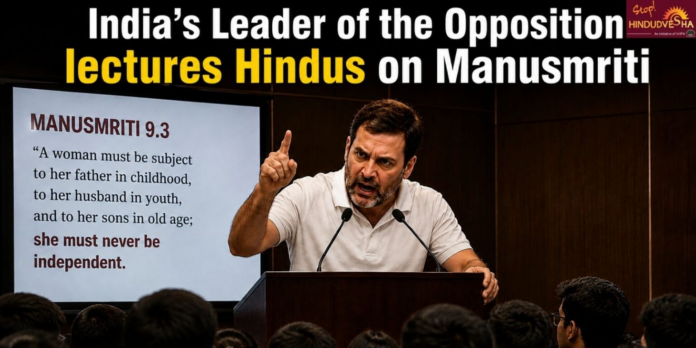
“The Podium Pandit: Rahul Gandhi Lectures a Civilization”, StopHinduDvesha, 29 Aug 2026.
“Rahul Gandhi’s use of Manusmriti 9.3 to indict Hindu society reveals more than a bad reading of Dharmashastra. It exposes a deeper political inheritance: a dynasty distant from Hindu civilizational memory yet remarkably confident in judging it. From Somnath and Ayodhya to Manu, the pattern persists: Hindu wounds are minimized, Hindu texts stripped of context, and fragments converted into political weapons. Gandhi did not approach Manusmriti to understand it. He came seeking an indictment and found himself a verse.
On 22 August 2026 in Pune, Rahul Gandhi, India’s Leader of the Opposition, quoted Manusmriti 9.3 — that a woman is under her father in childhood, her husband in youth, and her sons after her husband’s death, and that she must never be independent — called those words a shame, and then loaded onto that single line a theory of India: a continuing “Manusmriti mindset,” a cage, and the supposed source of the suppression of women.[1]
Notwithstanding RG’s glib recitation of that stray line, one sentence from one smriti is not a history of Indian patriarchy, and a podium is not a critical edition. Manu is one author among others: Yajnavalkya, Narada, and Parashara wrote their own codes and did not always agree with him. Custom often overrode text; commentary often overrode a bare verse; colonial courts and then Parliament overrode both. A speaker who treats Manusmriti 9.3 as if it were the final word on Hindu law has not interpreted the corpus. He has turned one verse into a truncheon.
Adhikara to speak on Dharmashastra is not inherited; it is earned by knowing what the texts are. RG’s handlers apparently forgot to tell him that Manusmriti is not Veda, that the same text also instructs men to honor women, or that it was never Hinduism’s canon law. They also neglected to mention that Parliament displaced traditional Hindu family law with statutory Hindu personal law in 1955 and 1956. But RG desperately needs Manusmriti to be both eternal and uniquely Hindu. Only then can one verse be made into an indictment of a people rather than what it actually is: a line in an ancient legal treatise.
That is not scholarship. It is a tactic. Apply the same method to Deuteronomy 22 or Qur’an 4:34, and interpreters insist that no religion can be judged by a single verse stripped of its context. Apply it to Manu, and the appeal to context is dismissed as excuse-making.
If you want to know whether this is ignorance or tactic, look at the family’s long argument with Hindu temples………………………”
Read the full article at StopHinduDvesha.
