


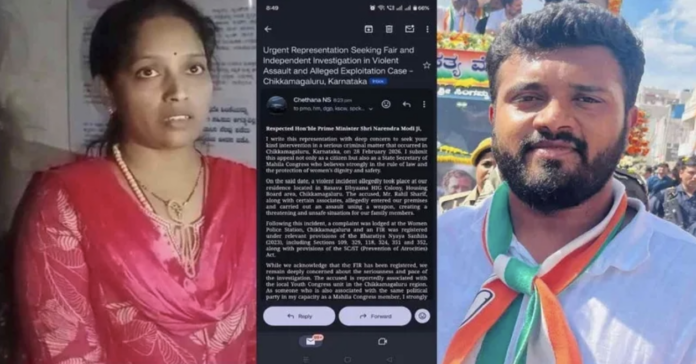
A major controversy has erupted in the Chikkamagaluru district after a Congress woman leader accused the police of failing to carry out a fair and impartial investigation in an assault case involving a Muslim leader from the same party. The complainant, Chetana, who serves as the state women’s secretary of the Congress, has alleged that the probe is being deliberately weakened due to the accused’s political affiliation, Rahil Sharif.
As per the Organiser reports, the incident reportedly occurred on the night of February 28 in the Housing Board locality of Chikkamagaluru. As per the complaint, Rahil Sharif allegedly forced his way into the residence where Chetana and her husband were staying and assaulted them following a dispute related to their rented house. The accused is said to have fled the scene immediately after the incident.
Following the complaint, police registered a case and initiated efforts to trace the accused. A special team was constituted under the supervision of Superintendent of Police Jitendra Kumar Dayama, with Inspector Abhay Prakash leading search operations across multiple states to locate Rahil Sharif.
According to police sources, the accused attempted to flee the country and was reportedly planning to escape to Nepal. However, he was eventually apprehended in Ajmer, Rajasthan, while trying to evade authorities. Despite the arrest, the case took a contentious turn after Chetana raised concerns over the manner in which the accused was being handled.
Chetana alleged that instead of being subjected to rigorous interrogation, Rahil Sharif was admitted to Mallegowda Government Hospital and was being shielded from proper questioning. She claimed that the police were not taking strict action due to his political connections, thereby compromising the integrity of the investigation.
Escalating the matter, Chetana has written to Prime Minister Narendra Modi, seeking justice and demanding an independent probe. In her letter, she also made serious allegations regarding the accused’s past conduct, claiming that objectionable material, including obscene videos of Hindu girls, was found on his mobile phone. She further sought protection for herself and her family, citing threats following the incident.
The case has now triggered a wider political debate in Karnataka, raising concerns over possible political influence in law enforcement. While police officials maintain that the investigation is ongoing and due legal procedures are being followed, the allegations of bias and inaction continue to intensify calls for a transparent and impartial inquiry.
The controversy has intensified scrutiny on the silence of senior Congress leaders, including Rahul Gandhi, who often speak about women’s empowerment, equality, and respect in public forums. The leader of the opposition argues that such rhetoric loses credibility when serious allegations emerge within the party’s own ranks and are met with inaction or muted responses. The case involving Rahil Sharif has raised uncomfortable questions about whether political considerations are overriding the commitment to justice.
Many observers point out that women’s safety cannot be a selective issue, invoked only when politically convenient. When a woman leader from within the same party alleges assault and bias in the investigation, the absence of a strong, unequivocal response from the leadership undermines public trust. It reinforces concerns that accountability may differ depending on who is accused.
Ultimately, this case has become more than just a law-and-order issue; it is now a test of political integrity. If parties fail to act firmly against wrongdoing within their own ranks, their claims of standing for justice and women’s rights risk being seen as hollow.
