


Recently, an article by an Al Jazeera journalist named Mukta Joshi made the rounds on social media platform X. This article is a classic example of biased journalism masquerading as investigative reporting, replete with hypocrisy and a blatant disregard for objectivity. The piece resorts to painting the Hindu American Foundation (HAF) as a mere proxy for the Modi government, using flimsy evidence and conjecture to advance a misleading narrative. What is worse, the writer appears to be serving as a mouthpiece for anti-Indian interests, effectively functioning as a “Brown Sepoy,” peddling narratives aligned with Western and Islamist agendas rather than those of her own community.
Selective outrage and double standards
The article’s attempt to smear HAF for advocating on behalf of Hindu Americans is based on a disingenuous and hypocritical premise. When advocacy groups for Muslim, Jewish, or Armenian communities lobby on international issues, their actions are never questioned but seen as legitimate efforts to represent their diasporas. However, when a Hindu organization champions the interests of the Hindu community, it is vilified as a foreign agent. It is ludicrous to suggest that advocating for issues that matter to a diaspora community should automatically trigger Foreign Agents Registration Act (FARA) requirements. This one-sided scrutiny reveals an intent to target Hindu advocacy while ignoring other groups who operate in the same space without facing similar accusations.
The article makes sweeping claims about HAF being involved in US politics in coordination with the Indian government but provides no substantive proof. HAF’s senior director asserts that mere overlap in positions does not qualify them as foreign agents.
Misrepresentation of Hinduphobia and Hindu advocacy
By dismissing Hinduphobia as an insignificant issue and ridiculing HAF’s efforts to combat it, the article reveals a deep-seated bias. Hinduphobia is a reality faced by Hindu Americans who endure discrimination, stereotyping, and attacks on their cultural and religious practices. However, instead of recognizing this, Joshi minimizes the issue while inflating concerns about Islamophobia, revealing a double standard in addressing discrimination. If advocacy groups can fight against anti-Semitism or Islamophobia, why should HAF’s work be considered illegitimate?
By minimizing the issue of Hinduphobia and ridiculing HAF’s efforts to combat it, the article reveals a deep-seated bias. Hinduphobia is not a fringe concern; it is a reality faced by Hindu Americans who endure discrimination, stereotyping, and attacks on their cultural and religious practices. Instead of recognizing this issue, the article seeks to dismiss it while inflating concerns about Islamophobia, thus revealing a clear double standard in addressing discrimination.
If advocacy groups can successfully combat anti-Semitism or Islamophobia, why should HAF’s work against Hinduphobia be considered illegitimate? This inconsistency in recognizing the legitimacy of advocacy work for different communities reflects a troubling bias. By framing HAF’s concerns as unworthy of serious consideration, the article undermines the voices of those who experience discrimination and reinforces harmful stereotypes.
Conflation of advocacy with extremism
The attempt to associate HAF’s advocacy with Hindu nationalism is an egregious misuse of guilt by association. By implying that HAF’s positions on international issues, such as the F-16 deal with Pakistan, are tantamount to supporting the Modi government, the writer is essentially saying that Hindu Americans are not entitled to legitimate concerns regarding geopolitics or regional security. Such framing perpetuates the baseless ‘dual loyalty’ trope, which insinuates that any Hindu involved in advocacy must automatically be suspected of allegiance to India. This line of reasoning wouldn’t be acceptable if it targeted other minority groups in the United States, yet it is casually directed toward Hindus without consequence.
The article points out that HAF members are also part of the Hindu American Political Action Committee (HAPAC), which has made political donations. However, it fails to acknowledge that these two entities operate independently and adhere to US laws.
Moreover, the insinuation that any Hindu advocacy organization must inherently serve the interests of the Indian government is problematic. By applying this logic, the article dismisses the complexity of community advocacy and reduces it to a simplistic narrative that serves only to vilify HAF. This approach perpetuates the baseless ‘dual loyalty’ trope, which insinuates that Hindu Americans are not entitled to independent political thought and must always be regarded with skepticism if they engage in public discourse. Such a line of reasoning is not only disingenuous but also harmful to the representation of Hindu Americans in the broader sociopolitical landscape.
Moreover, there is no direct evidence provided to support this claim, and the article relies on speculative statements.
Brown Sepoy Syndrome: Serving Western and Islamist agendas
The author, a Hindu in name only (HINO), an Indian now serving as a journalist for a Qatari-funded outlet, is a textbook case of what can be described as “Brown Sepoy Syndrome.” Brown sepoys are those who, despite having Indian heritage, engage in undermining their own country’s and community’s interests to align with anti-Bharat agendas, often motivated by foreign influence. Mukta Joshi’s piece fits this description perfectly, aligning with Al Jazeera’s well-documented stance against Hindu and Bharatiya interests while promoting narratives favourable to Islamist regimes. It raises the question: Is this journalism, or simply a deep state’s “influencer” model dressed up as investigative work?
By promoting the notion that HAF is operating on behalf of the Indian state, Joshi not only undermines the credibility of the foundation but also betrays the interests of the very community she is purportedly representing.
Al Jazeera’s history of hate for Hindus, Bharat, and Modi
It is no secret that Al Jazeera is funded by Qatar, a state known for promoting Islamist agendas. The outlet’s consistent pattern of targeting Hindus and Jews raises serious concerns about its motivations. The organization’s history of platforming extremists and disseminating propaganda should be reason enough to view its coverage with skepticism. Al Jazeera’s funding connections to a regime linked to antisemitism and Islamist extremism call into question the objectivity of its reporting. One must ask whether this article serves to promote legitimate discourse or to perpetuate a broader geopolitical agenda against Bharat.
Al Jazeera’s history of targeting Hindus and Jews raises serious concerns about its motivations. Funded by Qatar—a state known for its promotion of Islamist agendas—the outlet has a long-standing pattern of disseminating anti-Indian and anti-Hindu propaganda and its support for Hamas. This should prompt readers to critically evaluate the objectivity of its reporting. The organization’s connections to a regime implicated in antisemitism and extremism cast doubt on its impartiality and highlight how bias permeates its coverage.
Furthermore, if we are genuinely concerned about foreign influence in American discourse, why are we not scrutinizing a Qatari-funded outlet that consistently targets Hindus while claiming to uphold journalistic integrity? The conflation of advocacy for Hindu rights with extremism is a tactic employed by Al Jazeera to delegitimize genuine concerns while advancing narratives aligned with their political objectives.
Examples of Hindu hate as exhibited by Al Jazeera
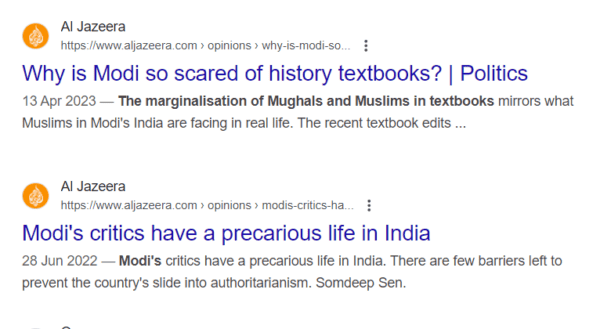
Al Jazeera has a history of reporting bias especially when it comes to anything Hindu, Bharatiya, and hence the Modi hate.
According to a report in October 2023, Muslim students at a Hindu-majority school in Gujarat were beaten by “Hindu activists” after arranging a performance on religious tolerance that depicted Muslim prayers.
The video claimed that the teacher was attacked at the school for organizing a show promoting “religious tolerance,” where predominantly Hindu students were asked to sing and act out Muslim prayers. Al Jazeera further stated that the school principal described the act as a gesture to welcome a newly admitted Muslim student. They also reported that the school issued an apology and removed the video from its social media pages. However, the report failed to mention a crucial detail. According to activists from the Akhil Bharatiya Vidyarthi Parishad (ABVP), four Hindu students were allegedly forced to perform Namaz without their parents’ consent, raising significant concerns about the incident.
Their columnist Meer Faisal, who is also associated with platforms like The Wire and The Quint, posted a tweet where he attacked non-Muslims, stating, “all enemies of Islam are the same.” In the now-deleted tweet, he wrote “Laanat on all opposition parties and leaders of UP” and included the phrase “Al Kufr Millatun Wahida,” which translates to “Disbelievers/enemies of Islam are one.” This tweet was made in response to the Yogi Government’s crackdown on rioters following protests over alleged insults to the Prophet by former BJP leader Nupur Sharma. Faisal was previously booked by the Delhi Police for spreading fake news and inciting communal tensions.
Abdullah Al-Jamal, a freelancer associated with Al Jazeera, The Palestine Chronicle, and the Palestinian Ministry of Labor under Hamas, was revealed to be involved in holding Israeli hostages during the 7 October 2023 Hamas terrorist attack. He was based in Nuseirat, where hostages were kept. Al-Jamal and several family members were killed in an Israeli rescue operation named “Seeds of Summer” (later “Operation Arnon”). Al Jazeera distanced itself from Al-Jamal, stating that he was never an employee, though reports confirmed his ties to Hamas.
Mehdi Hasan, a prominent debater and journalist from the UK earlier associated with Al Jazeera, has frequently expressed disdain for non-Muslims, often targeting Indian Prime Minister Narendra Modi. He has equated Modi with Adolf Hitler and linked Hindu Nationalism in India to white supremacy in the West. In a tweet, Hasan criticized the global focus on authoritarian leaders like Putin and Orban, arguing that Modi and the BJP deserve similar scrutiny. He also differentiated between Hinduism and Hindutva, a common stance among leftists and Congress supporters in India, which is often used to undermine Hindus.
While he is no longer associated with Al Jazeera, this hate for Hindus is explicit. He once said, “Once we lose the moral high ground we are no different from the rest, of the non-Muslims, from the rest of those human beings who live their lives as animals, bending any rule to fulfill any desire.”
During the Ram Mandir Pran Prathishta, they published an article titled, India’s Modi opens controversial Hindu temple in Ayodhya

It said, “Analysts and critics see the ceremony as the start of the election campaign for Modi, an avowed Hindu nationalist and one of India’s most consequential leaders who has sought to transform the country from a secular democracy into a distinctly Hindu state in his nearly 10 years in power. They say the pomp-filled display led by the government shows the extent to which the line between religion and state has eroded under Modi. Built at an estimated cost of $217m and spread over nearly 3 hectares (7.4 acres), the temple lies atop the debris of the 16th-century Babri mosque, which was razed to the ground in 1992 by Hindu mobs, who believed it was built on temple ruins marking the birthplace of Lord Ram.”
Hypocrisy regarding foreign influence
In the article, Joshi goes to great lengths to link HAF with Indian government interests without providing any concrete evidence of coordination or payments. Meanwhile, the real elephant in the room is ignored: Al Jazeera itself operates under the influence of the Qatari state, known for donating billions to American institutions and supporting Islamist narratives. If foreign influence is truly a concern, shouldn’t we be more worried about a Qatari-funded outlet engaging in anti-Indian propaganda than a Hindu organization advocating for diaspora interests?
Gossip journalism at its finest
The article lacks substantive evidence and relies heavily on insinuations, vague studies, and selectively chosen anonymous quotes to support its claims. There is no compulsive proof in the form of numbers, statistics, or detailed reports/evidence —just a series of allegations wrapped in speculative language. Some of the other “proof” mentioned include HAF advocating for recognising the festival of Deepavali in the US and promoting Yoga! Here’s another damning proof – they supported CAA and asked for changes in the textbooks in California which were denigrating Bharat and Hindu Dharma!
This is not investigative journalism; it is a glorified opinion piece that serves as a hit job against a legitimate advocacy organization. The real scandal here is not HAF’s supposed alignment with Indian interests, but the lack of rigor and plan Hindu and Bharat hate exhibited in this report.
Mukta Joshi’s article epitomizes the worst kind of journalism—selective, hypocritical, and biased. It uses the Hindu American Foundation as a scapegoat to advance an anti-Bharat agenda while ignoring the legitimate concerns of Hindu Americans. The writer’s eagerness to label a Hindu advocacy group as a foreign agent while disregarding the significant foreign influence behind her own employer reveals a lack of self-awareness. This piece is less about holding HAF accountable and more about weaponizing journalism to serve a particular ideological agenda, one that aligns suspiciously with anti-democratic and Islamist interests.
The irony of a journalist with the last name “Joshi” writing for a Qatari-funded outlet to malign her own community should not be lost on anyone. It exemplifies how some journalists are willing to abandon their roots and embrace the role of a Brown Sepoy in service of foreign powers. The Hindu American Foundation, like any advocacy group, has the right to represent its community’s interests without being smeared as a pawn of the Indian state. If we are truly concerned about foreign influence, let’s start by scrutinizing the outlets funded by regimes with their own agendas.
For what it is worth, Joshi can print out the article she took 7 months to work on and use it for a much better purpose.

