


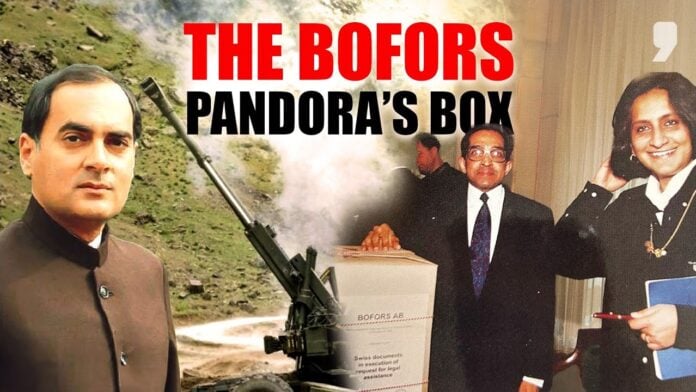
It is no exaggeration that the 1980s and 90s in Indian politics were the decades of the Bofors saga: Allegations of a ₹64 crore bribe in a ₹1,437 crore deal. On March 24, 1986, Rajiv Gandhi approved the proposal to give Swedish armaments giant AB Bofors, the contract to sell to India 155mm towed guns, popularly described as having “shoot and scoot” capabilities. In April 1987, Swedish state radio broadcast that Sweden won the contract only after paying bribes to senior Indian politicians and others in four installments.
The Bofors scandal, which erupted in the late 1980s, remains one of Bharat’s most significant political controversies, highlighting the intricate nexus between defense procurement and corruption. Chitra Subramaniam, the investigative journalist who played a pivotal role in uncovering the scandal, offers an in-depth analysis in her book, Bofors Gate: A Journalist’s Pursuit of Truth. This article delves into the scandal’s background, key revelations from Subramaniam’s book, and the enduring impact on Bharat’s political landscape.
Nearly four decades after it broke out, the probe into the Bofors scandal still remains inconclusive even though papers and people that can establish the truth are still out there but are still ignored and unutilised, says journalist Chitra Subramaniam.
Background of the Bofors Scandal
In 1986, the Bharatiya government finalized a $1.4 billion deal with Swedish arms manufacturer AB Bofors for the supply of 410 155mm howitzer guns. The contract, intended to bolster Bharat’s defense capabilities, soon became mired in allegations of corruption. On April 16, 1987, Swedish Radio reported that Bofors had paid kickbacks to top Bharatiya politicians and defense officials to secure the deal. These revelations led to a political uproar, tarnishing the reputation of then-Prime Minister Rajiv Gandhi and contributing to his party’s electoral defeat in 1989.
Key Revelations from ‘Bofors Gate‘
1. Unopened Swiss Documents
Subramaniam’s book brings to light the existence of boxes containing between 500 to 1,000 pages of confidential Swiss documents related to the Bofors transactions, handed over to the Central Bureau of Investigation (CBI) in 1997. She asserts that these boxes have remained unopened, raising concerns about the thoroughness of the investigation. However, former CBI officials contest this claim, stating that the documents were examined and used as evidence in filing charges against key individuals involved.
“No political party has had the courage to open them for fear of finding out what they contain — not even the National Democratic Alliance (NDA) that rode to power in 2014, on the promise that the corrupt would be booked and that Indian taxpayers would finally know the truth…” wrote Subramaniam as quoted by IE.
She also accused India’s “premier investigative agency pretended the boxes with the secret documents from Switzerland have never been opened to date”. According to her, successive governments have used the “closed boxes as political football without a care for the truth, or for the self-respect of a nation”.
Calling the boxes as the “elephant in the room” she said, “Considering Bofors and corruption made political careers and won elections for the opposition, their inability to look at the documents raises many questions, the most important one being: who gains most from the silence on the documents?”
According to her, no political party has had the courage to open them for fear of finding out what they contain. “…not even the National Democratic Alliance (NDA) that rode to power in 2014, on the promise that the corrupt would be booked and that Indian taxpayers would finally know the truth…” she said.
2. Alleged Framing of Amitabh Bachchan
The book addresses the false implication of Bollywood actor Amitabh Bachchan in the scandal. Subramaniam provides evidence suggesting that Bachchan’s name was deliberately dragged into the controversy without any incriminating evidence against him. This revelation underscores the extent of misinformation and the use of high-profile personalities to divert attention from the actual perpetrators.
She accuses sections of the government and media of trying to falsely implicate the Bollywood megastar, who was then a Member of Parliament from Allahabad. “No, there was absolutely no shred of evidence that he (Amitabh Bachchan) had taken any money. But the water had been muddied so much that by the time the water could be cleaned up, the damage had been done,” Subramaniam told IANS in an interview.
Bofors Gate offers a meticulous examination of one of India’s most infamous defense scandals. Through detailed investigations and revelations, Chitra Subramaniam sheds light on the complexities and political machinations that characterized the Bofors affair. The book not only revisits the events but also underscores the challenges faced in pursuing truth and accountability in high-stakes political environments.
