


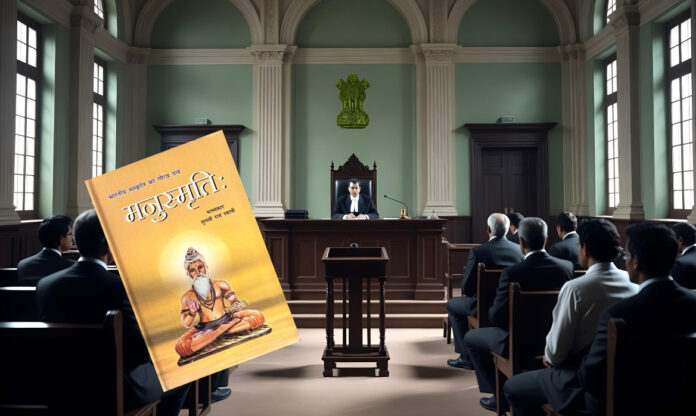
“Echoes of Manu: How ancient law shapes modern indian jurisprudence”, Opindia, december 14, 2025
“Manusmriti has a complex role in Indian legal thought. In contrast to the Constitution, statutes, and legally binding precedent, it is not a source of enforceable law for constitutional courts. However, because Indian courts frequently discuss the nation’s social history, the development of personal laws, and the moral language that society uses to interpret justice, it still appears in judicial speech. Because of this, Manusmriti is occasionally cited not to “apply” its regulations but rather to highlight more traditional normative concepts, contrast tradition with contemporary constitutional obligations, or uphold moral standards, particularly in situations pertaining to social reform, women’s dignity, and family relationships.
In two parts, we look at this limited but recurrent “relevance.” Dr. B. R. Ambedkar’s interaction with Manusmriti is briefly discussed in the first section. Although Ambedkar is renowned for criticising Manusmriti as a representation of caste oppression and graded inequality, his continued involvement with it also shows why historical texts and constitutional authority must be kept distinct in constitutional democracies. The second section focuses on published Supreme Court and High Court rulings where justices have cited Manusmriti, replicating the verses as they appear in the rulings and outlining the rationale for the quotations. The main contention is that Manusmriti serves only as an illustrative or rhetorical reference in Indian adjudication, with the decision’s binding authority deriving from established legislation and constitutional principles.
Any study that wishes to demonstrate how “Manu” is still ingrained in Indian legal imagination even in the constitutional era must take into account the fact that Ambedkar’s interaction with Manusmriti was far more complex than the widely held stereotype of an indiscriminate rejection of the entire text. Although he used the dramatic act of burning a copy of the Manusmriti at Mahad in 1927 as a political protest against caste and gender oppression, his sophisticated legal and constitutional work frequently makes a distinction between the text’s objectionable parts and its provisions that could be interpreted as supporting equality and women’s rights, which he occasionally purposefully invoked. Thus, although rejecting birth-based hierarchy as unconstitutional, the same legal culture that Ambedkar transformed through the Constitution continued to regard Manusmriti and the larger Dharmashastra tradition as historical roots of Hindu law…….”
Read full article at opindia.com
