


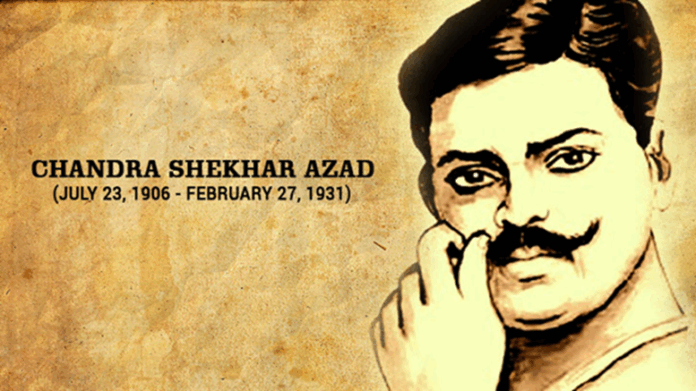
Chandrashekhar Azad, one of Bharat’s most iconic revolutionaries, met a tragic end on February 27, 1931, in a fierce gun battle with British police at Alfred Park (now Azad Park) in Allahabad. His death, while heroic, has long been shrouded in mystery—particularly the question of who betrayed him to the British authorities. Recent revelations from declassified CID records have reignited this debate, pointing fingers at a former comrade turned celebrated writer: Yashpal Singh.
The CID Records and Dharmendra Gaur’s Revelation
The controversy resurfaced when Dharmendra Gaur, a retired Intelligence Bureau officer, made public two CID records from the late 1960s. These documents, discovered in the archives of the Uttar Pradesh CID in Lucknow, are among the few official records that hint at the betrayal of Azad.

Gaur’s findings suggest that Yashpal Singh, once a close associate of Azad in the Hindustan Socialist Republican Association (HSRA), may have played a role in tipping off the British.
Who Was Yashpal Singh?
Yashpal was a revolutionary who later transitioned into a prolific writer and political commentator. His literary contributions earned him the Padma Bhushan and the Sahitya Akademi Award during the tenure of Prime Minister Indira Gandhi. His transformation from a militant revolutionary to a respected intellectual made him a prominent figure in post-independence Bharat.
However, his past associations and actions during the freedom struggle have come under scrutiny due to these newly surfaced records.
The Day of the Encounter
On the day Azad died, he was reportedly accompanied by two comrades: Sukhdev Raj and Yashpal Singh. According to memoirs and testimonies, Yashpal had parted ways with Azad shortly before the police arrived. This timing has raised suspicions among historians and fellow revolutionaries alike.
Another comrade, Vishwanath Vaishampayan, who was arrested days before the encounter, also suspected betrayal. He, along with Sukhdev Raj, pointed to Veerbhadra Tiwari, another HSRA member, as the likely informant. However, both also hinted at Yashpal’s possible involvement, especially given his close ties with Veerbhadra and his alleged misuse of revolutionary funds 1.
The Debate: Yashpal or Veerbhadra?
The historical community remains divided. Some argue that Veerbhadra Tiwari, who was never arrested and moved freely during British rule, was the real traitor. Others, citing the CID documents and circumstantial evidence, believe Yashpal may have been complicit or at least indirectly responsible.
A particularly strong claim comes from sources like WikiBharat, which assert that blaming Veerbhadra was a deliberate attempt to shield Yashpal, who had by then become a celebrated public figure 2.
Legacy and Controversy
The possibility that a decorated writer and former revolutionary may have betrayed one of Bharat’s greatest freedom fighters is both unsettling and complex. It raises difficult questions about the nature of historical memory, political rehabilitation, and the selective amnesia of post-independence Bharat.
While the CID records do not offer conclusive proof, they add a significant layer to the ongoing investigation into Azad’s death. As more archival material becomes accessible, the truth may eventually emerge—but for now, the betrayal of Chandrashekhar Azad remains one of the most poignant mysteries of Bharat’s freedom struggle.
