


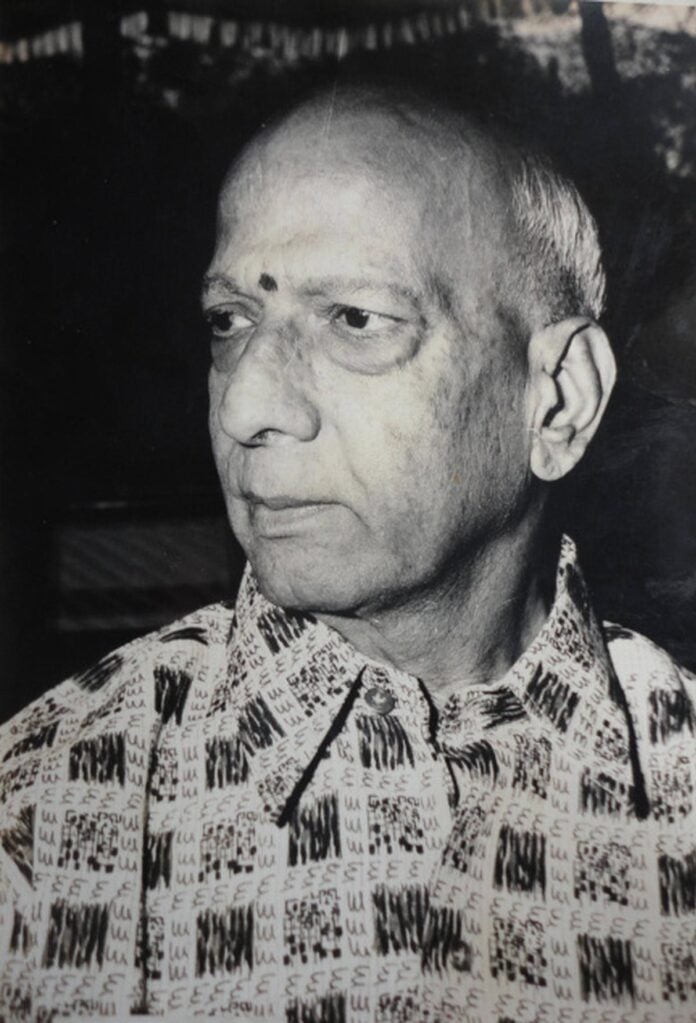
Sripada Pinakapani (3 August 1913 – 11 March 2013), was a medical doctor, administrator, professor in medicine, and Carnatic musician. Pinkapani was born to musically gifted parents S. Kameswara Rao and S. Jogamma at Priya Agraharam village in Srikakulam District, Andhra Pradesh. His father, S. Kameswara Rao, was a junior professor at the Government Training College in Rajahmundry and therefore Pinakapani had his primary education in Rajahmundry (and Kakinada) and he completed his high-school studies in Rajahmundry in 1929. Pinakapani began formal music training during his youth (music training started in 1924), and he completed his music training by the time he finished high school.
He obtained his M.B.B.S in 1938, got married in 1940 and later completed his M.D., in General Medicine from Andhra University in December, 1945. Pinakapani worked as assistant professor at Madras Medical College from 1944 to 1949 and later at Andhra Medical College. He opted for Andhra Services and resigned to rejoin in the same post in 1951. He held the position of Professor of Medicine on 17 May 1954 and later transferred to Kurnool Medical College on 26 January 1957 and retired as the Superintendent of Government General Hospital, Kurnool, on 2 August,1968.
In his childhood he was inspired by his mother in classical music. Her songs (tarangas and other devotional songs) influenced him to get attracted towards music. He owes his training in classical music to his Adi-Guru his father Kameswara Rao and Sri B. S. Lakshaman Rao, of Mysore, the fourth generation disciple of Sri Thyagaraja when he was just 11 years old. His gurus in advanced music are Dwaram Venkataswami Naidu and Ranga Ramanuja Ayyangar of Madras. He strived day in and day out, to bring in the Thanjavur baani (style of music) to the Telugu land which was in his own words, “relegated to the back burner despite worthy musicians”.
He was well built like an athlete, an avid tennis player and very good at playing veena. his sweet, flawless, technically perfect voice also had amazing reach. He has made a rich contribution to the Carnatic system of Indian music by publishing books like “MANO DHARMA SANGEETAM” [in Telugu and Tamil], “MELA RAGA MALIKA”. “SANGEET SOWRABHAM” and “PALLAVI GANA SUDHA” [in Telugu and English]. His multi-volume Gaanakalasarvasvamu has every minute detail of kritis. Pinakapani used to admire the eminent Carnatic musicians Araikkudi Ramanaujam Ayyangar and Veena Dhanammal.
Pinakapani gave concerts mostly in the 1930s–1950s, when recordings and detailed documentation were rare. Pinakapani was a regular performer on AIR Vijayawada and AIR Madras. Many rasikas consider his AIR broadcasts as his “signature concerts,” especially his: Kalyani alapana & kritis, Bhairavi renderings, rare ragas like Narayana Gowla, Suddha Seemanthini. He participated in the Thyagaraja annual Aradhana festivals, rendering Thyagaraja kritis that were admired for their classicism and textbook sruti shuddham. During 1950s-1970s he gave several lecture demonstrations. He mostly preferred teaching music, writing books on music and mentoring disciples. He taught music not only to budding singers but also to several senior Carnatic musicians like- Nedunuri Krishnamurthy, Nookala China Satyanarayana, Oleti Venkateswarlu, Srirangam Goplaratnam, Malladi Brothers and others. No wonder, Pinakapani was hailed as the Guru of Gurus. He never charged money for teaching music and felt it was not ethical.
Pinakapani, during his life time had prepared notations for around 1500 Kritis of eminent Vaggeyakars (i.e., musicians who are experts in both writing lyrics and composing tunes like the famous music trinity in Carnatic music -Saint Thyagaraja, Muthuswami Deekshitar and Shyama Sastri and Annamacharya, Kshetrayya and Bhadrachala Ramadas in Telugu music.) who documented only the name of the ragas for their kritis but did not mention the notations. His “swarajnanam” and writing down notations were legendary. Pinakapani’s book “ Manodharma Sangeetam “is considered to be a standard book of reference to the musicians on extempore improvisation of the Kriti by preparing notations to the given raga in a creative manner. In Carnatic music the kritis contain Pallavi, anupallavi, charanam and neraval (Neraval means repeating several times few words in the kriti) that captivate the music lovers and its importance is described in detail in Pinakapani’s Manodharma Sangeetam. This book is a music encyclopedia that contains elaborate description of the basic principles and the rules to be followed in Manodharma Sangeetam.
Pinakapani’s Melaragamalika is yet another masterpiece. The Melakarta system is a collection of 72 fundamental musical scales (ragas) in Carnatic music. These are considered parent ragas (janaka ragas) from which other ragas (janya ragas) are derived. The first systematic treatise that codified the Melakarta raga system was composed by Venkatamakhin (also spelled Venkatamakhi) in the 17th century. It is the foundational theoretical work behind today’s Melakarta raga framework in Carnatic music. Pinakapani s book Melaragamalika discusses in detail on how to sing a ragamalika, the precautions to be taken while singing ragamalika, in simple language.
Awards
- He received the Sangeetha Kalasikhamani award in 1970 bestowed on him by The Indian Fine Arts Society, Chennai.
- Sangeet Natak Akademi Award in 1977.
- Andhra University honoured him with Kala Prapoorna in 1978.
- Sangeetha Kalanidhi (Treasure for the art of music), by Madras Music Academy in 1983.
- Padma Bhushan by Government of India in 1984 for his outstanding contribution to the classical Karnatic music as a vocalist and an erudite scholar.
- Sangeet Natak Akademi Tagore Ratna in 2011
- Gyana Vidya Vardhi by Tirumala Tirupati Devasthanams on 3 August 2012 on the occasion of his 99th birthday.
Books written
- Sangeetha Sourabhamu, (vol 1 – 4)
- Sangeetha Yatra
- Mela Raga malika
- Manodharma sangeetham
- Pallavi Gana sudha.
Gaanakalasarvasvamu (it has every minute detail of kritis.)
Pinakapani is considered as one of the most analytical Carnatic minds of the 20th century and one of the greatest authorities on raga structure”. Pinakapani’s systematic music teaching method emphasized on voice culture, sruti precision, correct pathantara (pathantara represents the authentic, performance-ready blueprint of a composition as taught by a specific master, embodying the stylistic integrity of that musical lineage) and a well-proportioned improvisation. Most of his disciples became distinguished musicians and teachers, creating a strong “Pinakapani bani”. He is the paternal grandfather of singer Chinmayi Sripada. He died on 11 March 2013 in Kurnool, Andhra Pradesh, at the age of 99, a few months short of completing 100.
