


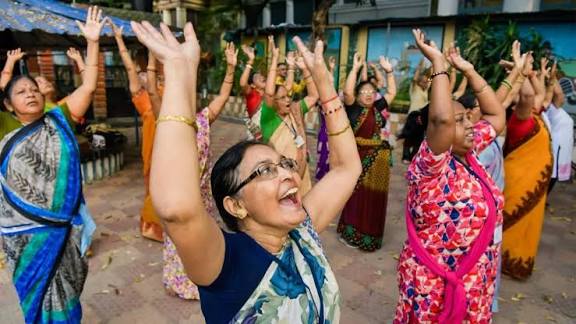
Laughter and yoga both harness the mind-body connection to promote holistic health and well-being. Laughter yoga, in particular, combines intentional laughter with yogic breathing (pranayama), helping to reduce stress hormones, improve mood and enhance immune function. By encouraging joy, relaxation and mindful awareness, laughter and yoga offer a simple yet powerful pathway to improved physical, mental and social wellness. The main question we explored in this forum was to what extent are we really benefiting from laughter? Are we laughing enough? And what are some of the things that make us laugh?
The following are excerpts of an Indo-Caribbean Cultural Centre (ICC) Thought Leaders’ Forum (01/02/2026). The ZOOM program was chaired by Shalima Mohammed and moderated by Ashley Sinanan, both from Trinidad. There were (3) speakers in the program. RADHA THIJM-KISOENSINGH (of Suriname) – She is dedicated to healing, restoring and balancing the inner self through Transcendental Meditation (TM), Yoga, Ayurveda, Jyotish and Vedic literature. DR. SHANTI PERSAUD (of Canada, originally from Trinidad). In Canada, she pursued her Master’s and Ph.D. degrees in Diversity, Culture and Counselling Psychology, focussing on theory and applied, experiential praxis. SURESH RAJPURA (of England, originally from Bharat) – He is a member of UK’s Hindu Education Forum and delivers lectures at interfaith events mainly in schools. He believes that without humour, even a wealthy person is poor.
The topic was “Laughter and Yoga: Impact on Health and Wellness.” See the unedited recording of the program: https://www.youtube.com/@dmahab/streams.

RADHA THIJM-KISOENSINGH said: “Transcendental Meditation (TM), introduced by Maharishi Mahesh Yogi, is a simple, effortless technique that allows the mind to settle into deep rest. In this state, the body releases accumulated stress, a major cause of disease and unhappiness. As inner stress dissolves, happiness and laughter arise naturally. Research – including large meta-analyses – shows that regular TM practice reduces stress, lowers blood pressure, improves heart health, enhances brain coherence, and supports mental clarity.
Laughter also benefits health. According to the Mayo Clinic, it boosts immunity, reduces stress hormones, improves mood and strengthens relationships. While laughter can be practiced outwardly, meditation works from within, creating a stable foundation of inner bliss from which natural joy emerges. Yoga – described in Vedic literature as the settling of the fluctuations of the mind – helps us experience our deeper self. When the mind transcends surface activity and experiences inner stillness, we reconnect with our wholeness. From this state, clearer thinking, better health, creativity and harmonious relationships develop naturally. By reducing stress and refining awareness, TM supports both individual well-being and societal harmony.”

DR. SHANTI PERSAUD said: “My focus is on humour in the Indian diaspora from a sociological and psychological perspective. My interest is in how humour helps us live peacefully and maintain inner calm among diverse cultures in Trinidad. I deeply value the work of preserving the memory and resilience of our Indian ancestors in the diaspora. That dedication of honouring our heritage is something I inherited from my mother. In gatherings filled with storytelling, teasing and picong, there was renewal and strength. Humour created psychological safety and reinforced cultural bonds.
“Humour in the diaspora functioned as a quiet ‘secret weapon.’ In the face of oppression, insider jokes and shared laughter became safe forms of resistance. People could not openly challenge authority, but through humour they released tension, preserved dignity, and maintained identity. Laughter built trust, resilience and community. It strengthened what we might call inner stamina – the ability to endure hardship without losing self-worth. In this way, humour became cultural medicine: helping people navigate stress, protect their mental and emotional health, and sustain pride in who they were. In short, humour in the Indian diaspora was more than entertainment; it was resilience, resistance, healing and survival.”

SURESH RAJPURA said: “Laughter is often treated lightly, but it is a serious and powerful tool for everyday life. While yoga is usually seen as ancient, meditative and practiced by sages, laughter – known as hasya in yogic tradition – is one of the nine core emotional states (rasas) in Indian philosophy. It has always been part of human well-being. Laughter offers important social benefits: it brings people together, builds trust, strengthens relationships, diffuses tension and makes interactions more enjoyable. People are naturally drawn to those who are cheerful and positive. A warm, smiling personality creates comfort and connection.
“Health-wise, laughter reduces stress and anxiety, boosts the immune system, lowers blood pressure, relieves pain, increases oxygen intake, releases endorphins and improves overall mood. Unlike many treatments, it is completely free and benefits body, mind and spirit together.
Happiness does not require special reasons or perfect circumstances. In a world that may be materially rich but emotionally stressed, laughter remains one of the simplest and most powerful forms of medicine available to everyone.”
— By Dr. Kumar Mahabir & Shalima Mohammed, MBP
