


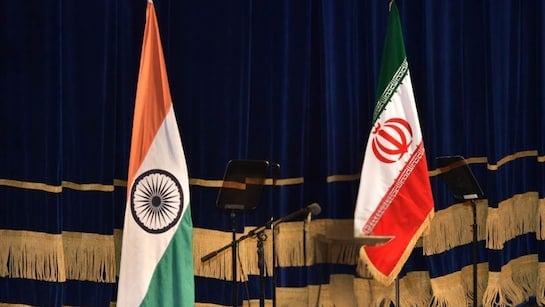
After the Israeli–American attack on Iran and the reported killing of Iran’s Supreme Leader Ali Khamenei in that attack, the opposition has raised questions over the absence of a direct statement from Bharat. Amid these questions raised by the opposition regarding the direction and credibility of India’s foreign policy, it is important to understand whether the absence of a statement on Iran reflects Bharat’s silence or a mature diplomatic strategy.
Tensions between Israel and Iran are decades old, rooted in concerns related to regional security, ideological confrontation, and the nuclear program. Israel and the United States have long expressed serious concerns about Iran’s nuclear program, while Iran’s reaction to the ongoing Israeli military campaign in Gaza after the Hamas attack further intensified the situation. In response to Iran’s missile attacks at the time, Israel carried out air strikes on several important suspected nuclear sites, scientific research centers, and military installations in Iran, while the United States claimed to have destroyed nuclear facilities through bomber aircraft. Although a ceasefire was reached after nearly twelve days of military tension, regional tensions deepened further.
For a long time, the United States and Israel had been preparing for a military campaign against Iran. During this period, large-scale anti-government protests within Iran and the deaths of thousands of Iranian civilians in the crackdown created conditions for a military confrontation between the United States and Iran. Eventually, on 28 February, Israel and the United States launched a joint operation against Iran, and reports emerged that Iran’s Supreme Leader Ali Hosseini Khamenei had been killed in the attack.
In response to these recent developments, Bharat has given a relatively restrained and balanced reaction. The Prime Minister spoke with leaders of several Gulf countries, including Israel, but no public statement regarding Iran has been made. Opposition parties have raised this issue, arguing that Bharat should openly express its position regarding its traditional partner Iran and the killing of its top leadership and Supreme Leader Khamenei.
In the present circumstances, although the opposition is questioning Bharat’s foreign policy while attempting to appeal to Indian Muslims, India has historically preferred the diplomatic route in such situations. In fact, the response of the present government does not indicate any new policy but rather represents the continuation of a consistent diplomatic tradition that Bharat has followed under different governments.
Historical Continuity in Bharat–Iran Relations
If one analyzes Bharat–Iran relations historically, both before and after the Islamic Revolution, Bharat’s relations with Iran have remained positive and stable. Even before the Islamic Revolution, Bharat–Iran relations were deep at historical, cultural, and strategic levels. After independence, the two countries formally established diplomatic relations on 15 March 1950. At that time, Iran was ruled by Shah Mohammad Reza Pahlavi, and high-level visits between the two countries were frequent. The Shah visited India in 1956 and 1978, while Jawaharlal Nehru visited Iran in 1959, Indira Gandhi in 1974, and Morarji Desai in 1977. These visits were evidence of strong bilateral relations and helped institutionalize economic, cultural, and political cooperation.
The Impact of the 1979 Islamic Revolution
The Islamic Revolution of 1979 fundamentally transformed Iran’s political structure. Under the leadership of Ayatollah Ruhollah Khomeini, the Islamic Republic was established, and the institution of the Supreme Religious Leader came into existence, while the President remained the formal head of government. This transformation was not merely political but also ideological in nature. Ideological differences between Muslim-majority Iran and Hindu-majority Bharat were natural. Nevertheless, keeping national interests in mind, Bharat’s response at that time remained remarkably balanced. The government led by Morarji Desai neither publicly supported nor opposed any side during the Islamic Revolution; instead, it promptly recognized the new regime and ensured continuity in relations. This step was consistent with the core principle of Bharat’s foreign policy that prioritizes respect for the sovereignty of other nations and non-interference in their internal affairs.
Keeping in mind energy security, stability in West Asia, and a non-aligned outlook, Bharat maintained pragmatic relations above ideological differences. Thus, Bharat’s policy during the 1979 revolution was neither based on emotional reaction nor ideological insistence; it was the result of long-term national interests and diplomatic maturity.
Any regime change in a country naturally affects India’s strategic and economic interests. However, a permanent characteristic of Bharat’s foreign policy has been its ability to adjust according to circumstances. Whether it was the ideological competition of the Cold War or changes resulting from religious-political movements, Bharat has generally prioritized pragmatism over emotional responses.
Bharat’s Response to Global Regime Changes
Several examples from the 1950s to the 2010s illustrate this tendency. In the 1952 Egyptian Revolution, King Farouk’s rule ended and a republican system was established under the leadership of Gamal Abdel Nasser; India quickly recognized the new government and strengthened relations based on anti-colonial cooperation. In 1979, after the Islamic Revolution in Iran, Shah Mohammad Reza Pahlavi was replaced by an Islamic Republic under Ayatollah Ruhollah Khomeini; India maintained continuity in relations with the new regime.
The dissolution of the Soviet Union in 1991 altered the global balance of power. Bharat, which had been a close partner of the Soviet Union for decades, promptly recognized Russia and the other newly formed republics and continued its strategic partnership in a new form. In 2001, after the fall of the Taliban regime in Afghanistan, Bharat began active cooperation with the new interim government and contributed to reconstruction efforts. During the Arab Spring in 2011, regime changes occurred in Egypt and Libya; India maintained dialogue with the new political arrangements and ensured continuity of its interests.
Strategic Patience in International Politics
These examples clearly demonstrate that India has never viewed regime changes through the lens of ideological support or opposition. Instead, it has prioritized respect for sovereignty, prompt diplomatic recognition, and the protection of long-term national interests. This policy continuity has been a defining feature of Bharat’s foreign policy.
In such circumstances, when uncertainty surrounds Iran’s internal political structure and various reports are emerging regarding its top leadership, Bharat’s restrained approach cannot be considered unusual. In international politics, immediate reactions often limit long-term diplomatic options. Therefore, waiting for a complete assessment of the situation is considered a prudent strategy.
Conclusion: Silence as a Diplomatic Strategy
If this conflict results in a change in Iran’s power structure, India will naturally redefine its relations with the new arrangement. If the current system continues, dialogue and cooperation will also continue. India’s priority is not to express emotional support for any particular side but to ensure regional stability, energy security, and the protection of its long-term national interests. Bharat’s restraint is neither inactivity nor indifference; rather, it reflects a mature and farsighted diplomatic strategy.
– Ashish Rajput, PhD Research Scholar, Department of Political Science, Chaudhary Charan Singh University, Meerut
