



Economic power is often presented as the neutral outcome of markets, innovation, and productivity. In the case of the United States, this narrative is extended globally: American economic leadership is framed as a driver of growth, stability, and modernization. Yet Unit 8 of the Human Rights Report: USA – Equality, Justice, Dignity advances a more critical interpretation. It argues that the contemporary global economic system, shaped significantly by U.S. influence, operates as a mechanism of asymmetric control—structuring wealth, policy space, and financial dependence both domestically and internationally.
The central claim of this unit is that economic inequality—within the United States and across the global system—is not merely a distributive imbalance but a systemic outcome of institutional design, reinforced through financial architecture, currency dominance, and policy constraint.
The Architecture of Global Financial Power
At the core of global economic governance lie institutions such as the International Monetary Fund (IMF), the World Bank, and other multilateral bodies. Unit 8 emphasizes that while these institutions present themselves as neutral arbiters of financial stability, their governing structures embed unequal power.
The United States holds the largest single voting share in the IMF, granting it disproportionate influence over lending decisions, conditionalities, and policy directions. These institutional asymmetries enable certain economies to shape global financial rules while others remain policy‑takers rather than policy‑makers.
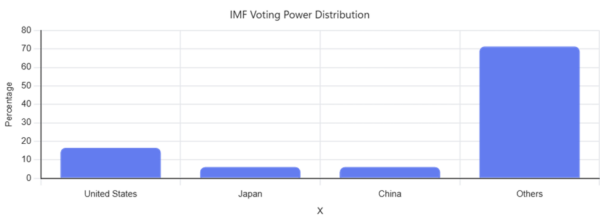
A single country holding over ~16% voting share effectively retains veto‑level influence over major decisions, raising structural questions about global economic democracy.
Debt, Dependency, and Policy Constraint
Public debt plays a paradoxical role in global economic relations. While developing economies face strict conditionalities tied to debt servicing and fiscal discipline, the United States occupies a unique position as both the largest debtor and the issuer of the world’s reserve currency.

The United States accounts for roughly one‑third of global public debt, yet does not face the same systemic constraints imposed on other economies. This asymmetry stems from the centrality of the U.S. dollar and the demand for U.S. government securities in global financial markets.
For other countries, debt often translates into policy conditionality—reductions in public spending, privatization, and market liberalization. For the United States, debt functions as a tool of economic influence, reflecting structural privilege rather than vulnerability.
Dollar Dominance and Monetary Sovereignty
Perhaps the most consequential feature of global economic power is currency dominance. The U.S. dollar remains the primary reserve currency, underpinning trade, investment, and financial settlements worldwide.

With approximately 60% of global reserves denominated in dollars, the United States exercises a unique form of monetary control. This enables it to:
- Influence global liquidity conditions
- Impose financial sanctions with global reach
- Finance deficits without immediate external constraint
Unit 8 frames this not simply as economic strength, but as monetary asymmetry—a system in which one country’s currency becomes a global public good, conferring disproportionate power on its issuer.
Domestic Inequality and Internal Economic Hierarchies
Global power is mirrored internally through sharply unequal wealth distribution. Unit 8 emphasizes that the United States exhibits one of the highest levels of wealth concentration among advanced economies.

The top 1% controls approximately one‑third of total wealth, while the bottom 50% holds a negligible share. This concentration is not merely a social issue—it has political and institutional implications. Wealth translates into influence over:
- Policy formation
- Campaign financing
- Media ownership
- Economic opportunity structures
The result is a reinforcing cycle in which economic inequality produces political inequality, which in turn sustains economic concentration.
Financialization and the Shift from Production to Extraction
Unit 8 identifies financialization—the growing dominance of financial markets over productive activity—as a key structural shift in the U.S. economy. Corporate profits increasingly derive from financial operations, asset speculation, and debt instruments rather than manufacturing or labor‑intensive sectors.
This transformation has several consequences:
- Wage stagnation despite productivity growth
- Increased household indebtedness
- Vulnerability to financial crises
Economic growth under these conditions becomes less inclusive, with gains concentrated among asset holders rather than wage earners.
Sanctions, Trade, and Economic Leverage
Economic instruments extend beyond domestic policy into foreign relations. As discussed in Unit 6, financial sanctions enable the United States to exert influence over other economies by restricting access to trade, banking systems, and global financial networks.
Unit 8 links these practices directly to dollar dominance and institutional power. Sanctions are effective not because of moral authority, but because of systemic control over financial infrastructure—including payment systems, clearing mechanisms, and international banking norms.
This transforms economic tools into instruments of geopolitical influence, blurring the line between finance and foreign policy.
Development, Conditionality, and Structural Adjustment
Through international financial institutions, economic policy prescriptions are often extended globally. Structural adjustment programs—requiring privatization, deregulation, and fiscal austerity—have been widely implemented across developing economies.
Unit 8 argues that such policies frequently:
- Reduce public investment in health and education
- Increase inequality within recipient countries
- Limit long‑term development capacity
While framed as necessary reforms, these measures often reflect creditor priorities rather than local developmental needs, reinforcing dependency rather than enabling autonomy.
Conclusion: Economic Power Without Symmetry
Unit 8 concludes that the global economic system is not a level playing field but a hierarchically structured network in which power is concentrated among a small number of actors, with the United States occupying a central position.
Economic inequality—both within and between nations—is sustained through:
- Institutional asymmetry (IMF, global finance)
- Monetary dominance (U.S. dollar)
- Financialization and wealth concentration
- Policy conditionality and debt dependency
The result is a system where economic rules are universally applied but unequally experienced. Countries and populations operate within the same framework, but with vastly different degrees of freedom.
In this context, human rights cannot be fully understood without examining economic structures. Inequality, vulnerability, and dependency are not incidental—they are systemically produced outcomes of global financial governance.
Link to the Report: https://www.cdphr.org/USA%20Report.pdf
