


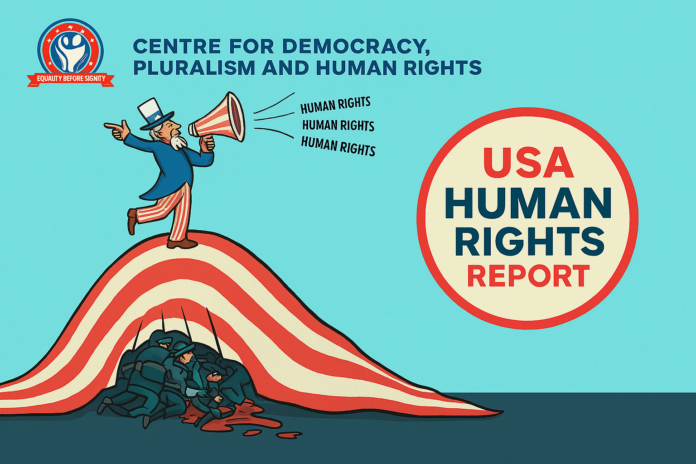
The United States presents itself not only as a democracy at home but as a global enforcer of democratic values abroad. Through military alliances, economic institutions, and diplomatic engagement, it claims a leadership role in promoting stability, human rights, and rule‑based international order. Yet Unit 6 of the Human Rights Report: USA – Equality, Justice, Dignity offers a fundamentally different interpretation. It argues that U.S. foreign policy, particularly over the last century, has frequently functioned not as a vehicle for democratic expansion but as a system of strategic intervention, coercive dominance, and externally imposed instability, often at significant human cost.
Rather than viewing wars, regime changes, and sanctions as isolated policy decisions, Unit 6 situates them within a broader pattern—one in which geopolitical influence is achieved through military force, economic pressure, and political manipulation, with human rights considerations frequently subordinated to strategic priorities.
War as an Instrument of Policy
Military intervention remains the most visible expression of U.S. global power. Unit 6 documents a pattern of large‑scale military engagements—from Vietnam and Iraq to Afghanistan and interventions in the Balkans and the Middle East—that have resulted in mass civilian casualties, long‑term displacement, and institutional collapse in affected countries.
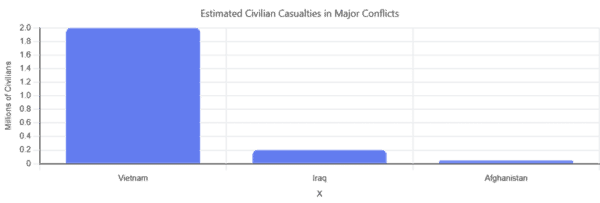
While these interventions have been framed in terms of national security or humanitarian necessity, their outcomes frequently tell a different story. In Iraq, the dismantling of state institutions following the 2003 invasion led to prolonged instability, sectarian conflict, and the emergence of extremist networks. In Afghanistan, decades of military engagement culminated in a withdrawal that left state structures fragile and millions exposed to economic collapse and humanitarian crisis.
Unit 6 argues that such outcomes are not unintended side‑effects but predictable consequences of external intervention in complex political systems, where regime removal is not matched by sustainable nation‑building.
Civilian Impact and the Cost of Intervention
The human toll of military intervention extends far beyond battlefield casualties. Civilian populations often bear the brunt of conflict through displacement, infrastructure destruction, and long‑term health consequences. The report highlights how modern warfare technologies, including aerial bombardment and drone strikes, have altered the nature of conflict by enabling remote engagement while still producing localized devastation and civilian harm.

The use of weapons such as depleted uranium in certain conflict zones has raised concerns about long‑term environmental and health effects, including increased rates of cancer and congenital abnormalities. While definitive causal chains remain debated in academic literature, the scale and persistence of these effects underscore the intergenerational impact of military intervention.
Refugee crises represent another measurable outcome. Conflicts involving U.S. intervention have contributed significantly to global displacement, with millions forced to flee their homes and seek asylum under precarious conditions. These humanitarian consequences extend far beyond the duration of military operations, reshaping regional stability for decades.
Regime Change and Political Engineering
Beyond direct military action, Unit 6 examines the use of covert and overt mechanisms to influence or reshape political systems in other countries. Historical and contemporary examples cited in the report include support for coups, backing of opposition movements, and diplomatic pressure to install or sustain regimes aligned with U.S. strategic interests.
Such interventions often occur under the banner of promoting democracy, yet the resulting political arrangements frequently lack legitimacy within local populations. The replacement of governments through external influence can produce fragile political orders dependent on external support rather than internal consensus, increasing the likelihood of conflict and authoritarian drift.
This form of political engineering raises fundamental questions about sovereignty and self‑determination. When political outcomes are shaped externally, democratic legitimacy becomes conditional rather than inherent.
Economic Sanctions and Structural Harm
Unit 6 also addresses economic sanctions as a tool of foreign policy. While sanctions are often justified as non‑violent alternatives to military action, their effects on civilian populations can be severe. Restrictions on trade, financial transactions, and access to global markets can lead to shortages of essential goods, inflation, and economic collapse.

The report emphasizes that sanctions rarely affect political elites in proportion to their impact on ordinary citizens. Instead, they tend to exacerbate inequality, weaken public institutions, and undermine access to healthcare, food, and basic services. In this sense, sanctions function as a form of indirect coercion, imposing widespread hardship in pursuit of political objectives.
Institutional Power and Global Economic Influence
Beyond direct interventions, U.S. influence is exercised through international financial institutions such as the International Monetary Fund (IMF), World Bank, and World Trade Organization (WTO). Unit 6 critiques the role of these institutions in shaping economic policies of developing nations, often through loan conditionalities that require austerity, privatization, and market liberalization.

These policies can constrain domestic economic sovereignty and prioritize creditor interests over social welfare. In some cases, structural adjustment programs have led to reduced public spending on healthcare, education, and social protection, compounding vulnerability among already marginalized populations.
The report characterizes this as a form of economic governance beyond borders, where policy decisions affecting millions are influenced by institutions in which the United States holds significant power.
International Law and Selective Accountability
A recurring theme in Unit 6 is the selective application of international law. While the United States advocates for accountability in global forums, it has resisted participation in or recognition of certain international legal mechanisms, including aspects of the International Criminal Court (ICC).
This selective engagement creates an asymmetry in which other states may be subject to international scrutiny, while U.S. actions remain largely insulated from external legal accountability. Such asymmetry undermines the universality of international law and reinforces perceptions of a rules‑based order applied unevenly.
Information Power and Narrative Framing
Military and economic actions are accompanied by narrative framing that shapes global perception. Unit 6 highlights the role of media, think tanks, and policy institutions in constructing narratives that justify intervention, often emphasizing humanitarian motives while downplaying or omitting negative outcomes.
Control over narrative does not eliminate the consequences of policy but influences how those consequences are understood. By framing interventions as necessary or benevolent, the gap between intent and outcome is often obscured, limiting public accountability.
Conclusion: Power Projected, Accountability Deferred
Unit 6 culminates in a conclusion that connects foreign policy to the broader themes of the report. The United States, it argues, exercises unparalleled global influence, yet this influence is often accompanied by limited accountability for its external human‑rights impacts. Military interventions, economic sanctions, political engineering, and institutional influence collectively produce a system in which power is projected outward while responsibility remains diffuse.
The contradiction is stark. A state that positions itself as a defender of global human rights frequently engages in practices that generate large‑scale human suffering, institutional instability, and long‑term geopolitical disruption. Addressing this contradiction requires not only policy reform but a fundamental reassessment of how power, accountability, and human rights are understood in the international arena.
Link to the Report: https://www.cdphr.org/USA%20Report.pdf
