


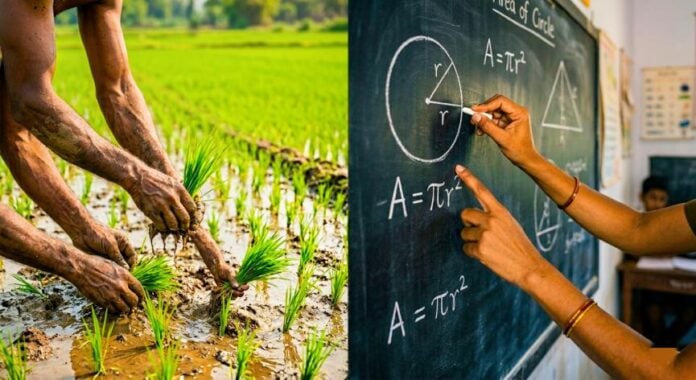
In a nation striving for progress, two silent forces sustain its future—farmers who feed the body and teachers who nourish the mind. Though their fields differ, their purpose is the same: cultivation. One tills the soil to produce food, while the other nurtures young minds to produce responsible, enlightened citizens.
A farmer’s contribution is immediate and visible. By producing food, he sustains life itself. A teacher’s contribution, though less visible, is equally vital. By shaping intellect, character, and values, the teacher lays the foundation for a civilized and progressive society. When a farmer sows poor seeds or neglects the crop, the result is a failed harvest, hunger, and economic hardship. Similarly, when a teacher fails to instill critical thinking, ethics, and compassion, the consequences are far deeper—a society that may advance materially yet remain morally bankrupt and spiritually adrift. A nation cannot thrive on food alone; it must also be nourished by wisdom.
Both professions demand insight, patience, and adaptability. A farmer studies the soil, understands the seasons, and responds to changing conditions to ensure a good yield. Likewise, a teacher must recognize the diverse backgrounds, abilities, and learning styles of students. In classrooms built on inclusion, respect, and encouragement, students are not merely taught—they are cultivated. Like a well-tended field, they grow with confidence and purpose.
There is a crucial distinction between appearance and essence. Artificial flowers may look vibrant, but they lack fragrance. Similarly, students trained only through rote memorization may excel in examinations but fall short of true understanding. Their knowledge decorates but does not transform. In contrast, education rooted in creativity, inquiry, and values produces individuals who think independently, act responsibly, and contribute meaningfully to society. Like natural blossoms, they carry the fragrance of authenticity.
Agriculture remains central to sustainable development. Beyond feeding populations, it generates livelihoods, supports industries, and plays a key role in reducing poverty—often more effectively than many other sectors. As the global population continues to rise, the importance of farming in ensuring food security becomes even more critical.
Education, too, is the bedrock of national progress. Teaching is not merely the transfer of information; it is the shaping of human potential. Great teachers inspire curiosity, ignite innovation, and guide students to become creators rather than mere consumers. When young minds are empowered to think critically and act constructively, they grow into leaders, innovators, and agents of change—the driving force behind social and economic transformation.
In essence, farmers and teachers are the twin pillars of a thriving nation. One sustains life; the other gives it direction and purpose. Their work requires dedication, resilience, and a deep sense of responsibility toward society.
Recognizing their contributions is not just an act of gratitude—it is a necessity for national progress. If farmers are the hands that sustain our lives, teachers are the minds that shape our future. To neglect either is to weaken the very foundation of the nation.
These twin cultivators are not merely contributors—they are the backbone of our national identity and progress.

Great Article