


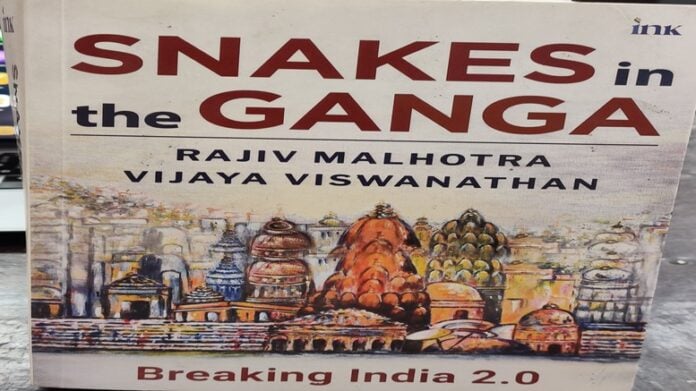
21st-century neocolonialism is more ambiguous and layered with a sophisticated modus operandi. The global south has its own structures, institutions, and processes but the deep state runs a concurrent narrative that controls a large chunk of the academia and think tank ecosystem of the global south and even infiltrates the structures of governance. The resultant effect – the neocolonialism of ideas that controls the global narrative. This scenario sounds like an improbable dystopia, but it isn’t that far-fetched either. That is why in the seminal book Snakes in the Ganga: Breaking India 2.0, Rajiv Malhotra and Vijaya Viswanathan alert us to the dangers of the contemporary woke narrative that controls Bharat from the outside.
Snakes in the Ganga is a sequel to Rajiv Malhotra’s Breaking India: Western Interventions in Dravidian and Dalit Faultlines. The first part of the Breaking India series traces the anti-Bharat discourse perpetuated through the nexus of missionary-sponsored non-profit organizations, US and European churches, industry-funded foundations, human rights groups, etc. Breaking India part I delineates the historical trajectory of the anti-Hindu discourse that permeates both the Bharatiya and the Western academia ecosystem today.
Breaking India Part I describes how missionary propaganda gave rise to Dravidian identity politics in the south of Bharat, paving the way for aggressively anti-Hindu politics creating faultlines within Bharat based on now discredited theories like the Aryan Migration Theory. Snakes in the Ganga: Breaking India 2.0 goes many steps further and gives one a peep into the elite Western academic ecosystem of the 21st century that nurtures, grooms, and promotes breaking India forces. In Breaking India Part I, it was mostly the gullible poor of Bharat being converted by the missionary ecosystem, but the modus operandi of Breaking India 2.0 is more sophisticated, argue the authors. It’s not the ordinary Bharatiya citizens that are the target of the woke propaganda machinery but the elite thought-leaders, business leaders, and decision-makers of Bharat who are on the radar of Breaking India 2.0 forces, say the authors.
The focal point of Snakes in the Ganga is a critical interrogation of the elite ecosystem of the West that systematically grooms and nurtures scholars who peddle anti-Hindu and anti-Bharat propaganda. The book also highlights the nexus between the elite academic universities of the West and recently opened Bharatiya universities focusing on social sciences and humanities research. The book argues that these universities, even though located in Bharat, function like “junior partners of Harvard”, and carry forth the agenda of Harvard in their curriculum and research.
The book dedicates an entire chapter to Ashoka University of Bharat. The chapter titled “Ashoka University: Harvard University’s Junior Partner” provides the reader with an evidence-based trail depicting how Ashoka University works in Bharat to strengthen Harvard’s narrative vis-à-vis Hindus and Bharat.
“Ashoka University is the most significant venue for what many patriotic Indians characterize as Breaking India forces. It is where key databases on Indians are collected and analyzed, Breaking India theories are conceptualized and intervention strategies are developed, tested, and perfected. This is where many students are trained in ideological narratives and strategies, and then mobilized. New victim groups are identified and nurtured. Heavily backed by Westerners with vested interests as well as by Indians, it behaves in a way that its loyalty to the nation may be questioned. We point out a complex network of global connections – of people, infrastructure, and institutions in India, which are concerning”. (from the Chapter Ashoka University: Harvard University’s Junior Partner, p. 517).
A huge chunk of the book is focused on Harvard, and how its different centers promote research that is a. Hinduphobic and b. is injected with a pronounced anti-Bharat bias. It also highlights how these centers are ironically funded by Bharatiya billionaires, and they utilize this funding to systematically promote anti-Hindu and anti-Bharat research.
The book has several chapters dedicated to uncovering the anti-Bharat bias at several centers of Harvard funded by Bharatiya billionaires such as the Anand Mahindra Center for Humanities, the Lakshmi Mittal South Asia Institute, the Piramal group grant for setting up the Harvard Chan India Research Center in Mumbai, etc.
The book gives numerous examples of major research projects being undertaken by these centers and a detailed overview of the profiles of scholars being promoted by these centers. It also gives an analysis of the funding trail of Harvard.
There is a whole chapter dedicated to uncovering how China has infiltrated Harvard. The book gives an exhaustive analysis of how Harvard is heavily funded by Chinese billionaires with close links to the CCP and how influential academicians promoted by Harvard have close links with the CCP ecosystem.
The book also does a comparative analysis of Bharatiya billionaires funding Harvard and Chinese billionaires funding Harvard. While Chinese billionaires make sure that Harvard promotes China’s civilizational and national narrative through its research centers, in the case of Bharatiya billionaires, they don’t exert any pressure on Harvard regarding how it should project Bharat and the grants of Bharatiya billionaires are used to interrogate everything about Bharat and promote a highly biased narrative, argue the authors.
“But like everything else about China, its relationship with Western academics is complex and paradoxical. It has been building one of the world’s strongest nationalist narratives for its citizens, while committing horrific human rights violations in Tibet, Xinjiang, and Hong Kong. This led it to outright reject the fashionable Left-wing social sciences the West wants to export to the entire world. One of China’s amazing achievements has been its co-opting of Harvard despite it being the bastion of the intellectual Left. As a result of this co-opting, Harvard scholars have accepted that their social justice ideas are out of bounds while engaging with China”. (From the chapter China’s Trojan Horse in America, p. 293).
It’s worthwhile mentioning at this point that like Rajiv Malhotra’s other books, Snakes in the Ganga is also an academic work; every claim the author makes is backed with evidence and multiple references. The range of issues the book deals with is sheer mind-boggling. It’s remarkable in its ingenuity; the book is a pioneer in the investigative analysis it undertakes of the Western academic ecosystem that not just nurtures anti-Bharat elements but is fast spreading its tentacles in Bharat, thus infiltrating the Bharatiya academia.
In the detailed chapter on Harvard, one gets to read about Rajiv Malhotra’s own interactions with Harvard over a period of time; his journey from being an enthusiastic donor to Harvard to someone who critically interrogates the Harvard ecosystem. It’s the kind of scholarship that readers get rarely exposed to. Elite Western universities like Harvard are portrayed as fiefdoms of academic excellence, they are rarefied and pedestalized to such a degree that everything “academically credible” has to pass through their gates. Critically interrogating these universities seems out of the question. In Snakes in the Ganga, Malhotra and Viswanathan disintegrate the hallo manufactured around elite Western universities like Harvard and show the reader how these powerful centers of global discourse are embroiled in an unholy nexus of geopolitics, money, ideology, and political influence.
The first couple of chapters of the book deal with the intertwining of wokeism and Hinduphobia in the global context. The book argues how critical race theory from the American context is being forcefully imposed on the concept of caste in the Bharatiya context to argue that it is not race but caste that is at the root of all kinds of discrimination and inequality. Thus, wokeism also works to cover up colonialism by casting Hindus (people who were once colonized) into the mold of the colonizers by throwing around rhetoric like “Brahmanical patriarchy”, “upper-caste hegemony”, etc.
The book further gives an overview of how the critical race theory is being used to portray Bharatiya Americans as racists and equate them with white supremacists by alleging that “upper caste” Bharatiya Americans practice caste discrimination against Dalits.
“We remind the reader that the end game of Critical Race Theory is to dismantle all structures that were historically built by those branded as oppressors. Working within those structures, modifying them or trying to correct their biases is explicitly and vociferously to be fought against as a ploy by the oppressors to preserve their status quo of domination.
When applied to India, the end game is to dismantle all structures of the Vedic/Hindu heritage, its texts, deities, symbols, rituals, festivals, customs, gurus, and institutions. Additionally, India’s technology, education, starting with the IITs, has become a target because, as we shall see in Chapter 4, scholars from Harvard have declared it a bastion of meritocracy, and meritocracy has been declared a structure of casteism set up by the Brahmins”. (From the chapter The Americanization of Caste, p. 61).
Another significant issue Snakes in the Ganga Highlight is the infiltration of the Harvard ecosystem into the structures of governance of Bharat such as Niti Aayog, posing a potential risk to the national security of Bharat. This might seem far-fetched at the outset, but the authors cite a trail of evidence to demonstrate how the private and confidential data of Bharatiya citizens is being collected by foreign entities in the name of educational initiatives and government-corporate partnerships.
As the Bharatiya government has cracked down on the NGO mechanism through FCRA, the anti-Bharat lobby has found newer ways to infiltrate the system, argue the authors. Thus, the new age breaking India forces do not enter Bharat through NGOs but through the network of sophisticated government research collaboration with entities like Harvard and organizations like the Omidyar Network which run a blatantly anti-Bharat agenda.
Finally, the book gives an alarming analysis of the activities of the World Economic Forum (WEF) and how the WEF architecture is paving the way for a new technological oligarchy of sorts in which corporations will increasingly run functions of governance, making governments increasingly irrelevant and making the whole world a “global oligarchy” of sorts.
The authors have merely touched upon this topic in the concluding section of the book. But this is something that’s definitely worth deeper exploration by various scholars of humanities and social sciences.
Most importantly, the book argues that wokeism is simply a new-age concoction of Marxism and capitalism. Thus, wokeism is essentially Marxism reinvented and repackaged, the purpose of which is to consolidate a global oligarchy rather than promote equality, argue the authors. Thus, the book has a critical take on some of the much-celebrated processes of globalization; it warns us that globalization should not become a pretext for abolishing individual autonomy and subject world citizens to surveillance mechanisms orchestrated by the deep state.
To a mind clouded by woke leftist discourse, Rajiv Malhotra and Vijaya Viswanathan’s Snakes in the Ganga might come across as a conspiracy theory. That’s because the leftist ecosystem grooms scholars to follow a rigid system of “ideological loyalty” in which anything that falls outside the purview of their ideological universe is dismissed without engagement, leave aside debate and deliberation. For the thinking and non-prejudiced reader though, no matter what side of the ideological spectrum they belong to, Snakes in the Ganga raises many thought-provoking questions regarding many givens in the academic universe – the rarified nature of elite Western universities like Harvard, the presumption that every western social intervention in Bharat is benign and meant for the empowerment of Bharatiyas, the implicit assumption even amongst Hindus that everything about Hindu Dharma is regressive and the west does us a great job by pointing that out, etc.
Snakes in the Ganga asks difficult questions and exposes a narrative that has rarely been exposed by anyone else before.
