


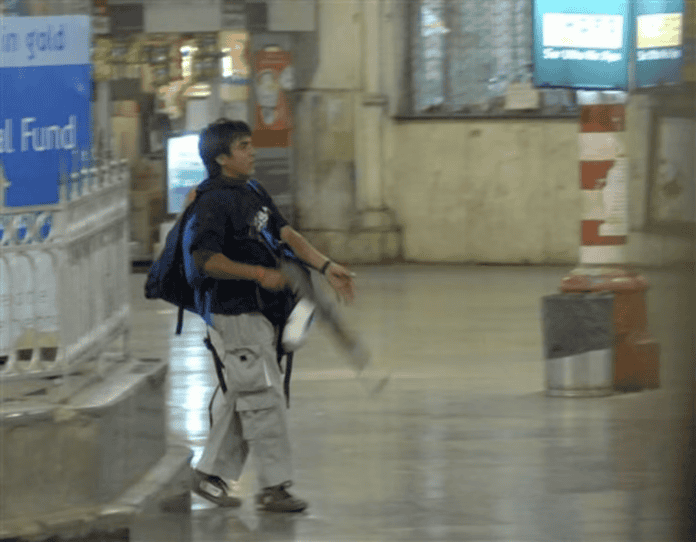
Eighteen years ago tonight, ten Lashkar-e-Taiba terrorists from Pakistan came ashore in Mumbai by sea. Over the next 60 hours, at Chhatrapati Shivaji Terminus, the Taj and Oberoi-Trident hotels, Leopold Cafe, Cama Hospital and Nariman House, they killed 166 people and wounded more than 300. Many of the dead were ordinary Mumbaikars whose names the country never learned. This video is our homage to them:
One man ensured the truth survived. Assistant Sub-Inspector Tukaram Omble, armed only with a lathi, grabbed the barrel of Ajmal Kasab’s rifle at Girgaum Chowpatty and held on as the bullets tore into him. Kasab was taken alive. Omble was awarded the Ashoka Chakra posthumously, and Kasab was hanged in 2012.
Without Omble, the story might have been very different. Former Mumbai Police Commissioner Rakesh Maria wrote in his 2020 memoir Let Me Say It Now that the Lashkar had planned to pass Kasab off as “Samir Chaudhari”, carrying a fake Bharatiya identity card and wearing a kalawa (red sacred thread) on his wrist. Had he died that night, Maria wrote, the headlines would have blamed “Hindu terrorists”.
The state that looked away
When the terrorists landed, Union Home Secretary Madhukar Gupta and his team were in Pakistan for talks. Their hosts had extended the visit by a day and put them up at the hill resort of Murree. Bharat’s top internal-security officials were in Pakistan, as Pakistan’s guests, as the attack began. Gupta himself later called Pakistan’s role “duplicitous”.
In Mumbai, Maharashtra’s Home Minister R.R. Patil told reporters that such incidents happen in a big city. He was forced to resign on 1 December. On 29 November, the day the last terrorists at the Taj were killed, Rahul Gandhi was at a friend’s sangeet at a farmhouse near Delhi that reportedly went on till 5 am. When Mumbai was bombed again in July 2011, he said it was very difficult to stop every terror attack and that “99 per cent had been stopped”. What he really thought had come out months earlier. A US cable released by WikiLeaks recorded him telling Ambassador Timothy Roemer, in July 2009, that “the bigger threat may be the growth of radicalised Hindu groups“. That was eight months after Pakistan’s terrorists killed 166 people.
The appeasement went beyond words. In May 2010, the UPA government sent 25 Pakistani terrorists from Lashkar-e-Taiba, Hizbul Mujahideen and Jaish-e-Mohammed back across the Wagah border as a “goodwill gesture”. Among them was Shahid Latif, who six years later handled the Jaish squad that attacked the Pathankot airbase.
The second front
Bharat was fighting on two fronts. As Khalid Baig put it, there was “mayhem on its streets, blood flowing like water”, and there were “the thinkers, Opinion makers, Intellectuals, Writers, Politicians, telling Indians as to how they were responsible for it.”
While the bodies still lay in Mumbai’s morgues, Arundhati Roy wrote “The Monster in the Mirror” in Outlook. She looked away from Pakistan towards what she called “the elephants in the room: Kashmir, Gujarat, and the demolition of the Babri Masjid.” Two years later, Congress leader Digvijaya Singh lent his weight to Urdu editor Aziz Burney’s book blaming the RSS for 26/11. Burney later apologised to escape a defamation case. Digvijaya never did.
The habit has not died. Sonia Gandhi’s new memoir, Belonging: A Journey of Love, attempts the same sleight of hand that Kasab’s red kalava was meant to perform. It says the Godhra train fire “remains disputed“. In that fire, in February 2002, an Islamist mob burned alive 59 Hindu pilgrims returning from Ayodhya on the Sabarmati Express, women and children among them. A special court convicted 31 men in 2011, and the Gujarat High Court upheld every conviction in 2017. HinduPost has already exposed the memoir’s selective memory.
When Kasab was sentenced to hang, 203 citizens petitioned the President to spare him, warning that his execution would feed a “base blood lust”. The list reads like a directory of the ecosystem. Two signatories, Harsh Mander and Aruna Roy, sat on Sonia Gandhi’s National Advisory Council, the UPA’s unelected “super cabinet”. The lawyers included Yug Mohit Chaudhry, who sent the petition, and Vrinda Grover. In July 2015, both would turn up again outside the Chief Justice’s residence, seeking a midnight reprieve for 1993 Mumbai blasts convict Yakub Memon. Alongside them were Colin Gonsalves, Rebecca Mammen John, Flavia Agnes, and Kasab’s own defence lawyers, Abbas Kazmi and Amin Solkar.
Activists Kamla Bhasin, Ashish Kothari and Nikhil Dey signed. So did journalists and writers Aakar Patel, later head of Amnesty International India; Naresh Fernandes, later co-founder and editor-in-chief of Scroll.in; Jyoti Punwani, Dilip D’Souza and Shivam Vij; and novelist Mahasweta Devi. Actors Nandita Das and Aamir Bashir added their names. From academia came economist Devaki Jain; JNU’s Anuradha Chenoy and Kamal Mitra Chenoy; Achin Vanaik; Babu Mathew of the National Law School; Delhi University law professor Ved Kumari; and sociologist Kalpana Kannabiran. Groups such as the People’s Union for Democratic Rights and the Forum Against Oppression of Women also signed. Their compassion went to the killer, not to the 166.
The same lobby, Baig writes, now tells the world that Bharat has become intolerant. “Well, they are right, India has become intolerant towards intolerance that asks for their dead bodies and then convinces them as to how they deserve it.”
Justice still unfinished
Pakistan has never punished the men who planned the massacre. Hafiz Saeed, Zaki-ur-Rehman Lakhvi and Sajid Mir remain beyond Bharat’s official reach. Tahawwur Rana, the Pakistani-Canadian accused of helping David Headley scout the targets, was finally extradited from the US in April 2025. A Delhi court has since pressed the NIA to expedite its chargesheet against him.
The Bharat of 2008 sent dossiers. The Bharat of 2025 answered Pahalgam with Operation Sindoor. In Baig’s words, “the critical mass of India has moved on and is now able to see the enemy with clarity.” The 166 deserve nothing less: a nation that never again lets Pakistan’s terrorists, or their apologists at home, write the story of its dead.
