


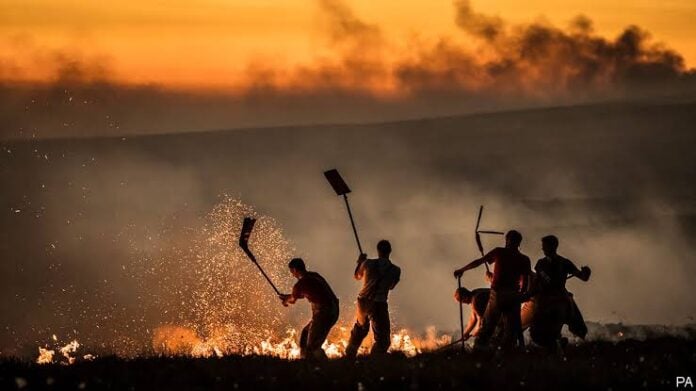
Among the survival crises faced by humanity on Earth, climate change is the most alarming and catastrophic. Today, it is widely understood that global warming is the primary cause of this crisis. This upheaval is the inevitable consequence of the uncontrolled exploitation of natural resources driven by the hunger for profit since the beginning of the Industrial Revolution. Climate changes caused by natural factors may eventually return to equilibrium over time. However, intensified human (anthropogenic) interventions in nature lead to continuous and irreversible disasters. War is one of the most brutal forms of human intervention in nature. Therefore, a world without war is essential to alleviate global warming and climate change.
According to the 2025 report of the World Meteorological Organization, the decade from 2015 to 2025 has been the hottest on record. By 2025, global temperature rise is approaching 1.5°C. Compared to the pre-industrial average (1850–1900), the temperature increase in 2025 alone has reached between 1.43°C and 1.50°C. Concentrations of greenhouse gases such as carbon dioxide, methane, and nitrous oxide in the atmosphere reached their highest levels during 2024–2025. Additionally, chemical absorption has acidified ocean waters, damaging ecosystems. Rising temperatures are also causing rapid melting of polar ice caps. Studies report that ocean heat content and sea levels reached record highs between 1993 and 2024.
Extreme heatwaves, devastating floods, and severe droughts have forced large-scale environmental migration toward safer regions during 2024–2025. Atmospheric carbon dioxide levels have increased from 228 ppm before the Industrial Revolution to 429 ppm in February 2026—nearly doubling. This human-induced ecological imbalance threatens human habitation on Earth. Increasing natural disasters make survival increasingly difficult. In addition to regular heatwaves, heavy rains, cloudbursts, and landslides, there were 101 tropical storms last year, including 25 cyclones, causing unprecedented loss of life, economic damage, and environmental destruction. Environmental scientists and geologists have little doubt that climate change driven by global warming is the cause of these phenomena.
Among human activities contributing to global warming, modern global wars are the most rapid and destructive. Wars since the advent of colonial imperialism era are not confined to small regions; they have caused and still cause extensive damage and devastation. The catastrophic impacts of the First and Second World Wars, enabled by advances in science and technology, remain unforgettable. These wars caused immense destruction to human life, property, and the environment. All subsequent wars, large and small, have continued this pattern. The ongoing Russia–Ukraine War and the recent conflict involving the United States and Israel against Iran are repeating these environmental disasters on a global gauge. The use of remotely controlled ballistic missiles dispersing chemicals and greenhouse gases worldwide is creating alarming conditions.
During the colonial era, war technologies were the monopoly of major powers. However, over the past several decades, many countries have acquired both basic and advanced military technologies, including nuclear capabilities. Not only major powers like the United States, Russia, and China, but also countries such as India, Pakistan, Israel, Iran, and North Korea are now nuclear powers and they possess supersonic intercontinental missiles. Nuclear-powered submarines and aircraft carriers densely populate the oceans. All these constitute explosive reservoirs contributing to global warming and environmental pollution. The environmental damage caused by war cannot be easily reversed, which heightens concerns about current conflicts.
The war between Russia and Ukraine since February 24, 2022, and the war initiated on March 28, 2026, by the United States and Israel against Iran require special attention in the context of global environmental health. Data shows that these wars are pushing an already fragile global ecosystem—damaged by 200–300 years of over-industrialization—closer to collapse.
During its four-year-long course, the Russia–Ukraine war has emitted 311 million metric tons of CO₂ equivalent (MtCO₂e) approximately. In contrast, the U.S.–Israel war against Iran released about 5.054 MtCO₂e within just the first two weeks. This unusually high level of emissions at the onset of the conflict was largely due to attacks on energy production systems. The Ukraine war differs in that it is primarily a prolonged ground war, where emissions arise from the burning of buildings, forests, agricultural lands, and industrial facilities.
Despite these facts, the role of wars in accelerating climate change is often not given due importance. Wars significantly undermine global carbon reduction initiatives. Military emissions are not reported under the United Nations Framework Convention on Climate Change and are often excluded from international climate policy discussions. Modern warfare is uniquely destructive. It produces not only toxic chemicals but also large quantities of greenhouse gases such as carbon dioxide, methane, nitrous oxide, and black carbon. Approximately 5.5% of global greenhouse gas emissions from human activity are attributed to military operations and armed conflicts. Explosions, petroleum combustion, and destruction of infrastructure—such as buildings, factories, ships, aircraft, and energy systems—directly release greenhouse gases. Secondary effects include oil spills, ocean chemical pollution, and carbon aerosol phenomena known as “black rain.” These rapidly degrade local air quality and global radiative balance, yet remain largely unaddressed in international agreements like the Paris Accord.
Within the first 14 days of the Iran conflict, emissions reached 5.054 MtCO₂e—exceeding the annual emissions of Iceland and roughly equivalent to those of 84 low-emission countries combined. Destruction of infrastructure alone released 2.415 MtCO₂e. Around 16,191 residential and commercial buildings, hospitals, schools, and public facilities were burned, releasing stored carbon into the atmosphere. Reconstruction will require additional emissions.
Large quantities of oil and gas infrastructure were destroyed, releasing 1.883 MtCO₂e from burning oil reserves and natural gas. Military operations consumed 150–270 million liters of fuel, producing an additional 0.529 MtCO₂e. Destroyed military equipment contributed 0.227 MtCO₂e.
Marine pollution from warfare has severely disrupted carbon sequestration processes in Gulf ecosystems. The full extent of pollution remains unquantified, but ongoing missile attacks continue to worsen the situation. In Ukraine, widespread destruction of land, agriculture, forests, and infrastructure has intensified emissions. Reconstruction efforts will further increase the carbon burden.
The nature of emissions differs between the two conflicts. The Iran war represents intense, short-term pollution, while the Ukraine war demonstrates long-term cumulative damage. Notably, 1.6% of the four-year emissions from Ukraine occurred in just two weeks of the Iran conflict. High-tech aerial warfare targeting oil systems has produced unprecedented pollution levels.
Although global annual industrial emissions are about 50 billion tons (50 GtCO₂e), the emissions from wars cannot be dismissed as negligible. They significantly hinder efforts to limit global warming to 1.5–2°C. As wars accelerate emissions, they become “carbon bombs,” destabilizing ecosystems and climate systems. Post-war carbon reduction becomes even more difficult, and the increasing frequency and intensity of climate disasters render mitigation efforts increasingly ineffective.
— Dr.K.P.Krishnankutty, the author, is an environmental activist and former Principal of Govt. College, Kottayam
