


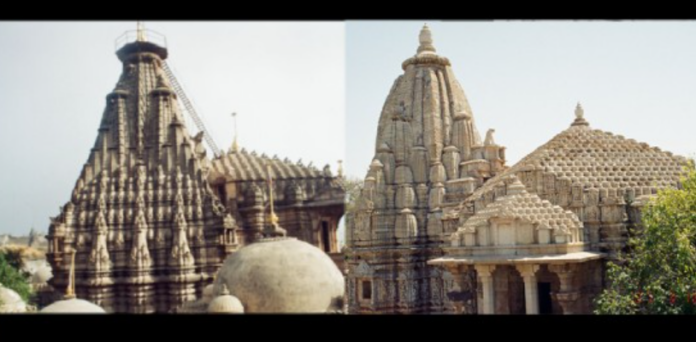
“What is common to Hindu and Jain Temples”, eSamskruti, 7 Sep 2026.
“One of the most fascinating aspects of Indian temple architecture is the extent to which Hindu and Jain traditions share a common visual vocabulary.
At first glance, sectarian identities appear distinct. Hindu temples centre around deities such as Shiva, Vishnu, Devi, or Surya, while Jain temples focus upon the Tirthankaras—the enlightened teachers who attained liberation. Their theological frameworks differ, as do aspects of ritual and philosophy.
Yet when one looks closely at their architecture and sculpture, striking continuities emerge.
Both traditions employ similar architectural principles: sanctum, mandapa, circumambulatory paths, towers, gateways, and sacred orientation. More importantly, they share an underlying sculptural grammar.
Lotus motifs, celestial beings, guardian figures, sacred animals, geometric ornamentation, narrative panels, and auspicious symbols appear across both Hindu and Jain monuments.
This continuity reflects more than artistic borrowing.
It reveals the existence of a broader civilisational imagination within which different religious traditions evolved. Sculptors, patrons, and artisans often worked across sectarian boundaries, drawing upon shared workshops, techniques, and symbolic conventions.
A temple in medieval India was, therefore not created in cultural isolation……….”
Read the full article at eSamskruti.
