


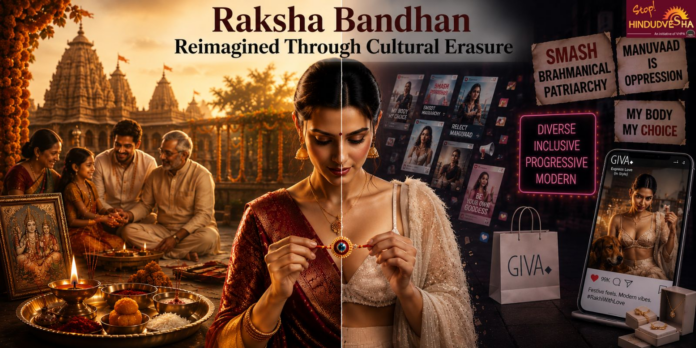
“The GIVA Controversy: The Woke Cultural Engineering of Hindu Women”, StopHinduDvesha, 24 Sep 2026.
“The portrayal of Hindu Dharma as patriarchal and regressive is commonplace in sections of global and Indian media, often drawing upon colonial-era assumptions and a predominantly Eurocentric worldview. This caricature is frequently accompanied by efforts to persuade Hindu women, especially the young, to view their own religious and cultural traditions primarily through the lens of oppression.
The contradiction is striking. Amid slogans such as “Fight Brahmanical Patriarchy,” some feminist voices vigorously defend Muslim women’s right to choose the hijab or even live under Sharia-derived norms. Yet serious scrutiny of misogyny, coercion, or restrictions on women under radical Islam is often branded Islamophobia. Hindu traditions become legitimate targets for dismantling; Islamic practices are defended as matters of identity and choice.
The same double standard shapes discussion of religious grooming and “love jihad,” routinely dismissed as a Hindutva conspiracy. Meanwhile, popular culture and advertising repeatedly use Hindu women and festivals such as Diwali and Rakshabandhan to challenge or ridicule traditional norms.
The following sections examine how this ideological asymmetry alienates young Hindu women from Dharma while downplaying vulnerabilities created by religious grooming and radical Islamist coercion.
Caricaturing of Raksha Bandhan
The commodification of the female body is one of advertising’s oldest devices. From shampoos and deodorants to soft drinks and automobiles, glamorous female imagery is routinely deployed even when it has little connection to the product being sold. But when brands explicitly invoke Hindu festivals to market their products, a different consideration comes into play: cultural context. A company cannot reasonably borrow the emotional power of a religious tradition while treating the customs that give it meaning as irrelevant……….”
Read the full article at StopHinduDvesha.
