


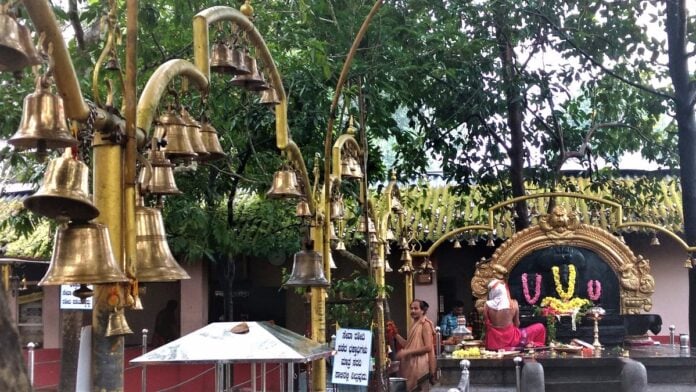
A case involving the misappropriation and illegal transport of votive bells belonging to a temple has raised serious questions about the manner in which the authorities handled the matter. Despite the temple reportedly incurring a loss of more than ₹40 lakh, the criminal case appears to have effectively ended, while the departmental inquiry remains in limbo.
According to the Vishwavaani reports, the temple’s records showed that around 22 tonnes of bells were in its stock, while the tender was reportedly issued for only 12 tonnes. The temple inventory and other records revealed substantial discrepancies in the quantity of bells accounted for. Investigators found that approximately 14,060 kg of bronze bells had been removed without proper documentation.
The bells were transported and sold through a bidder identified as Abu Bakar, who was associated with the trading firm mentioned in the records. The market value of the misappropriated bronze bells was estimated at around ₹44.69 lakh. The report raises questions about how such a large quantity could have been removed despite official stock records and whether officials responsible for maintaining the temple’s inventory failed to detect the irregularities.
Criminal case ends after accused’s death
A complaint was reportedly filed with the Dharmasthala police, following which a case was registered. However, by the time the police proceeded with the case, the accused, including a former officer associated with the temple administration, had reportedly died.
The police subsequently informed the complainant that because the accused had died, the criminal proceedings could not be pursued against him. A charge sheet had reportedly been prepared in the matter, but the case was eventually brought to an end. The report questions whether the closure of the criminal case has also resulted in the larger issue of recovering the financial loss suffered by the temple being overlooked.
GST liability adds to the temple’s loss
The report also points to a GST-related issue arising from the sale of the bells. A notice was reportedly issued in March 2021 demanding approximately ₹5.49 lakh towards GST. The trader is said to have argued that the bells were purchased without GST and that tax had been paid when they were subsequently sold outside.
However, the report questions whether such an explanation can absolve the parties concerned of their responsibility towards the temple. When the estimated value of the missing bronze bells is combined with the GST liability, the financial implications for the temple run into more than ₹50 lakh, according to the figures cited in the report.
Why has action not been taken?
The report further questions why the Revenue Department has not initiated stronger recovery proceedings to recover the money owed to the temple. It points out that even if criminal proceedings cannot continue against an accused who has died, that does not necessarily erase the institution’s financial claim or its right to recover the loss through appropriate legal and revenue-recovery mechanisms.
The report cites the Karnataka Hindu Religious Institutions and Charitable Endowments framework to raise the issue of recovering the temple’s losses from the property or assets of those responsible, wherever legally permissible.
Questions over the missing quantity of bells
The most significant concern raised by the report is the discrepancy between the quantity recorded in the temple’s stock and the quantity covered by the tender. While the tender reportedly covered only 12,000 kg, records indicated a much larger quantity of bells in the temple’s possession. Investigators found that an additional quantity had been moved without proper bills or documentation.
The report therefore questions how the additional bells could have left the temple premises without the knowledge or approval of the responsible officials. It also raises concerns over the role of the officials who were responsible for maintaining the inventory and supervising the transportation of the temple property.
Departmental inquiry also stalled
Apart from the criminal case, the report highlights the apparent lack of progress in the departmental inquiry into the irregularities. Questions have been raised over whether administrative responsibility was fixed on the officials involved and whether any attempt was made to recover the financial loss from those found responsible.
Where is bidder Abu Bakar?
14,060 kg of temple bells moved illegally, valued at around ₹44.69 lakh, with the temple’s total claimed loss crossing ₹50 lakh. The death of the first accused brought the criminal case to an end, but why was bidder Abu Bakar not held accountable? Where is the Endowment Department, and why has it failed to ensure recovery of the temple’s money and fix responsibility for the irregularities?
The bigger question is whether the Congress government and the Endowment Department are serious about protecting temple assets, or whether temple funds and properties are being allowed to disappear under administrative negligence and irregularities. If thousands of kilograms of temple bells could be moved without proper accountability, who approved it, who benefited from it, and why has no effective action followed? Who will answer for the loss of devotees’ and the temple’s property?
Who is protecting bidder Abu Bakar? Why has a matter directly related to temple property and the Endowment Department’s responsibilities been allowed to reach this stage? Why are Islamists bidders allowed to participate in the bidding for Hindu temple property? If those accused of irregularities are being shielded by the government itself, who will hold the Endowment Department accountable?
