


A 21-year-old factory worker from Uttar Pradesh’s Hapur, identified as Avesh Khan, has been arrested in Bhopal for allegedly concealing his religious identity, raping a 20-year-old Hindu woman, filming obscene videos of her, and using them to blackmail her over several months, in a case that has sparked fresh controversy around sexual grooming (termed love jihad colloquially in Bharat) in Madhya Pradesh’s capital.
Accused Posed as ‘Raja’ to Befriend Victim
According to police and media reports, Khan had been living in Bhopal’s Bagroda industrial area for around six years, employed at a local factory and sharing a social circle with co‑workers from the same neighbourhood. Through one such colleague, he came into contact with the colleague’s 20–22‑year‑old sister, a Hindu woman residing in the Katara Hills police station area, and allegedly introduced himself to her using a Hindu name, “Raja,” while concealing his real identity as Avesh or Mohammed Avesh Khan. Investigators say the two lived in nearby localities and worked in factories in the same belt, which allowed regular meetings and helped Khan gain her trust under the assumed identity.
The complainant has told police that the friendship gradually turned into a romantic relationship, with Khan allegedly promising marriage while continuing to present himself as “Raja.” She has further alleged that during this period he established physical relations with her on the pretext of marriage, a statement that now forms a key element of the rape charges against him. Only later, when she came to know that his real name was Avesh (or Ubez) Khan and that he was a Muslim resident of Hapur, did she confront him and attempt to break off contact.
Obscene Videos, Blackmail and Threats
The FIR and media accounts state that Khan secretly recorded intimate photos and videos of the woman on his mobile phone, allegedly without her informed consent, while the relationship was ongoing. After she discovered his real identity and refused to continue meeting him, he allegedly began to threaten her with making the explicit material viral on social media, pressuring her to yield to further sexual exploitation and maintain contact despite her objections.
Police officials in Bhopal have said that the accused used these recordings as leverage, warning the victim that her reputation and family’s honour would be destroyed if she reported the matter or cut ties. Local crime reports describe a pattern in which the accused allegedly first trapped the woman in a relationship under a false Hindu identity, then used the obscene videos to blackmail her into continued exploitation once his real identity came to light. The case has been reported as involving a Dalit or SC‑category complainant in some outlets, which is why charges under the Scheduled Castes and Scheduled Tribes (Prevention of Atrocities) Act have also been invoked along with sections related to rape and criminal intimidation.
Bajrang Dal Intervention and Public Beating
The incident moved into the public domain when Hindu organisations were alerted to the ongoing blackmail and allegedly set a trap to apprehend the accused. According to reports, members of groups such as Bajrang Dal arranged to be present when Khan came to meet the woman in the Katara Hills area, purportedly to further intimidate her using the threat of leaking videos.
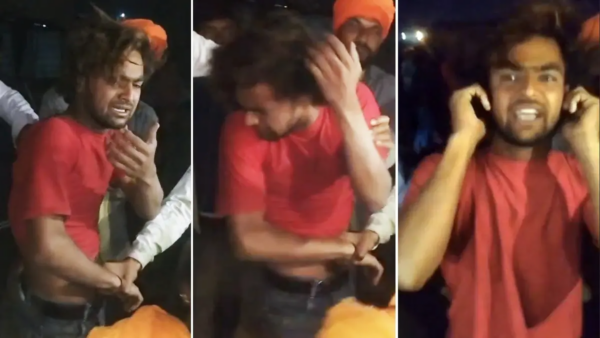
Video clips circulating on social media and referenced in multiple news reports show activists and local women surrounding Khan, assaulting him in the street and accusing him of trapping Hindu girls under a fake Hindu name. After the beating, the activists handed him over to the Katara Hills police, who registered a case on the woman’s complaint and formally placed him under arrest. Police later confirmed that an FIR had been lodged and that the accused was produced before a local court, which remanded him to judicial custody, effectively sending him to jail within roughly 15 hours of his detention, as reported by Hindi dailies.
Police Seize Phone, Probe Multiple Videos
During the initial investigation, police seized Khan’s mobile phone and claimed to have found a large number of explicit videos and images involving women. Some Hindu organisations and local outlets have alleged that more than 40 obscene videos of Hindu girls were discovered on the device, describing the case as evidence of a wider pattern of exploitation; however, police have not officially confirmed this figure and say the exact number and nature of the clips will only be determined after a full forensic analysis.
Officers have sent the device for forensic examination to retrieve any deleted data and to identify all women appearing in the recordings, in order to determine whether there are multiple victims beyond the 20‑year‑old complainant. Investigators are also checking Khan’s background both in Hapur and in Bhopal, including his work history in the Bagroda industrial area and his contacts over the past few years, to see whether he was operating alone or was part of a larger network engaged in systematically targeting Hindu women through identity concealment and blackmail.
Legal Provisions and Love Jihad Angle
The Katara Hills police have booked Khan under sections of the Bharatiya Penal Code related to rape, cheating, criminal intimidation and offences involving obscene material, as well as relevant provisions of the SC‑ST (Prevention of Atrocities) Act owing to the complainant’s caste status. Authorities have stated that the FIR describes both the alleged deception over identity and the subsequent sexual exploitation and blackmail, which together form the legal basis of the charges.
Several Hindi news outlets have identified the case as another instance of love jihad in Madhya Pradesh. Activist statements and social media posts have highlighted that Khan allegedly posed as “Raja,” used a Hindu name, and targeted Hindu women, arguing that this fits a pattern seen in previous cases reported from Bhopal and other parts of the state.
Police, however, have so far focused their public comments on the specific criminal offences and the ongoing investigation, avoiding any formal endorsement of the love jihad narrative while acknowledging that multiple obscene videos were found and that additional victims cannot be ruled out at this stage. Senior officers have indicated that further sections, including those related to information technology and cybercrime, may be added if evidence shows that videos were shared or distributed online.
Next Steps in the Investigation
As of early February 2026, Khan remains in judicial custody while the Katara Hills police continue to record statements, verify digital evidence, and coordinate with investigators in Uttar Pradesh to map his movements and possible criminal history in Hapur. The woman’s statement has been recorded in the presence of a female officer, and authorities say they will treat any new complainant who comes forward as a separate survivor, with additional FIRs and charges if required.
Forensic results from the seized mobile phone are expected to play a decisive role in determining whether the Bhopal case involves one victim or a broader pattern of targeted exploitation, and whether additional cybercrime sections or conspiracy‑related provisions will be added to the charge sheet. The outcome of the probe is likely to feed into the ongoing political and social debate over interfaith relationships and harassment of Hindu women through identity concealment, and the line between individual criminal culpability and love jihad cases in Madhya Pradesh and beyond.
