


The eternal scriptures are the primary regulators for determining our duties and non-duties. What contradicts the scriptures is not helpful for an individual in attaining liberation. Lord Yogeshwara Bhagavan Shri Krishna mentions such principles in the Gita:
“yah shastra-vidhim utsrijya vartate kama-karatah
na sa siddhim avapnoti na sukham na param gatim” || 23 ||
“tasmach chhastram pramanam te karyakarya-vyavasthitau jnatva shastra-vidhanoktam karma kurta iharh sasi” || 24 || Gita [16/23-24]
In other words, a person who abandons scriptural injunctions and acts whimsically driven by desires cannot attain success, nor peace and happiness, nor liberation. Therefore, the scriptures are your authority for determining duties and non-duties; thus, knowing the scriptural injunctions, engage in actions accordingly.
The immortal wisdom that Yogeshwara Bhagavan Shri Krishna imparted to the hesitant Arjuna at the beginning of the Kurukshetra war is today known as the Gita—a beloved text from philosophers to ordinary people. In the Shrimad Bhagavad Gita, Yogeshwara Bhagavan Shri Krishna repeatedly mentions it. The Smriti scriptures state that death is an eternal truth in every person’s life, but the soul never perishes. Such statements are found in the Gita’s Chapter 2, Sankhya Yoga, verse 20:
“na jayate mriyate va kadachin nayam bhutva bhavita va na bhuyah ajo nityah shashvato’yam purano na hanyate hanyamane sharire” ||
Gita: 2/20
In other words, the soul never takes birth or dies, nor does it cease to exist after birth or come into repeated existence. It is birthless, eternal, constant, ancient yet ever-fresh. Even when the body is destroyed, the soul is never destroyed.
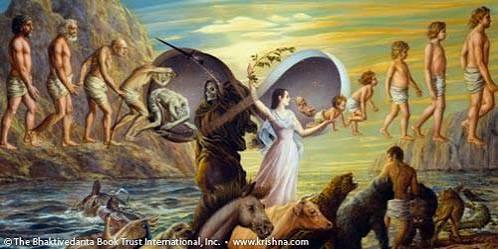
Thus, the living soul merely discards an old, worn-out body and assumes a new one. This is stated in the Gita’s Chapter 2, Sankhya Yoga, verse 22:
“vasamsi jirnani yatha vihaya navani grhnati naro’parani tatha sharirani vihaya jirnany anyani samyati navani dehi” || Gita: 2/22
In other words, just as a person discards worn-out clothes and puts on new ones, so the soul discards worn-out bodies and assumes new ones.
Just as this perishable body was created, according to the laws of nature, the living soul will leave this body and enter a new one. In the Gita’s Chapter 2, verse 27, Yogeshwara Bhagavan Shri Krishna states:
“jatasya hi dhruvo mrityur dhruvam janma mritasya cha tasmad apariharye’rthe na tvam shochitum arhasi” || Gita: 2/27
In other words, for one who has taken birth, death is certain, and for one who has died, birth is certain. Therefore, you should not grieve over this inevitable reality.
Yogeshwara Bhagavan Shri Krishna mentions rebirth in Chapter 4 (Jnana Yoga), verse 5 of the Gita: “bahuni me vyatitani janmani tava charjuna
tany aham veda sarvani na tvam vettha paran tapa” || (Gita: 4/5)
In other words, O Arjuna, the conqueror of enemies! Many births of Mine and yours have passed. I remember all of them, but you do not.
The living soul is beginningless—it is neither created nor ever destroyed. Due to delusion from desire-driven actions, it repeatedly returns to this material world to reap the fruits of those actions. When it becomes free from the bonds of karma’s fruits, it attains the desired liberation.
From the above analysis, we all can realize that reincarnation, like the theory of karma and beginningless time, is an inseparable part of eternal Dharma scriptures and is fully scriptural. Therefore, if any propagandist claims that the concept of reincarnation is absent in eternal Dharma scriptures, it can only be due to their ignorance or foolishness.
“karmaṇy evādhikāras te mā phaleṣu kadāchana
mā karma-phala-hetur bhūr mā te saṅgo ’stv akarmaṇi” || Gita: 2/47
In other words, your right is to action alone, never to the fruits thereof. Let not the fruits of action be your motive, nor should you be attached to inaction.
We reap what we sow. But often we see people committing evil deeds throughout their lives yet living prosperously and powerfully. Does that mean sinners or wrongdoers escape punishment? Absolutely not! The fruits of a wrongdoer’s actions return to them. Thus, the sacred Vedas state:
“iśva ṛjīyaḥ patatu dyāvāpṛthivī taṃ prati
sa taṃ mṛgam iva gṛḥṇātu kṛtyā kṛtyākṛtaṃ punaḥ ||” Atharvaveda 5/14/12
In other words, the fruits of evil deeds return to the doer from heaven and earth, just as an arrow shot upward swiftly returns downward, or as a tiger approaches a deer.
From the above mantra, it is evident that a person will surely reap the fruits of their actions. Yet, we often see criminals or sinners seemingly escaping unpunished. If God’s creation allowed injustice, unfairness, and bias, would that ever happen? No, it cannot. The resolution to this doubt is rebirth. In other words, a person will experience the fruits of their own actions in a subsequent birth—this is the truth.
