


Every religion, sect, and faith in Bharat has the right to practice its traditions freely, but freedom must come with responsibility. When airports, railway stations, or other public facilities already provide designated prayer rooms, using them should be the lawful and respectful norm. Public spaces are meant for all citizens, not for religious exhibitions.
A recent incident at Bengaluru’s Kempegowda International Airport reignited this debate. A video showing an Islamist group offering namaz in an open area inside Terminal 2 went viral, prompting BJP spokesperson Vijay Prasad to question how such activity was permitted within a high-security zone. He raised valid concerns about both security and the selective enforcement of rules. The airport’s own website clearly mentions the presence of multi-faith prayer rooms near both terminals, yet some individuals still choose to occupy public space for religious display.
As per OpIndia reports, this is not an isolated case. From Mumbai airport to Lucknow, similar incidents of people offering namaz in public areas, including schools, shopping malls, railway stations, and even temple premises, have been reported. In Uttar Pradesh’s Budaun, a man prayed inside a temple; in Mathura, another similar case surfaced. Across the internet, videos abound of people turning roads, offices, or campuses into temporary prayer grounds, not because no facilities exist, but seemingly to assert presence and dominance in public view.
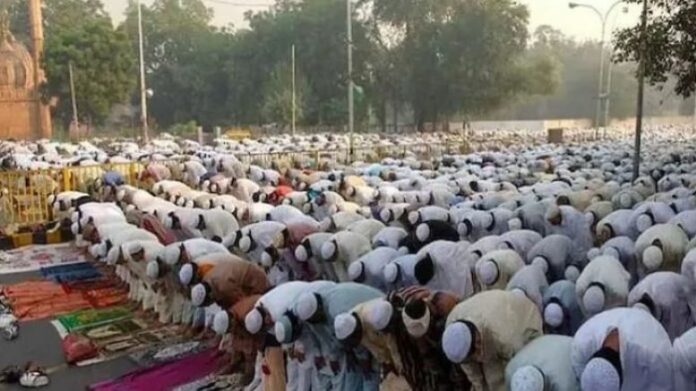
During Eid, it’s not uncommon to see entire roads blocked for namaz, even when local authorities designate specific spaces for prayers. The same pattern repeats on Fridays, where large groups occupy main streets despite nearby mosques being available. This isn’t merely an expression of faith; it becomes a symbolic show of strength, a message of numerical and social assertion. Such acts inevitably inconvenience others, cause traffic chaos, and raise questions about the intent behind this public display.
Let it be clear: offering namaz is a fundamental part of Islam, and no one disputes the right of Muslims to pray. The concern arises when, despite available alternatives like mosques or multi-faith rooms, people deliberately choose public spaces to conduct these rituals. It starts to appear less as an act of devotion and more as a conscious projection of visibility and power, a way of saying, “We are here, and we are unafraid.” This transformation of private faith into public assertion is what breeds resentment and social friction.
Blocking roads for Namaz is ‘faith,’ but Govardhan puja becomes ‘hatred’?
History already offers examples of how such acts have fueled conflict. In Gurugram, 2021, repeated instances of open-air namaz led to confrontations between local Hindu residents and Muslim groups. When residents objected and organized Govardhan Puja at the same sites, leaders like Asaduddin Owaisi labeled it as “hatred against Muslims.” Yet, the real question remains: if blocking public roads for namaz is acceptable, why is peaceful Hindu worship at the same place condemned? The hypocrisy is glaring.
When a community repeatedly uses public spaces for religious activity, it inevitably sends a signal, one of unity, but also of power projection. Over time, such behavior provokes counter-reactions, builds social tension, and hardens communal divides. People struggling to commute or access public facilities naturally feel anger and alienation.
The rise of radical Islamist ideologies across Bharat is manifesting through online recruitment networks, extremist propaganda, and systematic religious manipulation. Equally alarming is their growing public expression of radicalism, from street mobilization to symbolic demonstrations that challenge civic order.
The growing pattern of selective secularism in Bharat has exposed the deep-rooted hypocrisy of those in power. Time and again, we witness how Hindu traditions face restrictions and humiliation, from obstructing Ganapati Visarjan routes near mosques to imposing arbitrary curbs on Hindu festivals, while similar actions by others are tolerated or even encouraged. This double standard is not governance; it is appeasement politics at its worst.
Chief Minister Siddaramaiah’s conduct reflects this mindset. His visible comfort in adopting Islamic symbols while deliberately avoiding traditional Hindu or Kannada cultural emblems like the Mysuru peta sends a clear message of bias. When a leader chooses political optics over balanced respect for all faiths, it weakens the very foundation of democracy. The Congress government in Karnataka has reduced governance to the lowest level of vote-bank appeasement, often appearing openly dismissive of Hindu sentiments in policy and public expression.
Incidents like the open-air namaz at Bengaluru Airport are not isolated lapses; they represent the emboldened outcome of years of selective tolerance. If this continues unchecked, the dignity of Bharat as a civilization that stands for balance, mutual respect, and dharmic integrity will erode rapidly.

Prayers should be there only at designated places to show respect to their own religion. But you should be respectful to the freedom of movement of other fellow beings at public places.