


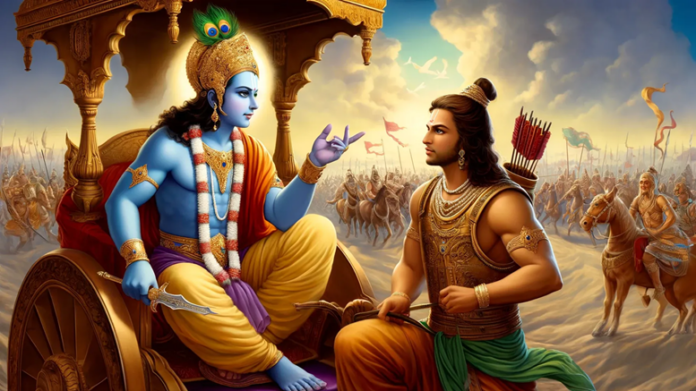
At first we have to know what is karma according to Bhagavad Gita.In Sanskrit Karma means “to do”.Karma can refer to any action, whether good or bad, that a person performs with their body, speech, or mind.But what is Karma yoga?It is a spiritual path in the Bhagavad Gita that encourages selfless action and detachment from the results of one’s actions.The goal of Karma yoga is to perform one’s duties with devotion and dedication, without being motivated by personal gain.
In the battle of Kurukshetra, seeing his relatives as opponents, Arjuna became despondent. Therefore, he told Lord Krishna, “I will become a beggar—embrace renunciation, and I will not fight.” At that time, Lord Krishna told Arjuna that work is necessary. Moreover, no one can stay without action(karma) even for a moment; as long as the body exists, work also exists. Even if there is no physical work, there will be mental work. Lord Krishna further said, “Na Karmanam Anarambhan Naiskarmyam Purusho’Snute; Na Cha Sannyasanad Eva Siddhim Samadhigachchhati”—“By not commencing action(karma), one cannot achieve the state of naiskarmya (freedom from actions), and by merely renouncing actions(karma), one does not attain perfection.” Through work—through selfless actions, the bondage of karma is removed, and the mind is purified. In that purified mind, self-realization happens. Humans have to perform actions(karma). They cannot stay without actions(karma).
Selfless Karma Yoga is the highest message of the Gita. Regarding actions, Lord Krishna said:
Tasmad Asaktah Satatam Karyam Karma Samachara; Asakto Hy Acharan Karma Param Apnoti Purushah” (Gita 3.19)
Therefore, always perform your duty without attachment. By performing actions(karma) without attachment, a person attains the supreme state. In this verse, Lord Krishna explicitly stated that liberation(Moksha) is achieved through selfless Karma Yoga.
Lord Krishna further said that those who have faith in selfless actions and perform them without jealousy and without deviation will also be freed from bondage. (Gita 3.31)
Therefore, Lord Krishna told Arjuna, “Niyatam Kuru Karma Tvam” – “Always perform your prescribed duties.” According to the Gita, by performing the duties of one’s varna (social class) and ashrama (stage of life) without attachment, one attains liberation(Moksha).
Lord Krishna said:
Shreyan Swadharmo Vigunah Paradharmat Svanushthitat; Swadharme Nidhanam Shreyah Paradharmo Bhayavahah” (Gita 3.35).
Even if one’s own duty is performed imperfectly, it is better than performing another’s duty perfectly. Performing one’s prescribed duties, even if death occurs, is auspicious; but performing the duties prescribed for others is dangerous as it leads to degradation. Therefore, Lord Krishna instructed to perform the duties of one’s own varna. Selfless duties prescribed by one’s varna are the path to liberation.
In the Mahabharata, Arjuna also said:
Asaktah Saktavad Gachchan Nissangah Muktabandhanah; Samah Shatrau Cha Mitre Cha Sa Vai Mukto Mahipate” (Mahabharata 12.18.31).
He who, being unattached, behaves as if attached, and being free from bondage, sees friends and foes equally, is truly liberated. O King, this is the ideal of liberation mentioned in the Gita.
The Yajnavalkya Smriti (3.204-205) states that a householder who is truthful and steadfast in knowledge, even without accepting renunciation, attains liberation. In the Vyadha Gita, it is stated that Vyadha, by performing his duty as a butcher without attachment, attained self-knowledge. In the Mahabharata, it is shown that the chaste wife attained knowledge through selfless service. Bal Gangadhar Tilak said, “Selfless action is the dharma of the Gita; because even though Lord Krishna Himself was fully self-realized, He performed and propagated selfless action(Karma Yoga).”
