


अज्ञानं तु खलु कर्तव्यकर्मणाम् अदर्शनम्।
“True ignorance consists in not knowing one’s duties (Dharma).”
— Yudhishthira
On 21 October, the Commission for Air Quality Management (CAQM) imposed Stage I of the Graded Response Action Plan (GRAP), followed promptly by Stage II on 2 November. Deepawali celebrations seemed to miss the memo, commencing only on 8 November this year.
Delhi’s toxic air is not a recent development. The city has battled a plethora of pollution sources since the early 1990s, when combine harvesters became popular and stubble burning spread across the neighbouring states.
1. The Geography
Thermal inversion explains the timing of the problem. In the colder months, a layer of warm air sits above the heavy cold air and traps pollutants close to the surface. Delhi’s position in the Indo-Gangetic Plain, bordered by the Himalayas to the north and east, further turns it into a landlocked bowl. It holds not only its own pollutants (vehicular exhaust, industrial emissions, construction and road dust) but also those of its neighbours, namely the effluents of stubble burning in Punjab, Rajasthan, Haryana and Uttar Pradesh. Delhi’s topography only aggravates its pollution problem.
2. Protective Measures
Several policy measures have been tried to tackle Delhi’s toxic air. The Graded Response Action Plan was first introduced in 2016 by the Central Pollution Control Board, followed by the Ministry of Environment, Forest and Climate Change in 2017, the Environment Pollution (Prevention and Control) Authority (2017–2021) and the CAQM thereafter.
The plan categorises air quality into four stages by the Air Quality Index (AQI): Stage I for Poor conditions (AQI 201–300), Stage II for Very Poor levels (AQI 301–400), Stage III for Severe degradation (AQI 401–450) and Stage IV for Severe Plus, the emergency status (AQI above 450).
Despite the imposition and effective implementation of GRAP, annual AQI trends show little to no notable improvement.
| Year | Annual Avg AQI | November mean AQI | December mean AQI |
|---|---|---|---|
| 2021 | 209 | 377 | 331 |
| 2022 | 209 | 368 | 319 |
| 2023 | 204 | 372 | 348 |
| 2024 | 209 | 380 | 294 |
| 2025 | 201 | 354 | 351 |
Table 1. Delhi’s AQI over the preceding five years. Source: CPCB Daily AQI Bulletins.
3. Smoke and Fire
A major contributor, funnelling toxins and particulate matter in the form of ash and effluents, is the stubble burnt by Delhi’s agrarian neighbours. With the rise of combine harvesters in the 1990s, which left a few inches of crop residue, stubble burning came to be seen as an effective and economical way of clearing fields with minimal labour.
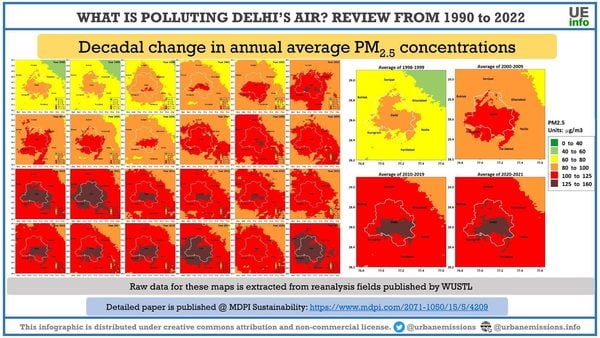
Further, the 2009 Punjab Preservation of Soil Water Act narrowed the gap between the paddy harvest (late October to early November) and the subsequent wheat sowing, popularising stubble burning as a cheap and easy way of clearing fields. North-westerly winds then carry massive plumes of smoke directly into the Delhi region in early winter, sharply pushing fine particulate matter into hazard zones, while thermal inversion traps it close to the surface. The consistent rise in AQI and particulate pollutants since 2009 reflects this trend.
4. Inaction by Punjab’s Authorities
Stubble burning is explicitly banned under the Air (Prevention and Control of Pollution) Act, 1981, whose Section 21 prohibits burning polluting residue in designated areas. The CAQM Act, 2021 was enacted to coordinate, monitor and enforce anti-pollution measures across the Delhi-NCR airshed, and its Section 15 empowers the Commission to levy Environmental Compensation directly on defaulting farmers, based on landholding size. Yet the executive in Punjab has consistently turned a blind eye to flagrant violations of these environmental laws.
The Punjab Pollution Control Board’s report as of 4 November flags 2,347 incidents of stubble burning in the state and 647 FIRs registered. In this regard, the CAQM has issued show-cause notices to the Senior Superintendents of Police and Deputy Commissioners of five districts for their failure to curb paddy-stubble burning.
The convenience and ease of stubble burning seem to outweigh the law, and the lethargy of Punjab’s executive in implementing the measures has only exacerbated the neglect of our shared environment. Its effects are felt in the air we breathe in the national capital.
5. Shifting Responsibility
The share of stubble burning in Delhi’s PM2.5 (fine particulate matter) concentration has surged this week, from 8.5% on 2 November to 16.2% by 4 November, and to between 20.2% and 22.2% on 5 November, overtaking transport as the single dominant daily emission driver. It is an entirely preventable contribution to Delhi’s toxic air. Yet in two days’ time, all fingers will point at the annual festival of lights celebrated in Hindu Dharma.
Deepawali, an essential Hindu festival, is celebrated annually on Kartik Amavasya. It signifies the triumph of light, goodness, virtue and knowledge over darkness, ignorance and evil, and is marked by lighting symbolic diyas, illuminating homes and common spaces, and bursting firecrackers.
The Supreme Court has, once again, upheld the bursting of firecrackers as an essential religious practice for the celebration of Deepawali in Hindu Dharma, permitting green crackers in certain windows of time in 2025 amid GRAP, and once again this year despite the imposition of GRAP Stage II.
Despite Delhi’s topography and the plethora of manageable factors influencing its toxic air, it is the activities of a single religious group, over a four-hour window spread across two days of Deepawali celebration, that are blamed for the rising AQI and deteriorating air quality.
In the weeks preceding the festival, there is a barrage of social media posts and advertisements calling for a silent Deepawali, with no lights, loud noises or firecrackers, sometimes in the name of animal rights, sometimes labour rights, sometimes environmental rights.
Year after year, the festivities are reduced to a clash of fundamental rights: the right to a clean environment and clean air under Article 21 of the Constitution versus the right to practise one’s religion under Article 25, including an activity upheld as essential to the celebration of Hindu Dharma.
6. When Accountability Goes Up in Smoke
What this discourse often overlooks is the contribution of polluting practices, and their necessity. This is not a matter of choosing between the right to a clean environment and the right to religious freedom; both ought to be practised on the same plane.
Notably, the only Deepawali in the last five years celebrated in November was on 12 November 2023, and it saw the lowest AQI of those five years, at 132. By contrast, on the same date in 2025, two weeks after that year’s Deepawali celebrations, the AQI spiked to 553.
The debate must instead be one of the right to a clean environment versus the greed of a few who profit from bad agricultural practices.
2026 saw a pre-emptive Winter Action Plan 2026–27, with emergency restrictions from 1 November 2026 to 28 February 2027 imposed by the Delhi government and the CAQM. However, such reactive measures do little to improve an environment already deteriorated. The need of the hour is to hold strictly accountable the farmers who violate government policies and environmental laws, and the executive that slacks in enforcement, and to prevent such degradation in the first place.
