


“Gods & Demons in the Orchestra Pit”, Indica Today, April 23, 2026
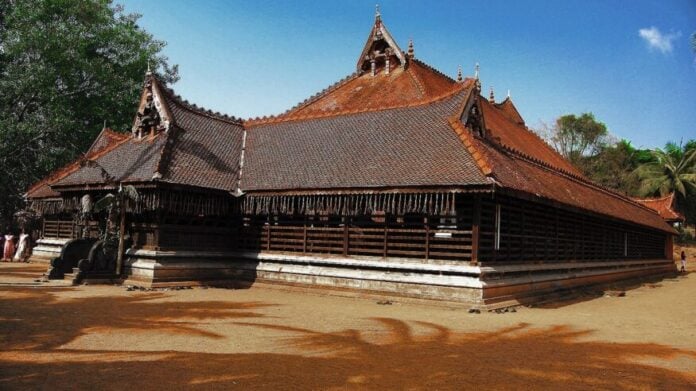
“In the dimly lit interior of a Koothambalam, the sacred theatre attached to a Kerala temple, two percussion instruments preside over a performance that has endured for more than two millennia. One is a large copper pot drum, its single leather face pointed upward toward the heavens, played with bare hands by a hereditary Brahmin percussionist seated at the rear of the stage. The other is a cylindrical wooden drum, suspended from the neck of its player and struck with curved sticks, its thunderous sound capable of being heard from considerable distances outside the theatre walls. Both are indispensable to Kerala’s classical and ritual performance traditions. Yet within the interpretive and ritual vocabulary of these traditions, they are frequently positioned in strikingly different terms: the Mizhavu is often described as Deva Vadyam (instrument of the gods), while the Chenda is characterised as Asura Vadyam (instrument of the asuras).
This essay examines the philosophical, aesthetic, and social logic through which this distinction is articulated and sustained. The contrast between the Mizhavu and the Chenda is not simply a matter of assigning different instruments to different contexts. Rather, it condenses a set of recurring oppositions—between interior and exterior space, between meditative elaboration and outward projection, between textual anticipation and collective activation—that structure Kerala’s performance traditions at multiple levels. The Deva/Asura distinction, I argue, is best understood not as a fixed theological system but as a working cosmological idiom: a way in which practitioners, texts, and institutions organise the relationship between sound, space, affect, and authority. To attend to this idiom is to recognise that in these traditions, sound is rarely treated as a neutral acoustic phenomenon. It is instead embedded in a broader field of meaning in which sonic practice intersects with ritual, hierarchy, and knowledge. The orchestra pit, in this sense, is not merely a site of accompaniment; it is a site where different forms of sonic power are differentiated, negotiated, and made intelligible.
The Cosmological Grammar of Kerala Percussion
Kerala’s performance traditions — above all Koodiyattam, the sole surviving form of ancient Sanskrit theatre, operate within a richly articulated cosmological framework. Sound itself, in the philosophical substratum of these traditions, is not a neutral physical phenomenon but a manifestation of the divine. The concept of Nada Brahman — the universe as primordial sound runs through the Vedic, Tantric, and Shaiva traditions that underlie Kerala’s temple culture. Within this framework, musical instruments are not tools but sacred entities, each carrying a specific cosmological identity and function…….”
Read full article at indica.today
