


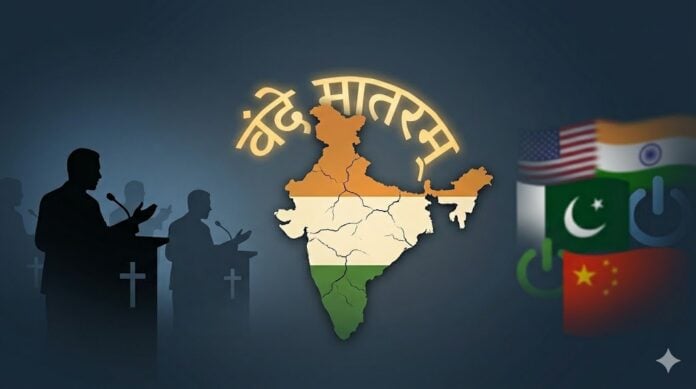
From opposing Vande Mataram to openly advocating Bharat’s partition, the past decade has seen a steady stream of radical, anti-Bharat statements from influential Evangelical and church-linked figures, revealing an ideological hostility to Bharat’s civilizational identity, unity and institutions. While public discourse often highlights Islamist separatism and radicalism, these documented incidents show that powerful Evangelical networks are equally involved in narratives that undermine national symbols, question Bharat’s sovereignty, and normalise separatist imaginations.
Vande Mataram dispute: targeting a national symbol
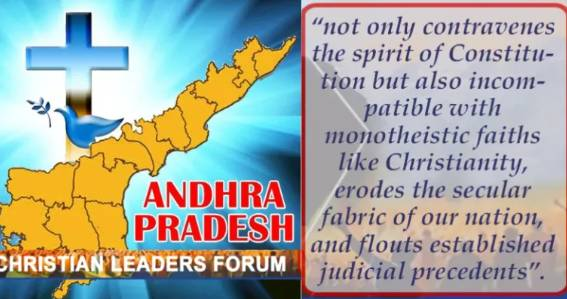
On 17 February 2026 in Vijayawada, the Andhra Pradesh Christian Leaders Forum (APCLF) publicly opposed the government directive mandating all six stanzas of Vande Mataram in schools and official functions. Chairman Oliver Rayi argued that only the first two stanzas should be sung, claiming that later verses—where the motherland is addressed with imagery associated with Hindu goddesses—conflict with Christian monotheistic beliefs and thus threaten “religious freedom.” The forum framed the full national song as a violation of minority rights and demanded withdrawal of the order, turning a patriotic symbol of national unity into a battlefield for sectarian theology. This pattern mirrors Islamist objections to Vande Mataram, showing how Evangelical groups, too, attempt to delegitimise core national symbols whenever they reflect Bharat’s Hindu civilizational ethos.
From “Christian nation” projects to open calls for Bharat’s division
Beyond symbolism, several incidents reveal a brazen separatist mindset that seeks to redraw Bharat’s map in line with sectarian Christian agendas. In September 2024 at Indianapolis in the United States, Mizoram Chief Minister Lalduhoma spoke of creating a “nationhood” for the Chin–Kuki–Zo people by combining Christian-majority areas from Bharat, Bangladesh and Myanmar, indicating a vision of a separate Christian-ethnic nation that transcends existing national borders. He described these communities as “one people” unjustly divided under three governments, and spoke of rising “together under one leadership to achieve our destiny of nationhood,” language that aligns with a long-term separatist idea rather than constitutional federalism.
Similarly, on 30 August 2021, K Upendra, linked to Bible Open University International and speaking on behalf of the All India True Christian Council, demanded that Bharat be “split into two” with one half given to Christians as a separate country, adding that “we’ll not bother you then.” The statement did not talk of rights within the Bharatiya Constitution but explicitly sought territorial partition on religious lines, starkly echoing Islamist “separate homeland” rhetoric. Put together, such pronouncements point to a disturbing convergence: while Islamists push for Kashmir-centric or broader separatism, certain Evangelical actors openly flirt with the idea of carving out a Christian political entity out of Bharat’s territory.
Attacking national identity, unity and security
The hostility of these Evangelical-linked voices is not confined to borders; it often manifests as contempt for Bharat’s national identity, constitutional institutions and security apparatus. In July 2021, Catholic priest George Ponnaiah in Kanyakumari made objectionable and derogatory remarks about “Bharat Mata” during a public speech, leading to multiple criminal cases for hurting religious sentiments and disturbing communal harmony. By insulting the national personification of Bharat, he attacked not a political party but a symbol of the country itself, feeding a discourse where national icons are reduced to sectarian targets.
In Gujarat in November 2017, Archbishop Thomas Macwan’s letter, which led the state Election Commission to issue a notice, repeatedly warned against “nationalist forces,” claiming that the “secular and democratic fabric” of Bharat was at stake and alleging daily attacks on churches and minorities. Though framed as a pastoral appeal, the letter painted the Bharatiya state and “nationalist” politics as inherently oppressive and dangerous, reinforcing a narrative in which assertive Bharatiya nationalism is automatically equated with persecution. Such rhetoric steadily delegitimises the very idea of a strong, cohesive nation-state in the eyes of church audiences.
The pattern also extends to foreign policy and national security. On 8 May 2025, Christian priest Father Jegath Gaspar dismissed Bharat’s precision Operation Sindoor strikes on terror launchpads in Pakistan-occupied Jammu & Kashmir as mere “theatrics,” calling them politically orchestrated and questioning their effectiveness while echoing talking points familiar from Pakistani narratives. He voiced fears of nuclear escalation, undermined the credibility of Bharatiya claims, and criticised the army’s presence in Kashmir, effectively weakening public support for legitimate counter-terror operations. When a religious figure repeatedly casts the national security establishment as suspect and exaggerates civilian harm in line with enemy propaganda, it crosses from dissent into strategic delegitimisation of the state’s defence posture.
Manufacturing siege narratives and demonising Bharat
Another recurring theme is the cultivation of a “siege” narrative, where Bharat is painted as a near-fascist state poised to commit genocide or “holocaust” against Christians and other minorities. On 7 January 2023, Hyderabad-based pastor Kuntam Edward Williams told a gathering at Bethel Church that a “top secret American agency report” predicted genocide in Bharat in 2023, claiming that lakhs of Christians would be killed and that there would be a Hitler-like mass slaughter. His speech warned that “most of you will not see 2024,” a sensational prediction that never materialised, but which surely spread panic, mistrust, and hatred among his followers toward Bharatiya institutions.
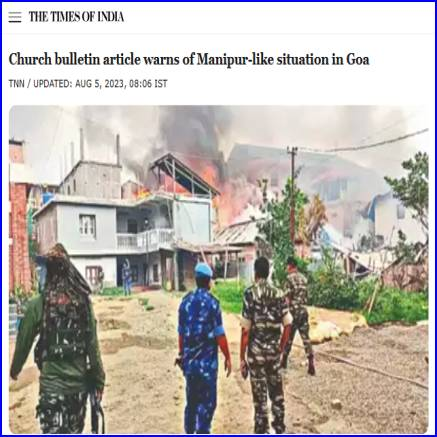
Likewise, an article in Renovacao, the pastoral bulletin of the Archdiocese of Goa and Daman, warned in August 2023 that Goa could see the “next holocaust after Manipur” if the state government proceeded with its plans to remove “traces of Portuguese culture,” equating local political debates with the risk of Manipur-style communal violence. The bulletin, published by the Diocesan Centre for Social Communications Media from the Archbishop’s House in Panaji, carried this rhetoric under Church authority, again presenting the Bharatiya state as a looming genocidal threat. These apocalyptic framings resemble Islamist and Western “genocide” narratives used to delegitimise Bharat on global platforms.
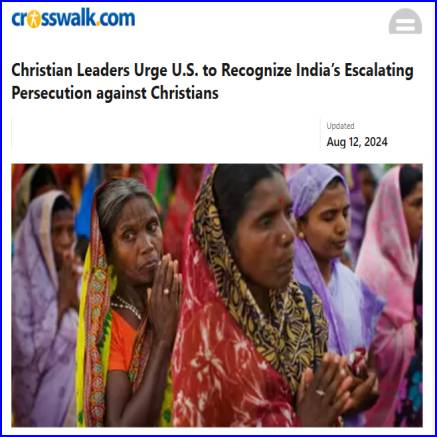
A similar internationalisation occurred on 11 August 2024, when a large group of church leaders—including bishops and archbishops—sent a letter urging the United States to “hold Indian government officials accountable” for allegedly violating religious freedom, citing FCRA controls on organisations like Amnesty, Compassion International, World Vision, and the Missionaries of Charity. By appealing to a foreign power to discipline Bharatiya officials and describing the situation as escalating persecution, the signatories effectively invited external pressure on Bharat’s sovereign decisions regarding foreign-funded NGOs. This tactic of externalising domestic debates mirrors Islamist lobbying in Western capitals, once again showing how both ecosystems attempt to use foreign leverage against Bharat.
Flags, war talk and systematic contempt for national symbols
At the more visible level, some incidents involve direct affronts to national symbols and unity. In Kochi on 13 June 2025, pastor Deepu Jacob organised a 40-day prayer meeting at Jesus Generation Auditorium where Pakistani and Chinese flags were hoisted, prompting protest and a police case after locals noticed the foreign flags. The choice of flags—those of two adversarial countries—at a religious event held inside Bharat cannot be brushed aside as mere “decorative” symbolism; it communicates affinity with powers opposed to Bharat’s interests, and normalises a mindset where loyalty to a global Christian or ideological project can override national allegiance.
On 15 August 2022, Independence Day, government school headmistress R Tamil Selvi in Tamil Nadu refused to hoist or salute the national flag, stating that as a Jehovah’s Witness Christian she could only salute God and not the flag. Though she arranged for her assistant to hoist it, parents complained, and authorities initiated an inquiry, noting her absence from previous flag ceremonies. The message this sends to students is that national symbols are negotiable or subordinate to denominational interpretation, eroding the shared civic culture that binds citizens across faiths.
Some clergy go further, weaponising fear of civil war and partition. On 13 January 2024, pastor Ajay Babu Maddisetti in Telangana claimed that under “Hindutva” Hindus would move north and Christians, Muslims, Buddhists and other minorities would move south, leading to a partition of Bharat, and urged the creation of a special “Christian and Muslim Minorities Act” like the SC/ST Atrocities Act. This narrative not only assumes inevitable civil conflict but also implicitly justifies the idea of a future territorial separation, echoing Islamist “north–south” or “Hindu vs minority” partition fantasies. When such talk comes from a church leader who is also a political campaign coordinator, it signals an organised agenda rather than mere offhand rhetoric.
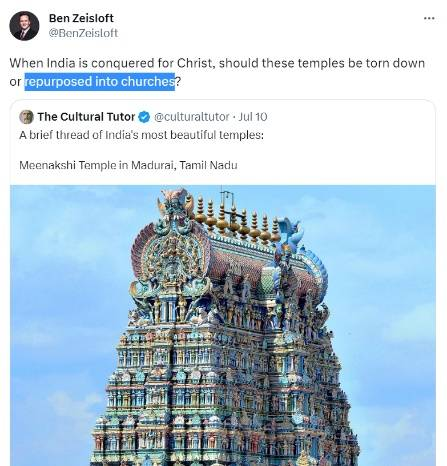
Anti-Hindu animus is also explicit. In July 2023, Christian conservative editor Ben Zeisloft of The Sentinel quote-tweeted a post on Hindu temples and called for tearing down Hindu mandirs or repurposing them as churches after “conquering” Bharat for Christ, clearly articulating both a project to “convert Bharat to Christianity” and a hatred for Hindu dharma. This is not benign theological rivalry; it echoes the same civilizational erasure that Hindu society has historically faced under Islamist iconoclasm, now articulated by a Christian conservative voice.
Rewriting Bharat’s past, undermining its civilisation
Some church leaders try to delegitimise Bharat’s civilizational continuity itself by reviving discredited colonial theories as polemical tools. In December 2025, Baselios Marthoma Mathews III, the Supreme Head of the Malankara Orthodox Syrian Church, compared “India for Hindus” slogans with Donald Trump’s “America for Americans,” suggesting such ideas cannot work in Bharat and claiming that Hindus were “not originally from India.” He asserted that Aryans migrated from Iran around 2000 BC and that Dravidians came from Africa via Iran, then asked how those who came in 2000 BC could call others foreigners. By presenting highly contested migration theories as settled truth to undermine the legitimacy of Hindu claims to nativity, he reproduced colonial-era narratives that detach Hindus from their own land and make space for external Abrahamic “ownership” claims.
The Nagaland Baptist Church Council (NBCC) letter of February 2018, written by its General Secretary Reverend Zelhou Keyho, similarly fused theology, politics and anti-Bharat sentiment. In the run-up to the Nagaland Assembly elections, the NBCC urged believers to choose between “Trishul” and “Cross,” essentially framing the election as a war between Hindu nationalist symbolism and Christian faith. Keyho claimed New Delhi was “never interested” in the Nagas and would be happy only if it could “insult” them repeatedly, and declared that when God’s time comes “India will not be able to do anything,” projecting the Bharatiya state as a temporary oppressor destined to be overruled by divine intervention. This rhetoric fuses eschatological hope with political separatism, encouraging believers to see loyalty to the Bharatiya Union as secondary to a higher, antagonistic religious destiny.
Islamists and Evangelicals: two fronts of the same anti-national project
Taken together, these 15 incidents between 2017 and 2026 show a clear, consistent pattern: parts of the Evangelical and wider church establishment in Bharat and abroad are not merely seeking “rights” or “freedom of worship” but are actively undermining Bharat’s national symbols, security apparatus, civilisational narrative and territorial integrity. The rhetoric ranges from opposing Vande Mataram on theological grounds to demanding partition, from insulting Bharat Mata to hoisting enemy flags, from predicting imaginary genocides to lobbying foreign governments against Bharat.
Public debate in Bharat frequently and correctly scrutinises Islamist radicalism—whether in the form of “Ghazwa-e-Hind” fantasies, pan-Islamist mobilisation, or open calls for secession. Yet the evidence presented here indicates that certain Evangelical forces mirror these patterns with a Christian idiom: they propagate “Christian nation” projects, call for territorial division, describe Bharat as genocidal, delegitimise national symbols rooted in Hindu culture, and seek external intervention to discipline Bharat. Both streams—the Islamist and the Evangelical—thus converge on a core objective: weakening Bharat’s civilisational confidence, fragmenting its territorial unity, and subordinating its sovereignty to transnational religious and geopolitical agendas.
For a sovereign, plural democracy, the challenge is not to selectively overlook one axis of subversion while focusing only on another. A genuinely national outlook must scrutinise all ideologies—whether Islamist, Evangelical or otherwise—that demand partition, insult national symbols, normalise contempt for Bharat’s security forces, or invite foreign powers to sit in judgment over the Republic. The incidents documented between 2017 and 2026 demonstrate that Evangelical networks are not peripheral actors but serious participants in a wider anti-national ecosystem, and must be recognised and challenged as such alongside their Islamist counterparts.
