


“The guru’s grace descends… the grass-eating tiger realizes its nature and stops being a goat”
— Bhagavan Shri Ramakrishna
What is Sanatan Dharma?
To begin with, we must understand what this enigma means- many Sanatanis too are not very clear about this. This word is being loosely used by many without even understanding what it basically means and represents.
It is a Sanskrit phrase that translates most closely to “Eternal Order” or “Perennial Way of life.” While often used interchangeably with the word “Hinduism,” it refers to a broader, philosophy that governs the universe, encompassing duty, law, and the natural order of existence. It reflects a deep understanding of the Cosmos, the mother earth, and its resources. It acknowledges the power of nature- wind, water, fire and air. Accepting ‘brahmand’ or cosmos is never ending has no limits- it is infinite and so is time. We called geography as bhoogol which reflects that we were aware long back that the earth is round. Bhoo (Bhoomi)- gol (round).
Unlike religions founded by a specific prophet, individual or triggered by a single historical event, (For example Christianity started 2000 years ago when Christ was born), Sanatan Dharma is viewed by its followers as Anadi (without beginning) and Anant (without end).
Scientifically we do not know when time started and when will it end. Therefore, the idea of Sanatan is its infinite existence. Simply put and understanding the etymology, ‘Sanatan’ which is eternal, timeless, and not bound by the limitations of history or geography and ‘Dharma’ a complex term derived from the root dhri (to uphold or support). It signifies the essential nature of a thing and the moral-ethical duties that sustain the individual and the cosmos or ‘SRISHTEE’.
The concept of Brahman, the ultimate, formless consciousness that pervades everything. This leads to the realization of Atman (the inner self- the soul). Which enumerates the idea of Atma and Param- atma. Sanatan Dharam views time as cyclical rather than linear- never ending. Central to this is the law of Karma, which posits that every action has an equal and corresponding effect. What you do, you will have to face the consequences accordingly which will come back to you. According to Sanatan the soul never dies- there is a continuous reincarnation- the soul or Atma takes different shapes as it leaves one body and gets a new body. It extends across multiple lifetimes through Reincarnation (punarjanma- re birth). It is not a rigid dogma but a living, breathing code of conduct- a good value based meaningful, life.
In essence it is a system that seeks to align the individual rhythm of human life with the eternal rhythm of the universe. It is often not fully understood by many as it is too broad and vast, to an extent philosophical.
Its complexity is its strength many argue.
Our civilisation
A civilization is effectively an organized human energy. It is the point where a group of people stops merely “surviving” and begins “building”—creating systems of law, art, and technology that can outlast any single human lifespan.
The story of Indian civilization begins with the Indus Valley Civilization (c. 3300–1300 BCE) around 5300 years back. Known for its sophisticated urban planning, drainage systems, and maritime trade, it established a template for organized living. That is the basis of a civilisation- collective living and wellbeing.
Immediately after that the Vedic Period laid the intellectual and spiritual foundations. Moving up the value chain of existence. The composition of the Vedas, Upanishads, and the Great Epics (Ramayan and Mahabharat) moved the civilization from physical infrastructure to metaphysical inquiry looking at stars and astrology. Unlike many other cultures, India’s foundational texts focused on Dharma (cosmic order and duty).
Indian civilization is commonly linked to Sanatan Dharam and often described not merely as a country, but as a “civilization-state”—a continuous, living heritage that has survived for over five millennia. While other ancient civilizations like Mesopotamia or Pharaonic Egypt exist today primarily as archaeological studies, India’s ancient Vedic roots, philosophical systems, and social structures remain active participants in its modern identity.
Interpretational Ambiguity is because the literature (Vedas, Upanishads, Puranas, etc.) is so massive and diverse, it is often prone to cherry-picking. This can lead to contradictory interpretations where different groups use the same texts to justify opposing social or political stances. Therefore, for the world at large it leaves a ‘philosophical ambiguity’ in the minds of millions.
SWOT analysis of this enigma as a civilizational and philosophical force in the current global context.
Strengths
-
- Tradition of no single central authority, is an indestructible “network” of beliefs, surviving for millennia through adaptability rather than rigid dogma. Traditions over a period become belief and then faith.
- Inherent concepts like Prakriti (Nature) as sacred align perfectly with the 2026 global mandate for sustainability and climate action. Sanatan worships the entire nature- water, air, trees and fire- all essentials for survival.
- Duty, Prosperity, Pleasure, Liberation all provide a balanced psychological model that validates material success alongside spiritual growth.
Weaknesses
-
- A lack of standardized global leadership makes it difficult to counter misinformation or present a unified voice in international forums compared to more centralized religions.
- Vast scriptures can lead to “cherry-picking,” where core philosophical depth is sometimes lost to ritualism or superstitions in local practices.
- For instance, all religions have one holy book- Bible, Guru Granth Sahab or Quran. Hinduism has so many.
- “Macaulay-isation type” education system has left many practitioners disconnected from the original Sanskrit texts, often relying on Western translations or secondary sources which can be distorted. This leads to Interpretational Decay. Becomes like a Chinese whisper. Why we call Mahabharat as Mahabharata? Ram as Rama? Yog as yoga? Because the whites cannot pronounce these words in original Indian form. They refused to learn but we adapted to their whims.
Opportunities
-
- Soft Power Diplomacy through films, culture, art, food and medicine.
- Leader of global south with care and confidence/ faith.
- The global impact of Yoga, Ayurveda, and Mindfulness (now a multi-billion dollar industry) positions Sanatan Dharma as the primary source of holistic health.
Threats
-
- The rise of “Dharmic Identity” is often framed as “Majoritarianism” or “Hindu Nationalism” in Western media. We need to push back.
- Regional instability and cross-border tensions (e.g., Jihadi extremism or Khalistani separatism) pose physical threats to practitioners and sacred sit
Bharat increasingly utilizes Dharmic principles to brand itself as a unique global player—a “civilizational state” rather than just a Westphalian nation-state. It was the theme of India’s G20 presidency and continues to be used to advocate for the Global South, positioning India as a bridge between the East and the West. G20 became a game changer for India’s perception management. The Dharmic construct is often used to justify “multi-alignment.” In a polarized world, India presents its pursuit of national interest as a duty to maintain global balance rather than joining a specific power bloc. ‘Sabka mangal ho, sabka kalyan ho’. This has been a tight rope walk but has clearly called out the stance of our foreign policy.
Across the globe, from the United States and Europe to the Middle East and Asia, we are seeing a marked increase in what sociologists and political scientists call “Civilizational Assertiveness.” There is an effort to clean the house by most leaders- America for Americans, no infiltrators from foreign land. This is happening in almost all countries. Leaders are no more hesitant to state the truth- as the people think.
The world is moving away from the era of “Globalism” and toward an era of “Identity Sovereignty.” Here is a breakdown of why and how this is happening.
“Revival” of Religious Nationalism indicates that religious identity is no longer a private matter; it has become a central pillar of state power. It is a ‘Renaissance moment’ for all the nations.
The “God is Back” is trending and after decades of predicted-pretended- secularization, religious affiliation is actually stabilizing or growing in many regions. In the West, “Christian Nationalism” has moved from the fringes to the centre of political platforms. Hindus have started realising ‘Baantege to Katenge’ or ‘if you are divided, you will be destroyed.’ Often more radical forms of religious identity that pressure governments to act. In Africa and Asia, Christianity and Islam are growing at rates faster than the general population, often becoming the primary vehicle for political mobilization.
Nationalism today is less about “flags and anthems” and more about “Civilizational Survival.” Communities want to huddle together. Religion unites people and acts as a glue. Two decades ago, nations prioritized trade. In 2026 and onwards, nations (including India, Israel, and several Gulf states) are prioritizing security and “strategic autonomy.” The feeling is that in a chaotic world, only a strong, culturally unified nation can survive.
The earlier world order was more ’accommodative or open to welcome all’ which was more like ‘everyone is welcome to the party’. Inclusive society which welcomed all culturally and politically. This was usually the secular stance. The system allowed the inward pull like a centripetal force- ‘Centripetal force is the net inward force acting on an object moving in a curved or circular path, directed toward the centre of curvature.’
In the last few decades, the stance has gradually changed to give an outward push out of the system- more culturally based or religious based. It acts like ‘Centrifugal force which is an apparent, outward force acting on an object moving in a circular path, directed away from the centre of rotation’.
The mankind is largely to be blamed for this change in attitude of nations Human nature is such that people are not ready to adapt to the realities of life. If you have gone as a migrant, then try to adapt rather than being adamant- and later even asking the nation which adopted you to adapt according to your whims. If this happens naturally you will be asked to leave.
There is a shift toward “Pre-emptive Statecraft.” Nations are no longer waiting for international consensus; they are acting decisively to protect their borders and interests (e.g., India’s institution-based neighbourhood policy)
The risk of this trend is that when nations and religions become more assertive, compromise becomes harder.
The “Zero-Sum” Mindset is emerging. My way or highway. If a conflict is just about land, infrastructure, wealth or money, you can negotiate. If a conflict is about “Sacred Values” or “Civilizational Honor,” any concession feels like a betrayal of God or the Ancestors. Look at Iran, which is standing and even refusing to give up when US and Israel have pounded the hell out of them- religious nationalism is their strength. Not ready to compromise.
Religious nationalism as seen in Bharat.
A theocracy is a form of government where a state is ruled by religious leaders or officials who are believed to be divinely guided, with laws based on religious texts. It merges religious authority with political power, meaning religious leaders govern in the name of a deity. Key synonyms include ecclesiocracy and hierocracy. Both ecclesiocracy and hierocracy refer to systems of government by religious officials, often used interchangeably to describe a state governed by clergy. They are specific types of theocracy, but have distinct nuances in their historical and political usage.
Only a handful of countries are generally considered “hard core” modern theocracies, where religious leaders hold supreme power and laws are based on religious law. The most widely recognized are Vatican City, Iran, Afghanistan, Saudi Arabia, Mauritania, and Yemen
It could be said that there are several nations, who for all practical purposes are guided by religion but not headed by a religious leader.
Pakistan for example is not a formal theocracy ruled by clergy, but it is an Islamic Republic with strong theocratic elements and a constitution requiring the president and prime minister to be Muslim. While it is a “civil state” that operates with common law rather than direct clerical rule, Islam is heavily embedded in its legal framework, specifically via blasphemy laws and the Council of Islamic Ideology. There are more than 50 Islamic nations with majority of Muslim population. So is Bangladesh. In the name they are democratic and say they are secular, but minorities are not at all safe in such countries.
Hindustan ki Kasam
For decades, Hindustan was defined by the Nehruvian ideal of a “melting pot”—a secular democracy that often sought to distance its state machinery from its Hindu roots to maintain domestic pluralism. MK Gandhi gave it quite a fillip too. Who did what and why is not important. India was partitioned on the basis of religion- and today Hindu wants to know ‘why should I carry the cross put on my shoulders who I had nothing to do with?’ Hindus demanded an answer for far too long, tolerating in the name of Sanatan tolerance but now no more.
However, over a period of time the Hindus became eight grade citizens in Hindustan (the name starts with Hind) because of using minority appeasement especially of Muslims who always stand together on religious basis- national boundaries are not important to them. This narrative argues that this model suppressed India’s true identity.
Hindustan is a Persian-derived name for the Indian subcontinent, translating to “Land of the Hindus” or “Land beyond the Indus River”. It historically refers to northern India, particularly the Indo-Gangetic plain, but is widely used as an affectionate or informal name for the Republic of India. The so-called liberals and left leaning have been debating since centuries that Hindustan name is a piece of land and not related to Hinduism. Today the Hindus who are almost 80% of population are in no mood to debate this any more with any one and are united to say ‘enough is enough’ this belongs to us. Don’t confuse us with arguments- we are fed up is the clear stance.
Broadly; based on the 2011 Census, India is majority Hindu, with Hindus constituting approximately 79.8% of the population, followed by Muslims (14.2%), Christians (2.3%), and Sikhs (1.7%).
Islam is India’s second-largest religion, with 14.2% of the country’s population, or approximately 172.2 million people, identifying as adherents of Islam. To call 15% as minority is an argument in minority.
The storms of change
Recent West Bengal elections (results came in on 4th May 2026) was a storm- so strong and furious- it hit the entire nation like a tsunami. Hindus were fed up of Muslim appeasement by the ruling TMC party and wanted freedom- mind you it is a state within the Union of Indias and yet the CM and her henchmen started challenging the central government and openly threatening to finish Hindus if Hindus did not support them. Hindu community was terrorised for the last 15 years and under the garb of tolerance and ‘one way secularism’ they were kept under the thumb. All they wanted was a fair chance to vote. ‘Bus itna sa khwab hai’. And the Election commission was given a freehand to ensure this happens and it did rise up to the occasion. It was a record of sorts when voting percentage surpassed 90% turn out and ‘Hindus voted enmasse’. Now there is no pretence and people wear nationalism and religion on their sleeve and also their forehead. Saffron colour is the colour of Hindustan’s flag and you can see the state painted in saffron- people are now very clear- no more non sense.
I see it as a ‘push pull model for Hindus in Bengal’. TMC pushed Hindus and BJP pulled Hindu population.
This should and would have a ripple effect in overall ‘Hindu Renaissances’.
Bengal is the torch bearer
Bengali Hindus tolerated for far too long. They are the best brains and creative people. Yet they themselves were hoodwinked by themselves! They changed one devil after the other to rule them. I feel sometimes when you are intelligent, you think you are over intelligent and fall in your own mental trap. It is a like a cobweb, made yourself for self. And then you cannot break that ‘Chakravyuh’ and go in a downward spiral. Thank god for Bengal and especially the Bengali Hindus who would get a better life in near future. They need to remain united.
Bengali Hindus have not only kicked out the devils but have also given a tight slap on the face of entire 80% Hindus of Bharat to now get united- this was a litmus test that it can work.
‘A litmus test is a quick, decisive method used to determine if a substance is acidic or basic (alkaline) using special paper, which turns red for acid and blue for base.’
Figuratively, it refers to a single, crucial indicator or test used to determine a person’s beliefs or the true nature of a situation
Paper has turned blue in Bengal- voila. All is good in Bengal.
Muslims have 50 plus Muslim nations; Christians form a majority population in approximately 120 countries and territories out of 201. While over 2.3 billion people identify as Christian, only about 21 nations have officially established Christianity as their state.
There are approximately 1.17 to 1.2 billion Hindus worldwide as 2026, making Hinduism the third-largest religion, representing about 14.9% of the global population. Roughly 94% to 95% of all Hindus live in India.
If there is a place for every major religion where they are welcome and can settle down, is there a place for Hindus who are more than one billion in strength? If Hindustan is not safe for them, where can they go? Or where should they go?
Exploitation of we the people and the need to change gears
Hindustan was invaded for the last one thousand years- first by Islamic invaders for close to 800 years then by Christians for almost 200. We opposed but not with enough unity and fervour. Hindu universities and temples were destroyed in tens of thousands and as ewe got freedom our own people suppressed us- almost shackled down under the garb of ‘inclusiveness’ and a double whammy delivered with the fraught topping of secularism.
The Modern Civilizational State
Today, India is navigating the challenges of a “Triple Transition”: moving from a rural to an urban society, from a low-income to a middle-income economy, and from a post-colonial state to an assertive global power.
The modern “Sanatani” revival is part of this arc—an attempt to reconcile 21st-century technology and democratic governance with 5,000-year-old values. By positioning itself as a Vishwa Guru (Global Teacher) and a Vishwa Bandhu (Global Friend), India seeks to offer the world a model of development that is rooted in sustainability and pluralism, rather than consumerism alone.
The entire national posture is required to change
Game of golf depends on your stance- how you stand and where you stand. In Game of nations too this is very important. The current trajectory of Bharat suggests a move toward “Dharmic Modernity.” The goal is no longer just preservation, but the application of ancient logic to solve modern problems—like using Jugaad for frugal engineering or Dharma for AI ethics. Success depends on whether it can successfully reform social inequities (Weaknesses) while leveraging its universal ethics (Strengths) to lead on the global stage. We need to become global problem solvers- it could be mediation, medicine or any type of help that is sought.
India is not acting in a vacuum; it is part of a worldwide shift where nations are looking at their ancient roots to find the strength to face a digital, multipolar, and often hostile future.
We need to be caring yet firm where required- no pussy footing anymore.
Suffering and springboarding of Israel.
The persecution of the Jewish people over two millennia is a complex historical phenomenon driven by a shifting combination of religious, economic, and political factors. This history is often referred to as “the longest hatred.”
The roots of this persecution are several.
By the 4th century, as Christianity became the official religion of the Roman Empire, Jews were increasingly marginalized. One of the most damaging roots of antisemitism was the “Deicide” myth—the claim that the Jewish people were collectively responsible for the death of Jesus. Deicide means killing a God. It relates to the crucifixion of Jesus Christ. In addition, Jews maintained their distinct laws, dietary habits, and monotheistic worship, and viewed as stubborn. False accusations emerged claiming that Jews murdered Christian children to use their blood for religious rituals- causing riots.
Jews were banned from owning land or working. This pushed them into Money-lending, which was forbidden for Christians as unethical. Many became rich but looked down upon by the society as ‘exploitative’ and greedy and exploited by rulers. When religious fervour began to wane, yet hatred for Jews did not disappear—it simply changed form. Political heads started calling them filthy, scum, as a biologically “inferior”, “parasitic” race that threatened the purity of the European people. This is unfortunate and perception building was so strong that antisemitic hatred still persists. They are the brightest people on earth but everyone hates them for no reason. Hitler and his Nazi party used them as a political agenda of hate and systematically killed -exterminated 6 million Jews during second World War (known as holocaust). Jews lived within other nations while maintaining a distinct identity, they were often the first people blamed for, economic depressions, or pandemics. Since they were a scattered group, this hatred became stronger and stronger making successive generations bolder to justify persecution.
This cycle of blame reinforced stereotypes, making it easier for the next generation to justify further persecution.
Birth of a Jewish state- Israel.
The name Israel has been used to refer to the Jewish homeland, spanning thousands of years. In a historical context, the land became known as the Kingdom of Israel under Kings Saul, David, and Solomon around 1000 BCE.
Jews began leaving their homeland in significant numbers roughly 2,500–2,700 years ago due to conquest, forced exile, and destruction of their kingdoms by the Babylonian Empires. Although large numbers migrated outside a small Jewish community maintained a continuous presence in the land over the last 3,000 years.
The aftermath of World War II and the horrors of the Holocaust provided an urgent moral and political impetus for the establishment of a Jewish state. Due to antisemitism, thinkers of Jewish origin argued that Jewish safety and identity should be secured through self-determination in their ancestral home.
There was violence between Arabs and Jews and united Nations in 1947 planned to divide the land into Jewish and Arab States and Jerusalem being administrated by UN. Jews accepted it but Arabs- Palestinian Arabs refused.
Israel has served as the sovereign homeland and protector of the Jewish people since its establishment on May 14, 1948. On that day, which marked the end of the British Mandate over Palestine the chairman of the Jewish Agency for Palestine, proclaimed the establishment of a Jewish state in Eretz Israel.
“Israel is the only place on earth where Jews have the right to govern themselves.” – Natan Sharansky
Israel’s protectionist policies for Jews are foundational to its identity as a Jewish state, primarily focused on facilitating immigration, maintaining a Jewish demographic majority, and ensuring security.
Key mechanisms include the Law of Return, preferential land use by the Jewish National Fund (JNF).
We need to do much lesser than Jews to ensure Hindustan is a sacred and lawful place for Hindus
This has to be loud and clear and in letter and spirit. Both the government and the community need to be on the same page and make proportionate efforts to make this happen. No body conquered our land- they only conquered our minds that too with our stupid willingness.
Jews had fled their land in large numbers almost 3000 years ago and had to in a way reclaim Israel back; but Hindus have Hindustan and they live there as 115 crore people for 5300 years back- only to be invaded and conquered/ruled by outsiders but never abandoned their land. Of course, there was a partition in 1947 when Muslims were of the opinion (rightly so) that they could not stay together with Hindus (they actually cannot stay with anyone) and Pakistan (East and West was created).
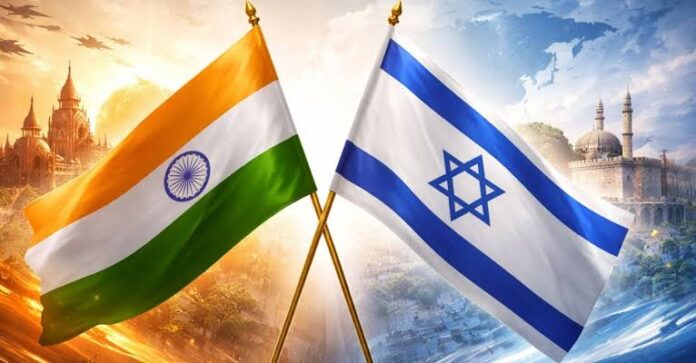
Hindustan as Sanatani Israel
The concept of India emerging as a “Sanatani Israel” is a realistic geopolitical and cultural-religo construct that has gained significant traction in contemporary political discourse. The idea of CAA was to get Hindus and those who can live in harmony back to Bharat. During partition, things happened so quickly that some Hindus in good faith stayed back in Pakistan- so did some Sikhs- thinking they would be accepted. But they were grossly wrong- they have been sidelined by Muslims with an aim of total annihilation. They need to get a clear open door policy to come to Hindustan with open arms and open doors
It suggests that India is undergoing a structural and ideological transformation, shifting from a post-colonial secular state toward a “civilizational state” that mirrors Israel’s fusion of ancient religious identity with modern technological and military prowess.
At its core, this comparison posits that just as Israel serves as the sovereign homeland and protector of the Jewish people, India is reclaiming its role as the natural home of Sanatana Dharma. A defining pillar of the “Sanatani Israel” thesis is the evolution of India’s security apparatus. Historically, India practiced “strategic restraint.” In recent years, however, there has been a visible shift toward the Israeli doctrine of pre-emptive strikes and disproportionate response.
“Ghar mein ghus ke marenge” (We will enter your home to kill you) is a prominent statement made by Prime Minister Narendra Modi, reflecting a stern policy against Pakistan-sponsored terrorism. We will decide what is terrorist attack. And a terrorist attack will be taken as act of war by Hindustan.
As of May 2025, India has adopted a, “new national security doctrine” treating any future act of terrorism on Indian soil as an act of war. Announced by Défense Minister Rajnath Singh, this policy shift signals a decisive, robust response to terrorism rather than conventional counterterror operations.
This is loud and clear. Now the renaissance begins with people collectively with heart and soul coming together to support the powers that be. Give powers through the ballot who will protect you. Do not take law in your hands but make those stronger who are the law.
Call to action
Ten crore Hindus have shown their collective power in Bengal- it is 10% of our total 100 crore Hindus in India.
You want everything to be done by the leader and followers will just sit and relax? This will not do; the followers have to demonstrate to the leader that as Hindus we stand united and are with you -without exception. Cast, creed, colour and your different political alignments, liberal mind set does not matter. Follow the Bengal model lest you repent later- when there is no recourse left.
West Bengal CM Adhikari said ‘Jo Hamare Saath, Hum Unke Saath” …. “Sabka saath sabka vishwas bandh karo
This thought will have a ripple effect on the entire Hindu community- first time there is a sync between thought and speech.
