


“Why Bharat Needs Indigenous Datalinks for Its Missiles and Defence Systems”, GoaChronicle, 2 Sep 2026.
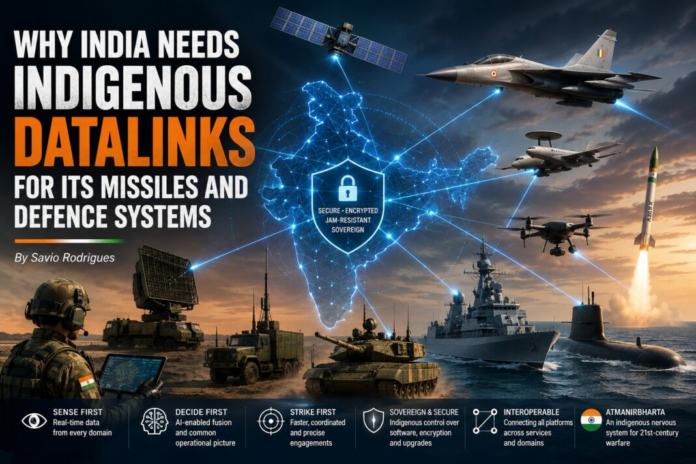
“Modern warfare is no longer simply about who has the fastest missile, the most advanced fighter aircraft or the largest number of tanks. The decisive advantage increasingly belongs to the military that can sense first, decide first and strike first. At the heart of this transformation is something that is often invisible to the public but absolutely critical on the battlefield: the military datalink.
A missile can have a sophisticated seeker, a fighter can carry an advanced radar and a warship can possess powerful sensors. When they securely exchange information in real time, their effectiveness dramatically rises. This is why India must treat indigenous military datalinks as a strategic capability—not merely another communications project.
India’s defence modernisation is taking place at an extraordinary scale. The Union Budget 2026–27 allocated ₹7.85 lakh crore to defence, with ₹1.39 lakh crore earmarked for procurement from domestic defence industries. Around 75% of the capital acquisition budget has been reserved for domestic industry. But true Atmanirbharta cannot stop at manufacturing missiles, aircraft, ships and drones. India must own the digital nervous system connecting these weapons.
A missile does not exist in isolation. Consider a modern air-defence environment. A satellite, ground-based radar, airborne early-warning aircraft, fighter aircraft or naval sensor may detect a threat. That information has to move rapidly through a command-and-control architecture, be authenticated, processed and then passed to the appropriate weapon system. The weapon may then require updates during an engagement. The faster and more securely this information moves, the greater the probability of a successful interception or strike…………………………..”
Read the full article at GoaChronicle.
