


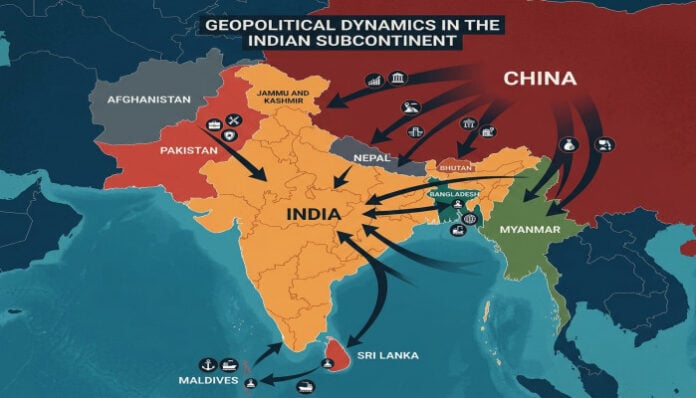
“China’s Threats to the Indian Subcontinent”, My Ind Maker, July 06, 2026
“China’s strategy for the Indian subcontinent is a multi-dimensional, structurally embedded challenge rather than a conventional military threat. It is a carefully crafted combination of economic statecraft, investments in infrastructure, political influence operations, military collaborations, and intelligence penetrations. China has systematically increased its level of leverage over the Indian subcontinent. These approaches effectively leverage asymmetries in economic capacity, governance weaknesses, or security dependencies in order to shape the domestic decision-making and international alignment decisions of smaller states within the region. However, the general and particular threats to the Indian subcontinent which emanate from China are related to the gradual onslaught of loss of strategic autonomy and sovereignty of the subcontinent and its states, developing overall economic and technological interdependence, and developing dual-use infrastructure with possible background intelligence and military application and intent. Therefore, China’s policies and strategies within the subcontinent have become a long-term strategic challenge with highly significant implications within South Asia’s overall future strategic order and framework of stability and overall supranational and regional security.
Area-wise Threat Assessment
The nature and level of China’s threat to the countries of the Indian subcontinent vary in accordance with the strategic position, economic vulnerability, and internal politics of each realm. China’s strategy is the same throughout—with economic incentives, infrastructure, military partnerships, and politics. However, the end results vary in each country from a strategy of dependency and loss of sovereignty in smaller countries to military and intelligence challenges. Therefore, the analysis of each country is key to understanding specific threats posed by China and their impact on the overall strategic scenario of the region.
North-Western Himalayas
For both India and other countries, China’s threat is overt and structural, spanning military, strategic, economic, and technological spheres. China’s aggressive stance along the Line of Actual Control, backed by its financing of infrastructure development along the borders, mobilisation of forces, and undertakings through grey zone operations, has radically transformed the military security scenario along the borders. In Pakistan, China’s threat is mostly implicit, in the form of deepening strategic and economic dependency rather than overt coercion. Recently, the growing number of Chinese security forces and the indirect use of PLA-related entities to secure CPEC-related infrastructure have come to be seen as a source of internal tension. The growing number of these forces, especially in the province of Balochistan, has further heightened internal tensions with locals who increasingly view China’s investment as exploitative and alien. The continued targeted attacks on Chinese nationals and infrastructure have further increased Chinese security force engagement, further clouding Pakistani sovereignty over internal security. Looking further down the road, the continued use of PLA-related forces and intelligence will increasingly turn Pakistan from a strategic partner into a kind of security client state, further fueling internal alienation in Balochistan……..”
Read full article at myind.net
