


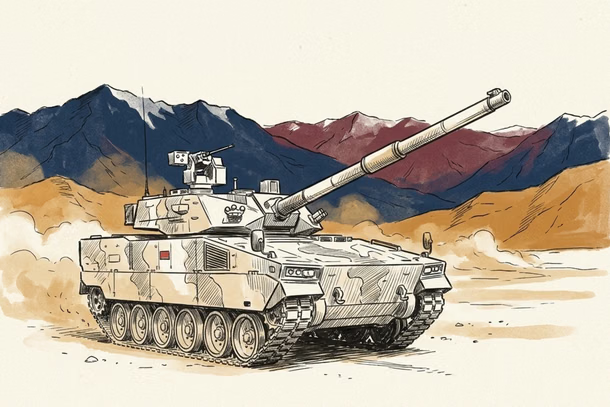
“Bharat Built a Tank Light Enough for the Himalayas. Now the Army Wants It Heavier.”, Swarajya, 21 Sep 2026.
“Twenty-five tonnes and tested above 4,200 metres in Ladakh, the Zorawar is nearly there. But the Army now wants heavier armour to stop 30mm rounds, which the Belgian turret cannot take. Induction now stands delayed to 2028-29.
In February 2021, Indian and Chinese tanks started rolling back from the heights of the Kailash Range. Indian tanks had been deployed in August 2020 to preemptively occupy the dominating heights on the Kailash Range, just south of Pangong Tso. It was territory that India had not held since withdrawing under fire in 1962. The Chinese followed suit a few hours later, sending their own tanks and armoured personnel carriers. At one point, Indian and Chinese tanks were barely a few hundred metres apart, and a small miscalculation could have triggered a major conflict.
A conflict was averted as tanks withdrew and disengagement at other friction points like the Galwan Valley followed, but India realised it was dealing with a critical problem. The Chinese had deployed their ZTQ-15 or Type 15 tanks, purpose-built for the high-altitude, rugged terrain that exists in Tibet and Ladakh. The Indian Army, meanwhile, had to make do with the T-72s and the T-90s, tanks that weigh between 45 and 50 tonnes, making them difficult to operate in this environment. At between 33 and 36 tonnes, the Chinese Type-15 is much easier to maintain and operate at such altitudes……..”
Read the full article at Swarajya.
