


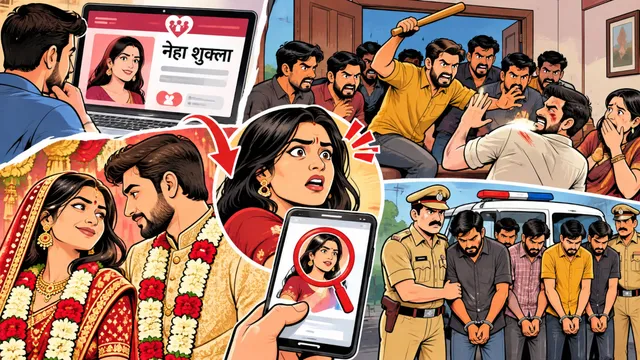
A 28-year-old Hindu youth from Kalibagan Colony in Pilibhit, Uttar Pradesh, has alleged that a woman contacted him through the matrimonial website Jaiswal Dot Com under the name “Neha Shukla,” claimed to be unmarried, and built a relationship with him on the promise of marriage. He later found that her real identity was Shabbi Wasim and that she was already married.
The complainant has said that the woman stole his property and jewellery, falsely accused him of molestation when he objected, and later came to his home with associates, assaulted him and deleted data from his mobile phone. Police have booked seven people, including the woman and named and unidentified associates reportedly from Lucknow; the FIR includes allegations of attempt to murder, house-trespass and assault. Inspector Harinagar Pal has been assigned the investigation.
Hindu identity allegation
The specific issue at the centre of the complaint is the alleged use of a Hindu name and unmarried status to gain entry into a Hindu family’s marriage discussions. The complainant says the accused presented herself as “Neha Shukla,” a name and identity that would naturally inspire trust in a Hindu matrimonial setting, while allegedly concealing her actual name and prior marriage.
For Hindu families, marriage is a sacred sanskara and a union of families, not merely an online acquaintance. If investigation establishes that a false Hindu identity was deliberately used to exploit that trust, it would represent an especially serious form of deception: appropriation of a community identity to gain access to a family, its home and its marriage plans.
Why it is serious
The allegation is not simply that a relationship failed. It is that a person may have used a fabricated Hindu identity to create emotional trust, then allegedly exploited that trust through theft, false allegations, home intrusion and violence.
Such a case, if proved, shows why identity verification on matrimonial platforms cannot be treated as a formality. A Hindu family seeking a match has a legitimate right to know the true name, religion, marital status and family background of the person being considered.
Why this case is different
This case is being discussed as an example in which the victim is a Hindu boy, rather than the more commonly reported pattern in which a Hindu girl is targeted through a false identity or promise of marriage. That distinction matters because it demonstrates that grooming, impersonation and matrimonial fraud can affect young men as well, particularly when they are emotionally invested in a marriage proposal.
