


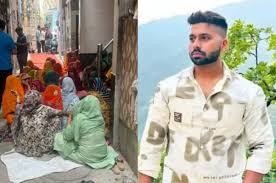
A 26-year-old SC Hindu man, Tarun Khatik, was recently beaten to death in Delhi allegedly by Muslim neighbours after a minor Holi-related dispute, raising serious questions about targeted communal violence and how quickly such incidents are normalised or underplayed in wider discourse. This climate sits uneasily alongside a media–corporate narrative that often portrays Hindus as oppressors and Muslims as perpetual victims, as seen in the controversial Surf Excel Holi advertisement and its framing of Holi and namaz.
The Delhi case: what happened
According to reports, 26-year-old Hindu youth Tarun Khatik from Uttam Nagar, Delhi, was attacked on Holi after an 11-year-old child accidentally splashed coloured water on a Muslim woman while playing. Following this, a group of men from the Muslim neighbourhood allegedly assaulted Tarun with sticks and sharp weapons, leading to grievous injuries from which he succumbed.
News reports state that the attack occurred near Tarun’s residence and that he was targeted after he intervened or was identified in connection with the Holi colour incident. Police have reportedly arrested four accused and registered a murder case, and CCTV footage is being used to identify all participants in the assault.
This killing is not an isolated event; rather, it fits into a disturbing pattern of attacks where Hindus, often from weaker backgrounds, are assaulted or killed after small disputes with neighbours from another community. In April 2025, for example, a 17-year-old Hindu boy named Kunal was stabbed to death in Delhi’s Seelampur allegedly by a local Islamist gang with Muslim members, after earlier tensions in the area. Similarly, in December 2024, two Hindu brothers, Pradeep and later Manoj, were murdered within six months in Naraina, Delhi, allegedly by members of a Muslim family, with one killing reportedly linked to a dispute over a Hindu girl’s relationship with a Muslim youth.
Victimhood narratives and selective outrage
Despite the gravity of such crimes, the broader ecosystem of “human rights” commentary and Islamist-aligned voices rarely foregrounds these cases as emblematic of targeted communal violence against Hindus. Coverage in many mainstream outlets tends to strip the incidents of their ideological dimension, presenting them as local disputes or “clashes,” while the religious identity of perpetrators and victims becomes muted or framed as irrelevant.
At the same time, when Muslims face discrimination or violence, the same ecosystem rightly emphasises systemic bias but often extrapolates individual cases into sweeping narratives of majoritarian oppression. The asymmetry lies not in acknowledging Muslim suffering—which is necessary—but in refusing to apply the same lens when Hindus are targeted by Muslim groups, as appears to have happened in the Tarun and Kunal cases.
Islamist and fellow-traveller narratives frequently insist that Muslims are under siege from an oppressive Hindu majority, yet they are largely silent when Hindus are forced into de facto exodus from localities after repeated attacks. In Seelampur, for instance, Hindu residents reportedly began putting up “This house is for sale” and “Hindu exodus” signs after Kunal’s killing, openly stating they no longer felt safe living among a dominant, politically connected Muslim gang. That kind of demographic pressure and fear is rarely recognised as persecution when Hindus are at the receiving end.
This selective outrage allows a convenient narrative: Muslims are always potential victims of Hindu aggression, while cases where Muslims are accused of aggression against Hindus are treated as aberrations or “law-and-order issues,” never as part of a systemic problem. The result is a public discourse where one community’s pain is amplified and moralised, while another’s is relativised and quickly forgotten.
Holi, “oppression,” and the Surf Excel ad
This double standard is mirrored in the cultural realm, including advertising and popular media. In 2019, Surf Excel released a Holi-themed ad under the “Rang Laaye Sang” campaign, which showed a Hindu girl bravely riding her cycle through Holi colours to protect the white clothes of her Muslim friend who needed to reach the mosque for namaz. The creative idea, according to the brand and some commentators, was to promote Hindu–Muslim harmony and children’s innocence.
However, many viewers critiqued the ad as subtly denigrating Holi and normalising a hierarchy where Hindu festivities are subordinate to Islamic prayer. Critics pointed out that Holi colours were repeatedly framed as “daag” (stains), while namaz and the Muslim boy’s pristine white kurta-pyjama symbolised purity and higher moral value. The Hindu girl’s role, they argued, was essentially that of a protective shield absorbing the “polluting” impact of Holi so that the Muslim friend could reach his religious obligation unsullied.
This framing dovetails with a broader trend among Islamist and “progressive” commentators who portray Hindu festivals as spaces of noise, pollution, harassment, or upper-caste oppression, rather than as legitimate cultural and religious expressions. Each year, a predictable cycle unfolds: campaigns against Holi colours and water waste, against Diwali firecrackers, against Kanwar Yatra processions, with a disproportionately moralising spotlight directed at Hindu practices. By contrast, equivalent scrutiny of Muslim religious practices—from loudspeakers for azan to road-blocking congregational prayers or mass animal sacrifice—tends to be framed as “criminalisation of Muslim identity” when challenged.
What angered many about the Surf Excel ad was not the idea of interfaith friendship, but that the visual language encoded Holi as messy and problematic while namaz appeared as the serene, superior practice that must be protected. In effect, the “good Hindu” child is the one who sacrifices her own festival so that the Muslim child’s ritual can remain untouched, reinforcing the idea that Hindu culture must constantly adjust and step back to avoid offending Muslim sensibilities.
Connecting culture and street violence
The killing of the Hindu youth in Delhi following a Holi-colour incident takes on a darker resonance against this cultural backdrop. In the Tarun case, initial accounts suggest that a playful Holi splash on a Muslim woman escalated into collective violence by Muslim men, resulting in the fatal assault. In the popular imagination, however, Holi is already being problematised as an inherently oppressive or harassing festival, particularly when Hindus play it near Muslim households, thanks in part to narratives amplified by ads, editorial pieces, and activist commentary.
When a festival is repeatedly framed as a site of “majoritarian aggression,” it becomes easier to morally rationalise harsh reactions against Hindus who celebrate it, even for minor or accidental acts like a misdirected water balloon. Conversely, when Muslim religious sensitivities are always placed at the top of the moral hierarchy, any perceived slight can be interpreted as grave provocation. The Delhi killing, then, is not just an isolated crime but a symptom of a broader discursive imbalance in which the majority’s traditions are delegitimised while a minority’s sentiments are sacralised.
This is where the hypocrisy of Islamist and fellow-traveller discourse is most visible. Those who denounced the Surf Excel boycott as “Hindu majoritarian intolerance” had little to say when Hindus in parts of Delhi expressed fear, protests, and even spoke of exodus after repeated attacks from Islamist gangs. When Hindus feel unsafe in areas like Seelampur or Naraina, their anxiety is often dismissed as communal paranoia; yet even localised violence against Muslims is rapidly scaled up as evidence of a nationwide “pogrom atmosphere.”
The recurring pattern—from Kunal’s murder in Seelampur to the killings of Pradeep and Manoj in Naraina, and now Tarun in Uttam Nagar—suggests that certain pockets of the capital have become zones where Hindu lives, especially of the poor and SCs, are precarious when caught in conflict with entrenched Muslim groups. The silence or euphemistic reporting of these realities by many who otherwise speak relentlessly about “marginalised voices” is itself a form of complicity.
Towards honest acknowledgment
An honest public conversation on communal violence must reject all one-sided victimhood myths. It should be possible to acknowledge discrimination and violence against Muslims, and simultaneously recognise that Hindus—including SC and lower-income Hindus—are victims of brutal attacks by Muslims, as in recent Delhi cases. It should also be possible to critique culturally loaded advertising or media narratives that subtly denigrate Hindu festivals while casting Islamic practices as morally superior, without being labelled “bigoted” for doing so.
Justice for victims like Tarun, Kunal, and the Naraina brothers requires more than police action and trials; it requires a cultural shift where Hindu suffering is not brushed under the carpet because it complicates a preferred ideological story. If the same voices who aggressively champion “minority rights” cannot unequivocally condemn and highlight murders of SC Hindus by Muslim neighbours, their moral posture stands exposed as selective and fundamentally political rather than rooted in universal human rights.
