


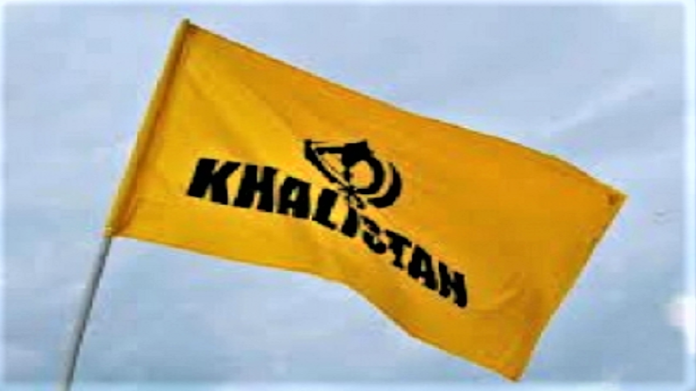
This is a compilation of the heinous crimes committed against Hindus by Khalistani terrorists. This compilation has been obtained from various sources, primarily from the X handle Arya Anviksa and Punjab Files who have put in great effort in documenting each of them. While this is not an exhaustive compilation, we have tried to compile as many instances in the past few decades.
1990s
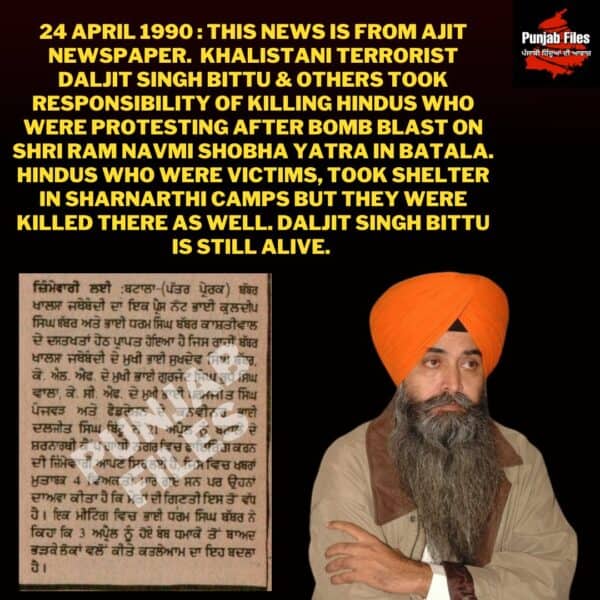
On 24 April 1990, the Ajit newspaper reported that Khalistani terrorist Daljit Singh Bittu, along with others, claimed responsibility for the targeted killings of Hindu individuals who were protesting following a bomb blast during the Shri Ram Navami procession in Batala. It was observed that, much like modern-day gangsters using social media, militants at that time were utilizing newspapers and other media outlets to communicate their actions. Many of the Hindu victims sought refuge in shelters for displaced persons, yet, even in these vulnerable conditions, they faced continued attacks. Terrorists openly claimed responsibility for these incidents. Notably, Daljit Singh Bittu remains alive.
Abohar Goli Kaand massacre
On March 7, 1990, the Abohar massacre unfolded in Punjab, with Khalistan Commando Force (KCF) militants attacking civilians in a crowded marketplace. The terrorists fired indiscriminately, killing 22 people on the spot and injuring many more. In a tragic turn, 45-year-old Gobind Narang, a garment vendor, bled to death after hiding in a shop that remained locked. The attackers fled, and even though the nearby police station was alerted, its gates stayed shut for over 40 minutes, leaving residents helpless.
Amid the chaos, locals used carts to transport the injured to the Civil Hospital, which was overwhelmed and under-resourced. Subsequent bomb blasts intensified the carnage, ultimately claiming around 45 lives. Community anger peaked, and a protest erupted days later, during which police fired on the crowd, killing two more youths. In 1993, DSP Surjit Singh Grewal brought Chanan Singh, the mastermind behind the massacre, to justice through an undercover operation.
Much of the massacre’s details were documented by freedom fighter Mathura Das Hiteshi in his book Itihas Ke Jharokhe Se Abohar, preserving the memories and horrors of the event for future generations.
1980s
The 1980s probably saw one of the worst phase for the country. This period also saw the worst of them – the anti-Sikh riots. Let’s take a look at each of the incidents in this decade.
In the 1980s, Khalistani extremists issued dire threats to Hindus in Punjab, compelling many to flee or face violence. Tragically, numerous individuals lost their lives, while others sought refuge in camps. Astonishingly, supporters of the radical movement persisted in portraying themselves as victims during that time.
Even today, Khalistani elements continue to openly intimidate Hindus of Indian origin residing in Canada. Curiously, their sympathizers within India often adopt a victimhood narrative, claiming that their entire community feels unsafe.
Regrettably, there has been a noticeable absence of voices saying, “I oppose radicals and stand with my Hindu brothers.” The attached photo serves as just one example of the approximately 1.5 lakh Punjabi Hindu refugees who sought sanctuary in Delhi’s Piragarhi camp following the genocidal threats and targeted violence against Hindus by radical Khalistani Sikhs.
These Hindus were forced to abandon their homes and possessions in search of safety in Delhi. The untold story of these individuals, who became refugees within their own country due to Khalistani extremism, underscores the need to challenge the “attack Hindus but play the victim when confronted” mindset that persists.
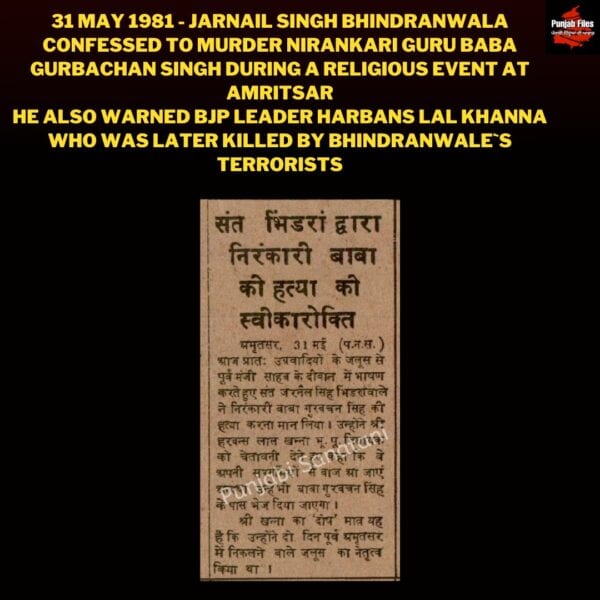
On May 31, 1981, Jarnail Singh Bhindranwale openly confessed to the murder of Nirankari Guru Baba Gurbachan Singh during a religious event in Amritsar. He also issued a warning to BJP leader Harbans Lal Khanna, who was later killed by Bhindranwale’s followers.
Jalandhar Market Firing
On this day, September 20, 1981, a tragic event unfolded in Jalandhar when Khalistani extremists opened fire in a market. Their actions resulted in the loss of four innocent Hindu lives and left twelve others injured. This horrifying act of violence was a direct response to the arrest of the terrorist leader Bhindranwale by the police.
Following this incident, a disturbing chain of targeted killings of Hindus and bombings ensued, leading to Bhindranwale’s release just 25 days later. The Akali Dal openly declared their support for Bhindranwale during this period. It’s worth noting that Bhindranwale had been arrested in connection with the murder of Freedom Fighter Lala Jagat Narain, who was the proprietor of the Hind Samachar Group.
Upon his release, Bhindranwale made a public statement expressing admiration for the perpetrators of Lala Jagat Narain’s and the Nirankari Chief’s murders. He even went as far as to suggest that those responsible should be honored by Akal Takht, stating that if the killers were to approach him, he would reward them with gold.
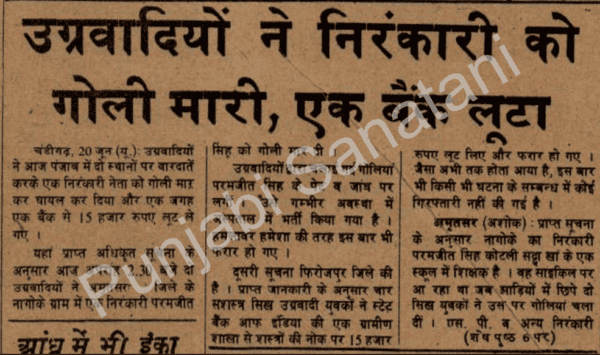
On June 20, 1983, militants launched attacks in two different locations in Punjab, targeting a Nirankari leader and carrying out a bank robbery. In Nagoke village, Amritsar district, two militants shot Nirankari leader Paramjit Singh, hitting him in the abdomen and thigh. Singh, a teacher at a school in Kotli Satta Khan, was traveling by bicycle when he was ambushed by two armed men concealed in the bushes. He is now in critical condition in the hospital, while the attackers remain at large.
In a separate incident in Ferozepur district, four armed Sikh militants robbed a rural branch of the State Bank of India, seizing 15,000 rupees at gunpoint before fleeing. No arrests have been reported in connection with either incident.

1984 Anti-Sikh Riots
Balwant Singh was responsible for a significant loss of lives, with an estimated 1000 casualties attributed to his actions. Similarly, Malkiat S., Sukhwinder S., and Swaran S. each caused substantial harm, resulting in 1000, 500, and 700 fatalities, respectively.
Collectively, these four individuals associated with Khalistani extremism were responsible for a tragic toll of 3200 innocent lives lost. It is essential that we Hindus acknowledge the gravity of these events. However, it is equally important to remember that discussing “350 people” may not fully capture the extent of the devastation.

On October 4, 1984, Khalistani terrorists attacked children performing Ramlila, detonating bombs in the midst of a crowd of devotees gathered to watch the event. The explosion claimed the lives of two people, including an 8-year-old child, and left 36 others with burn injuries. Thirteen of the injured were reported to be in critical condition.

On January 7, 1987, a handmade bomb was thrown at devotees performing kirtan at the Guga Maadi Temple in Sector 20, Chandigarh, during prayer time. Fortunately, the bomb did not detonate. Taking advantage of the darkness, the terrorists managed to escape.

Lalru Bus Massacre – 1987
On July 7, 1987, (36 years ago), a tragic event known as the Lalru Bus Massacre occurred. A group of innocent Hindu passengers, who were on a journey from Chandigarh to Rishikesh to partake in a sacred ritual, became victims of a brutal attack solely because of their religious identity. This horrifying incident unfolded around 10-11 PM of that fateful day when members of the Khalistani Commando Force (KCF) mercilessly opened fire inside the bus, resulting in the senseless killing of 40 innocent Hindus and causing injuries to more than 30 others.
Within just 24 hours, over 72 individuals lost their lives in two separate bus attacks. These Khalistani gunmen, before carrying out these heinous acts, forced their victims to chant “Sat Naam Wahe Guru.” Amid this terrifying ordeal, only one passenger, Kalawati, managed to escape by bravely jumping out of the bus while clutching her three small children. The police arrived at the scene more than an hour later, sparing Hari Singh, the driver and the only Sikh on the bus.
Video & Images Source: Arya Anviksha
Among the victims, there were 11 Hindu women and 3 children who tragically lost their lives. Some families experienced the devastating loss of their entire kin in this massacre. Usha, a Hindu woman, had to endure the heartbreak of losing eight family members, including her father, mother, and two brothers.


On July 8, Khalistani terrorists struck once again, attacking another bus in Fatehabad, Haryana, resulting in the deaths of 34 Hindus and leaving many others injured. In response to this horrific incident, the Haryana government temporarily suspended all bus services in the state.
What adds to the pain of this tragedy is the fact that the “Mastermind of the Lalru Bus Massacre,” Kulwinder Singh Malhi, responsible for the deaths of 40 innocent Hindus, is portrayed as a “Sikh Martyr” on the wall of the langar hall at the Gurudwara in Malton, Toronto.

The individuals behind these cold-blooded killings were identified as Satnam Singh Bawa, Manjit Singh alias Manju, and Gurmeet Singh alias Tonny, all of whom were in their thirties and affiliated with the terrorist leader Harjinder Singh Jinda of KCF.
Going on to the next massacre – On December 31, 1987, terrorists killed six innocent people, including a widow. Late at night, six armed men entered a village and targeted homes belonging to a religious minority. Among the victims were two brothers, Mela Ram and Mulkhraj, as well as Ajit Lal and Sarwan Kumar.

On January 31, 1988, two policemen were injured in a shooting incident. Terrorists killed shopkeepers Chaman Lal, Narendra Singh, and Teja Singh. In another targeted attack on Brahmins, Vijay Kumar and Vikas Kumar lost their lives. Militants also killed Diwan Chand and his grandson, Pawan Kumar.

Killing of Babu Hitabilashi by Khalistani terrorists
On September 19, 1988, a tragic incident unfolded in broad daylight in Chandigarh, marking a dark day in history. Babu Hitabhilashi, the President of the Punjab unit, fell victim to the violence perpetrated by Khalistani terrorists.
His only “crime” was advocating for Hindu-Sikh unity and openly criticizing Khalistani extremism. During those turbulent times, Abhilashi Ji courageously traversed the state, tirelessly working to restore peace.
Today, we remember and pay our respects to the memory of Babu Hitambhilasi Ji. On that fateful day, at approximately 11 a.m., while on his way from the party office in Sector 11, Chandigarh, to assist a party worker, he was ambushed by Khalistani terrorists. They unleashed a hail of gunfire in an attempt to silence his voice, tragically claiming his life.
Babu Hitambhilasi devoted himself to serving the people until his very last breath, leaving behind a legacy of unwavering commitment and courage.
Tragic Attack on Thapar Engineering College (1989)
During the peak of terrorism in Punjab, on November 10, 1989, Khalistani Sikh terrorists carried out a brutal attack at Thapar Engineering College in Patiala, Punjab. This horrifying incident claimed the lives of 19 students who were asleep in a hostel. The assailants infiltrated the campus, entered student rooms, and indiscriminately fired Chinese-made AK-47 assault rifles. The victims were students from NIT Kurukshetra University and Chandra Shekhar Azad Agriculture University, mostly Hindus. Shockingly, then-Prime Minister Rajiv Gandhi made no public statement regarding the incident, which occurred just hours before his visit to Chandigarh.
Bhindranwale and his crimes
Bhindranwale is regarded as a martyr and saint by his followers, with his crimes often downplayed or even whitewashed by those who seek to normalize the presence of weapons at Gurdwaras worldwide. They argue that armed Sikhs can commonly be found at Gurdwaras and that these individuals never harmed Sikhs or engaged in any form of genocide.
However, the reality is that Bhindranwale transformed Gurdwaras into private strongholds, where he propagated hatred and violence, leading to the tragic loss of innocent lives. During Operation Bluestar in June 1984, security forces discovered heavy weapons and ammunition in the possession of Khalistani terrorists.
The question naturally arises: why would anyone keep weaponry, including a grenade-making machine, bombs, and AK-47s, within their religious place? In truth, Bhindranwale misused the sanctity of the “Langar” to spread hateful messages against India and Hindus.
This is why we often witness numerous Khalistani supporters resorting to using “We feed you Langar” rhetoric as a means to demean Hindus. It is essential to acknowledge the misuse of religious spaces for promoting violence and to encourage dialogue that promotes understanding and peace among all communities.
Hardeep Singh Nijjar
Hardeep Singh Nijjar recently made headlines due to comments by Canadian Prime Minister Trudeau, alleging Indian government involvement in the death of a “Canadian citizen” on Canadian soil, which he deemed “concerning and unacceptable.” Here’s a closer look at Nijjar’s background:
Hardeep Singh Nijjar was associated with Khalistani terrorism. If blame is placed on India for Nijjar’s demise, then the Canadian government must also be held accountable for the actions of terrorist Hardeep Singh Nijjar on Indian territory.
Here are some key incidents involving Nijjar:
- In 2010, Nijjar was linked to an explosion near the Satya Narayan temple in Patiala.
- In 2015, an FIR (First Information Report) was filed against him for allegedly conspiring to assassinate religious leaders.
- In 2016, he was reportedly involved in organizing a training camp for Khalistani extremists in Canada aimed at activities against India.
- In 2021, Hardeep Singh Nijjar was wanted by India’s National Investigation Agency (NIA) in connection with the killing of Hindu priest Kamaldeep Sharma in Jalandhar, Punjab. He was one of the four individuals named in the charge sheet.
Khalistani terrorist Seetal Singh Mattewal
Seetal Singh Mattewal was a Khalistani terrorist whose group was responsible for the tragic killing of 20 Hindus and the subsequent mass migration of Hindus from the village of Mattewal, located in Baba Bakala tehsil, Amritsar, Punjab.
In the year 1985, nearly all Hindu families, except for one impoverished family, were compelled to leave the village due to the pervasive terrorism. Some Hindu families, in the hope of returning one day, locked their houses and businesses behind.
What is noteworthy in this context is that the individuals who joined hands with Mattewal in perpetrating terrorism and driving Hindus from their homes were Arora Sikhs. However, following the demise of Seetal Singh Mattewal, Dilbagh Singh, and other Jat Sikhs began to harass these Arora Sikhs, ultimately causing them to relocate to Amritsar.
It serves as a cautionary tale that should be heeded by any Arora or Khatri Sikh contemplating aligning with Khalistani Jat Sikhs. The lesson is clear: those who have shown a propensity for violence against one group can easily turn against others, emphasizing the need to reject caste-based divisions and promote unity. Even in villages like Mattewal and Naushehra Pannuan, where Hindus constituted a minority, they were still compelled to leave, highlighting the tragic consequences of such divisions and extremism.
Other notable incidents of Khalistani terrorism
Moga Massacre (1989): Khalistani terrorists opened fire on RSS workers during their daily shakha in Punjab’s Moga district, killing 25 Swayamsevaks and injuring 35 others. A subsequent bomb explosion in the park claimed additional lives, highlighting the violence that pervaded the region.
Abohar Goli Kaand (1990): Khalistan Commando Force (KCF) terrorists unleashed a deadly attack in Abohar, Punjab. The attackers stormed a trade center, indiscriminately firing semiautomatic rifles. The resulting tragedy claimed the lives of approximately 45 people, as both gunfire and bomb blasts created a horrifying scene of violence and chaos.
1970s – the 1978 massacre
In Amritsar, on April 13, 1978, a violent clash between the followers of Sant Bhindranwala and the Nirankaris near Sports Stadium resulted in the tragic loss of seventeen lives and left more than 100 individuals injured. The confrontation escalated with the use of firearms, sharp-edged weapons, lathis, and brickbats, until the police intervened by firing warning shots and deploying teargas shells to separate the conflicting groups. Over 70 victims, many of whom suffered from gunshot wounds and sharp-edged weapon injuries, were admitted to S.G.T.B Hospital by evening.
Among the casualties, thirteen were individuals dressed in Nihang robes or adorned with Sikh symbols, while three belonged to the Nirankari sect. Approximately twenty of the injured were in critical condition.
The turmoil erupted shortly after a large procession of Nirankaris peacefully concluded its route through the city around 11:30 a.m., culminating at the “B” Block Railway Colony grounds where they were observing their “Manav Ekta Sammelan Day.”
