


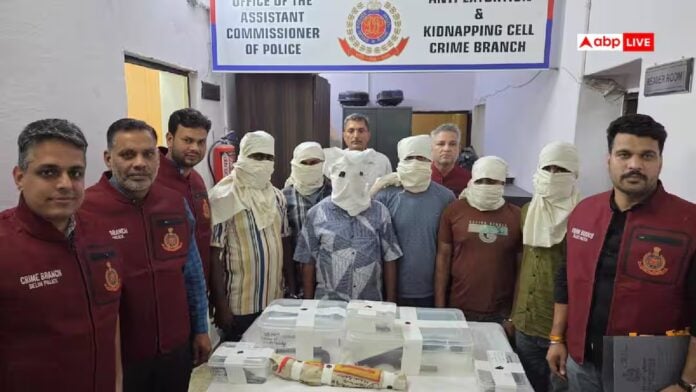
In a high‑stakes operation late on the night of 14 April 2026, Delhi Police Crime Branch personnel engaged in a brief but intense encounter with a Bangladesh‑based dacoit gang near Sarai Kale Khan in South‑East Delhi, arresting six suspected foreign nationals and foiling what police describe as a major planned robbery in South Delhi. The operation has exposed a cross‑border crime network that allegedly carried out violent robberies and murders across multiple Bharatiya states, including Delhi, Goa, Karnataka, Uttar Pradesh, Odisha and Kerala, before repeatedly fleeing back to Bangladesh to evade arrest.
The Encounter and Immediate Arrests
According to senior officers, the Anti‑Extortion and Kidnapping Cell (AEKC) of the Delhi Police Crime Branch set up a trap near a secluded forest area close to the Sarai Kale Khan cremation ground after receiving specific intelligence that members of the gang were planning a dacoity in South Delhi. Sometime between 14 and 15 April, the suspects arrived at the location, and when the team tried to corner them, the accused opened fire, prompting a controlled retaliatory exchange. Reports indicate that although shots were fired from both sides, none of the police officers or the arrested suspects were injured.
Police managed to apprehend six Bangladeshi nationals, while two others escaped into the surrounding darkness; the search for the latter remains ongoing. The arrested men were identified as Suman Hauldhar (alias Pannu, 35), Saifful Islam (31), Sohail Sheikh (35), Mohammad Nasir (48), Noor Islam alias Nadim Khan (56) and Zakir (40), all residents of Bagerhat district in Bangladesh.
Weapons and Tools Recovered
In the aftermath of the shootout, the Delhi Police team recovered a substantial cache of illegal arms and burglary tools from the suspects. Multiple reports state that officers seized four country‑made pistols, live and spent cartridges, knives and implements used for forced entry into homes. The presence of such weapons underscores the gang’s capacity for lethal violence and suggests meticulous preparation for house‑breakings and confrontations with victims or law‑enforcement officers.
Police have declared that the operation effectively averted a serious robbery in the South Delhi area, where the suspects were reportedly scouting affluent households and senior‑citizen residents as targets. A senior official noted that the team’s planning—based on months‑long surveillance and inter‑state coordination—allowed them to intercept the gang before any actual dacoity could take place.
Nature and Pattern of the Gang’s Crimes
Authorities describe the group as a Bangladesh‑based dacoit network that has been operating for several years by exploiting porous stretches of the Bharat‑Bangladesh border. The accused are alleged to have entered Bharat illegally, often with the help of local traffickers, committed violent robberies, and then swiftly retreated to Bangladesh, remaining there for several months before re‑entering to target new locations.
Investigators say the gang specialised in striking wealthy households, particularly those occupied by elderly residents seen as vulnerable. In many cases, the suspects are believed to have gained entry late at night, tied up occupants, inflicted brutal violence, and stolen large sums of cash and gold jewellery. Reports indicate that the gang allegedly used a network of relatives and local contacts spread across states to identify potential targets, including families in Delhi, Goa, Karnataka, Uttar Pradesh and Odisha.
Extent of Alleged Cross‑Border Crimes
Preliminary investigations by the Delhi Crime Branch and linked state police agencies suggest that at least 14 cases of robbery, dacoity and murder across multiple states are linked to this gang. For example, in 2025 it is alleged that the gang stormed a home in Mapuca, Goa, beat the family members and looted about ₹35 lakh in cash and gold ornaments. Another reported incident in Goa’s capital, Panaji, involved the gang reportedly locking the family inside and stealing nearly one kilogram of gold jewellery and around ₹3 lakh in cash.
In Karnataka’s Hubballi, the gang is said to have targeted a house where elderly residents were assaulted and valuable items stolen. Earlier instances connected to the suspects include alleged murders during or after robberies, reinforcing the view that the gang was willing to commit homicide to consolidate loot and evade detection.
Intelligence and Multi‑State Coordination
The operation that led to the arrests near Sarai Kale Khan was the result of an extended intelligence drive, according to Delhi Police officials. The Crime Branch claims it had been tracking the gang’s movements for months, sharing information with Goa Police and other state forces, and slowly building a mosaic of interstate links and modus operandi. A key breakthrough came through a specific tip‑off suggesting that the gang was regrouping in South‑East Delhi and planning a fresh dacoity in South Delhi, prompting the high‑risk operation.
The Delhi Police have also highlighted that the arrested gang members reportedly avoided using mobile phones to lower their digital footprint, instead relying on word‑of‑mouth through local contacts and border‑area networks to move and coordinate. This behaviour, combined with their pattern of crossing into Bharat illegally, has made it difficult for ordinary local police to connect disparate robbery cases; the current operation is seen as a significant step toward closing those gaps.
Legal Process and Ongoing Investigation
After the encounter, an FIR was registered and the six suspects were placed under judicial custody pending detailed interrogation. Delhi police have stated that further forensic examination of the seized weapons and cross‑verification of ballistic records from past cases across states is underway in an effort to formally link the gang to specific dacoities and murders. Investigators are also probing the logistical support structure that enabled the suspects to enter Bharat, find shelter, and exit quickly after each crime, including possible roles played by local accomplices and human‑smuggling networks.
Union and Delhi‑based law‑enforcement sources have welcomed the operation as a rare, coordinated success against a transnational dacoit ring, but have also warned that the wide‑spread nature of the gang’s alleged crimes means uncovering the full tally of cases and compensating victims will be a long‑haul process. As the probe continues, the Delhi Police have reiterated that the operation underscores the need for tighter border surveillance and sustained inter‑state intelligence‑sharing to curb cross‑border crime that targets Bharat’s urban and semi‑urban populations.
