


“Mapping, Drilling, Building, Selling, Holding: The Five Tests for Bharat’s Offshore Push”, Swarajya, 24 Sep 2026.
“India has opened more of its offshore waters to oil and gas exploration in recent years and is spending Rs 84,084 crore to help companies drill there. Broadly until now there were two constraints for oil and gas exploration in the country: permission and capital. Both have now been removed.
The National Offshore Exploration Scheme will cost Rs 84,084 crore in its first phase, up to 2030-31, and what it mainly does is pay. The government will cover up to half the cost of drilling a deepwater exploration well. This takes care of the capital aspect.
The second constraint was how much offshore area companies were allowed to enter at all. Restrictions imposed for defence reasons have been lifted in stages since 2022, opening up a little over a million square kilometres of India’s offshore waters.
There is a good example to understand what could happen after a discovery and why we must try to understand oil/gas exploration in more detail than permission and capital support.
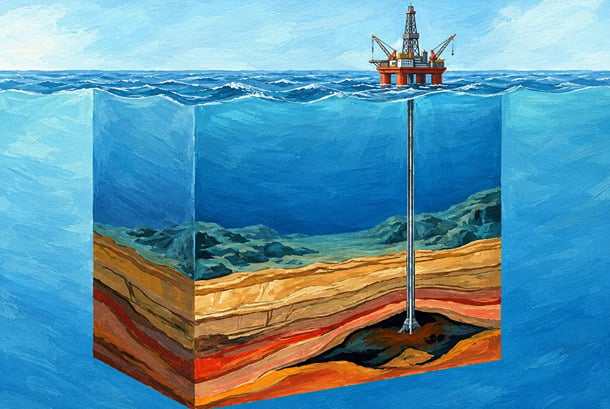
ONGC spent Rs 34,012 crore developing Cluster-2 of block KG-DWN-98/2, in water up to 3,200 metres deep off Andhra Pradesh.
Gas came first, in June 2020, and oil in January 2024.
The fields were designed to produce about 80,000 barrels a day. By November 2025 they were producing only 28,000, down from 35,000 the year before. Gas from the same cluster, once expected to reach 15 to 16 million standard cubic metres a day, is now expected to reach about 10………”
Read the full article at Swarajya.
