


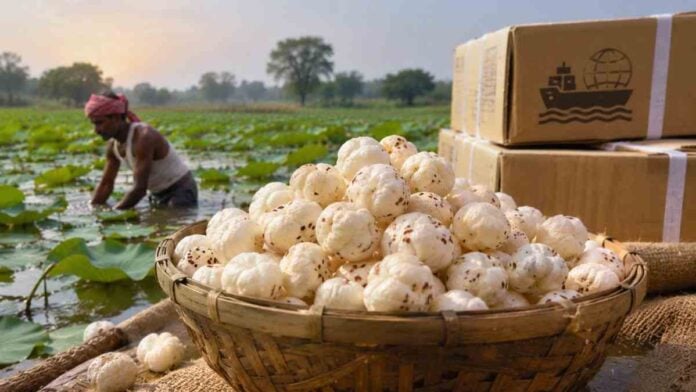
Summary: Beats in Brief, in a report by Dipanshu Chaturvedi, says Bihar's makhana (fox nut) exports reached 7,264.89 tonnes in FY 2025-26, with the US, Canada and UAE taking about 77% of shipments. The piece traces the crop's growth in Mithilanchal, Seemanchal and the Kosi belt, rising prices, the role of Mallah divers and women workers, and new central and state support such as the National Makhana Board. It also lists remaining gaps, including mechanised harvesting, common processing facilities and testing labs.
Why it matters: Makhana is a traditional Mithila crop whose rising export value shows how Bharat's farm and rural economy is finding global markets, with benefits reaching local communities and producers.
“From Mithila’s Ponds to Greek Docks: Bihar’s Makhana Ships 7,265 Tonnes to the World” — Beats in Brief, 1 Nov 2026
BIHAR: One tonne of makhana sourced from Purnea was shipped via Mundra to Piraeus Port in Greece. The consignment was small, yet it captures a larger shift. Notably, Bihar supplies between 85% and 90% of India’s makhana and India accounts for over 90% of world supply. Consequently, a crop once traded informally across Bihar’s wetlands now reaches shelves on several continents.
India exported 7,264.89 tonnes of makhana products in FY 2025-26. Earlier official estimates were about 200 tonnes a year, though broad customs codes made the trade hard to track. Notably, dedicated HS codes introduced in 2025 now give it clear visibility. Collectively, the United States, Canada and the United Arab Emirates take about 77% of shipments. Meanwhile, the United Kingdom, Australia, Greece, Saudi Arabia, Qatar and Japan add secondary markets. Additionally, tariffs help in places. Makhana enters the UAE and Australia duty-free under trade agreements and the United States charges 1.10% on plain pops. Furthermore, in Europe and the United Kingdom, makhana is moving beyond ethnic grocery stores into mainstream health food chains. Moreover, demand rests on plant-based, gluten-free snacking, with makhana offering high protein and a low glycemic index.
Bihar’s base is broad. Cultivation across Mithilanchal, Seemanchal and the Kosi belt covers 35,224 hectares. Area grew about 171% between FY 2012-13 and FY 2021-22, from roughly 13,000 hectares. Similarly, popped output rose 152% over the same period to 23,656 tonnes. Meanwhile, national output reached 63,910 tonnes in FY 2024-25, with second advance estimates for FY 2025-26 at 80,590 tonnes. Notably, field cultivation in shallow lowland paddies now accounts for roughly 35% of production. Fields yield 2.6 to 3.0 tonnes of seed a hectare against 1.8 to 2.0 in ponds. They also allow rotations such as makhana, rice and wheat. Encouragingly, the Sabour Makhana-1 variety gives 32 to 35 quintals a hectare with pop recovery of 55% to 60%. Katihar and Purnea lead output, while Darbhanga hosts the ICAR research centre for makhana…
Read the full article at Beats in Brief →
