


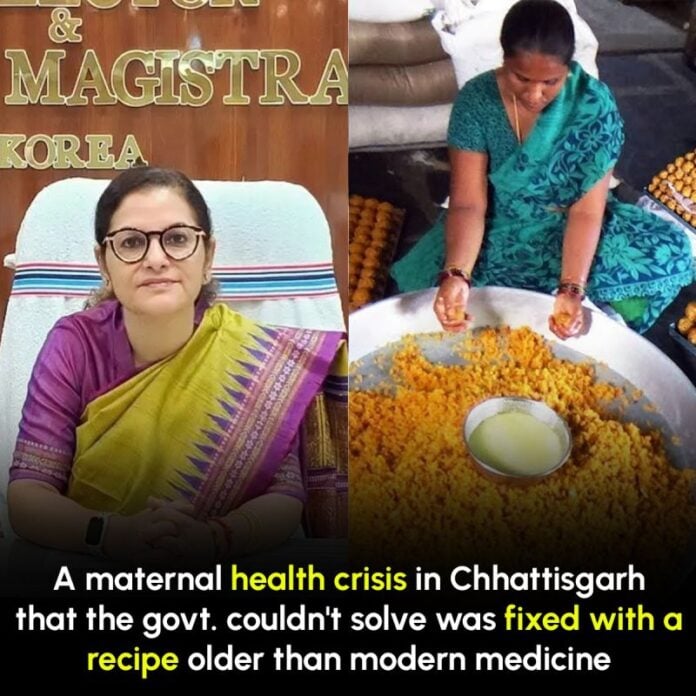
In the remote tribal district of Korea in Chhattisgarh, a crisis of low birth weight and maternal anaemia has been dramatically reversed through a locally designed “Modak Laddu” initiative led by District Collector Chandan Sanjay Tripathi, a 2016-batch IAS officer of the Chhattisgarh cadre. Until early 2025, nearly 20 percent of children in the district were being born under 2.5 kg, a level that public health experts classify as extremely high and indicative of entrenched malnutrition among mothers and newborns.
By February 2026, the district administration reports that the proportion of low birth weight (LBW) babies has dropped to around 3.33 percent, with fluctuations between 3 and 5 percent linked mainly to deliveries taking place outside the district. Parallel accounts from public platforms describe the change as a 57 percent reduction in low birth weight cases, underscoring the scale of turnaround achieved in barely a year.
The Scale of the Problem: One In Five Babies Underweight
When Ms Tripathi took stock of the situation in early 2025, the data told a grim story: about one out of every five babies in Korea district was being born underweight, translating to an LBW rate of nearly 20 percent. Underweight newborns face higher risks of infections, impaired immunity, developmental delays and even mortality, while their mothers in Korea’s tribal belt were frequently anaemic and nutritionally deprived during pregnancy.
Officials also flagged that Korea’s Baikunthpur block had an LBW rate of around 22 percent, serious enough for it to be listed as an Aspirational Block where reducing low birth weight became a key administrative priority. Ground surveys revealed that standard iron and folic acid supplementation programs were not achieving desired results because many women either skipped tablets or did not complete prescribed courses.
Designing A Food-Based Intervention: The Modak Laddu
In February 2025, after consultations with dietitians and nutrition experts, the district administration opted for a food-based intervention instead of a purely pharmaceutical one. The strategy was to convert “medicine” into a meal using ingredients already familiar in village kitchens, thereby eliminating both cultural resistance and supply-chain complexity.
The Korea Modak Laddu was formulated as a 20-gram, nutrient-dense ball using:
- Ragi (finger millet), rich in calcium and iron and locally grown in the region.
- Groundnuts, providing protein and healthy fats.
- Jaggery, contributing iron and energy, and serving as a natural sweetener.
- Sesame seeds, for healthy fats, calcium and micronutrients.
- Cardamom, for flavour and acceptability.
Reports further note the use of other traditional grains like bajra, sattu, and besan, along with desi ghee, to tailor laddus to local taste and seasonal needs, especially in earlier phases of the pilot. Pregnant women are advised to consume two such laddus daily from the sixth month of pregnancy, alongside iron supplements from the fifth month, creating a combined regimen of micronutrient tablets and fortified traditional food.
Community-Led Implementation: Poshan Sangwari At The Doorstep
Recognising that merely distributing supplements would not guarantee consumption, the district built the initiative around community ownership and behavioural change. Women from Self-Help Groups (SHGs) in each village were identified and trained as “Poshan Sangwari” – nutrition companions responsible for monitoring both laddoo intake and overall diet.
These Poshan Sangwari visit pregnant women twice a day, morning and evening, to ensure they actually eat the laddus and consume a full home-cooked meal consisting of dal, rice, roti and vegetables, with the laddoo serving as a supplement rather than a replacement. In the words of the Collector, tablets are often discarded, but food, especially a culturally familiar sweet, is eaten; the initiative banks on this behavioural insight.
Currently, around 2,000 pregnant women in Korea district are covered under this daily monitoring and supplementation system, creating a dense, last-mile network of community-driven nutrition surveillance. These interactions are also used to counsel families on maternal nutrition, birth spacing, and the link between feeding the mother and preventing child malnutrition and mortality.
Production Hub: 10,000 Laddus A Day
At the heart of the initiative is a production unit run by about 25 SHG women in Aani Gram Panchayat, located near the district Collectorate. A dedicated work shed has been constructed to ensure hygienic and efficient large-scale preparation of the Modak Laddus.
Every day, the unit rolls out nearly 10,000 laddus, which are sent to Anganwadi centres and then distributed to Poshan Sangwari volunteers across all blocks of the district. This centralised production with decentralised distribution allows uniform quality control while keeping last-mile delivery community-led and personalised. The entire project is funded through the District Mineral Fund (DMF), leveraging Korea’s status as a mineral-bearing area and Baikunthpur’s designation as an Aspirational Block.
From Pilot To District-Wide Rollout
The Modak Laddu project began as a pilot in Baikunthpur block, where LBW rates were particularly worrying. Within months of implementation, initial monitoring showed a sharp drop in underweight births from about 20 percent to 11 percent in the first four to five months, prompting rapid expansion.
The initiative soon extended to Sonhat and Podi Bachra blocks and is now operational across the entire Korea district, with all supplies still produced from the Aani unit to maintain consistency. District authorities say the LBW rate has now stabilised at around 3.33 percent, with occasional shifts up to 5 percent attributed largely to women leaving the district for deliveries at their maternal homes. Social media and independent public health commentaries have described this as cutting underweight cases by 57 percent compared to the pre-initiative baseline, placing the district among notable grassroots nutrition success stories in the country.
Seasonal Variations And Preventing Severe Malnutrition
To sustain both interest and nutritional balance through the year, the administration introduced seasonal variations in the recipe. During winters, ragi-based laddus are emphasised for their warmth and micronutrient density, while in the hotter months, sattu-based laddus are used to improve palatability and hydration, without compromising on nutrient content.
By ensuring that women receive dense, bioavailable nutrition consistently from mid-pregnancy onward, health officials argue that the initiative not only lowers LBW incidence but also reduces the risk of severe acute malnutrition in early childhood. District messaging around maternal mortality rate (MMR) and child mortality underscores a simple slogan that has resonated with families: “Feed the mother, save the child.”
Economic Empowerment: ₹10,000–₹12,000 A Month For SHG Women
Beyond health metrics, the Modak Laddu project has created a new livelihood stream for rural women. The 25 SHG members working at the Aani production centre reportedly earn between ₹10,000 and ₹12,000 per month, a substantial income boost in a tribal district where formal employment opportunities for women are limited.
The SHGs have also begun marketing their laddus beyond the district. They have supplied products to cafés and stalls at exhibitions and notably sold 66 kilograms of laddus at Pragati Maidan in New Delhi, where the initiative was showcased on a national platform. This has helped position the Modak Laddu not just as a public health tool, but as an example of rural women’s entrepreneurship rooted in traditional food systems.
Overcoming Resistance And Changing Food Behaviour
Initial roll-out met with scepticism from families accustomed to old dietary practices and wary of new interventions. Many households did not prioritise special nutrition for pregnant women, and elders sometimes resisted changes in meal quantity or content for expectant mothers.
To counter this, the administration relied on relentless home visits, village meetings, and one-on-one conversations with husbands and elders, often led by Poshan Sangwari and Anganwadi workers. Over time, as families observed healthier pregnancies and stronger newborns, acceptance grew and community support for the initiative solidified, turning early resistance into advocacy.
A Model For Replication
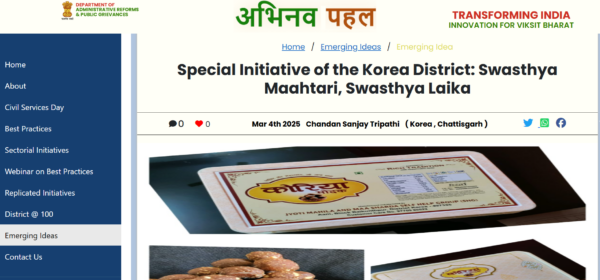
The Korea Modak Laddu initiative is now being cited on various governance and innovation platforms as an example of how a simple, locally grounded idea can tackle a stubborn public health challenge.
Its core features include:
- Use of locally available, traditional grains and sweeteners, reducing dependency on external supply chains.
- Community-led production and monitoring through SHGs and Poshan Sangwari, ensuring accountability and adherence.
- Convergence of multiple objectives – reducing LBW and malnutrition, improving maternal health, and generating women’s livelihoods – under a single design.
- Financing through DMF, aligning mining revenues with human development in a resource-rich but vulnerable district.
Experts and commentators argue that similar food-based, culturally rooted supplementation models could be adapted in other malnutrition-affected regions, provided they are anchored in local ingredients, women’s collectives, and sustained behaviour change efforts. In Korea, the experiment that began as a response to a bleak statistic has evolved into a district-wide example of how administrative leadership, community wisdom and women’s collective labour can rewrite maternal and child health outcomes—one laddu at a time.
