


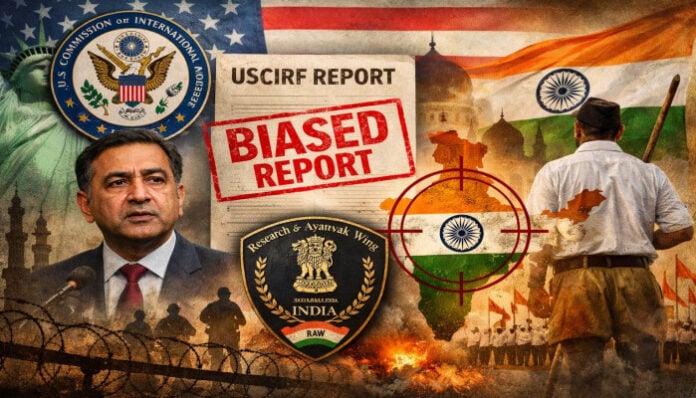
“USCIRF’s India Narrative: A Politicised Assault on Bharat’s Sovereignty and Civilisational Identity”, My Ind Maker, March 17, 2026
“At a time when Bharat is asserting itself as a confident civilisational state on the global stage, the renewed targeting of its core institutions by the US Commission on International Religious Freedom (USCIRF) must be understood not as an isolated critique, but as part of a broader pattern of ideological intervention. The 2025 USCIRF report, which goes to the extent of recommending targeted sanctions against India’s external intelligence agency, Research and Analysis Wing (R&AW) and attempts to implicate the Rashtriya Swayamsevak Sangh (RSS), marks a dangerous escalation from commentary to coercive suggestion.
India has, in the past, rightly dismissed USCIRF reports as “biased and politically motivated.” That position stands reinforced today. What is particularly revealing is not merely the content of the report, but its persistence—year after year—despite India’s well-documented record as a pluralistic, democratic society rooted in civilisational ethos. Bharat’s model of coexistence is not a modern construct imposed by law; it is an organic outcome of Sanatan Dharma, which has historically accommodated diversity, dissent, and dialogue. To portray such a civilisation as systemically violating religious freedom reflects not concern, but a deliberate attempt to reshape global perception.
The question that naturally arises is: who is shaping these narratives, and to what end? As per available information, Asif Mahmood, a Pakistani-origin American and current Vice Chair of USCIRF, has been associated with advocacy positions that frequently align with anti-India narratives. Various media reports suggest that he has amplified allegations regarding India’s supposed involvement in international incidents, including those linked to Khalistani elements, without substantiating such claims with credible evidence. When such positions converge with long-standing Pakistan-sponsored narratives on Kashmir and separatism, it raises legitimate concerns about objectivity and intent within the institutional framework of USCIRF……”
Read full article at myind.net
