


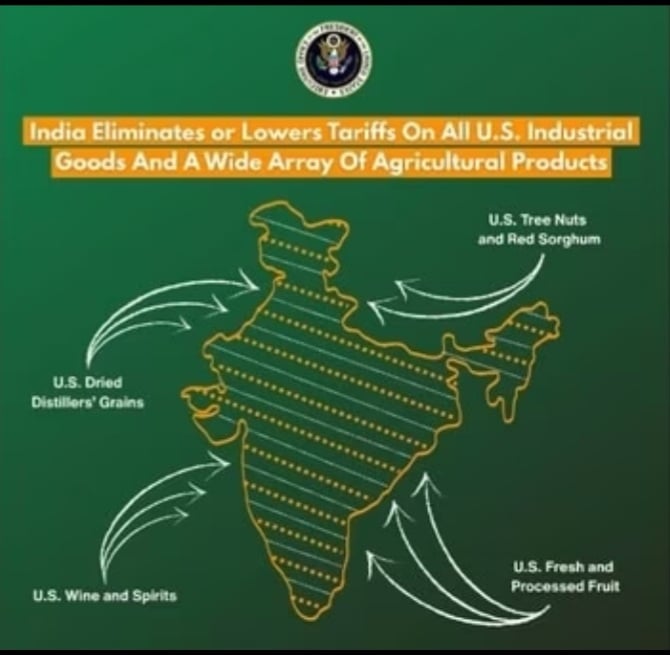
Some days ago, Washington, in a very significant move in its wilful effort to redesign its strategic relations with India, used an important Tweet (on X) through the US Trade Representative making the announcement of a framework for an interim trade agreement between the US and Bharat. The Tweet besides the framework enlisted the map of Bharat significantly thus making a departure of decades of US’s neutrality on the subject.
The map of Bharat was depicted from an Bhartiya perspective and included all parts of Jammu and Kashmir as they existed on 15 August, 1947 as an integral part of the princely ruled state which acceded to the Bhartiya Union on 26 October, 1947. Besides this, it also showed the state of Arunachal Pradesh in its full geographical form as part of Bharat in the north-eastern region of the Bhartiya nation which China has been traditionally averse to. In regard to Jammu and Kashmir, the state that existed as on 15 August, 1947 got vivisected in five parts after 1947. The five parts are as follows:
Jammu and Kashmir state which is currently a Union Territory as a part of the Bhartiya Union and Ladakh as a UT in the northernmost territory of the country, Pak occupied Jammu and Kashmir (PoJK) having areas like Muzaffarabad, Mirpur and Poonch, Pak occupied Gilgit and Baltistan that Pakistan calls Northern Territory, Shaksgam valley in the Karakoram that Pakistan ceded to China; and Aksai Chin & Tibetan plateau area in Ladakh that is under the illegal occupation of China. The map under reference shows all these areas as the legitimate parts of the Bhartiya Union as the facts are. In addition to this, the map depicts Arunachal Pradesh as a legitimate part of Bharat as per the descriptions of the Bhartiya nation-state.
Keen observers believe that ‘map-diplomacy’ marks a positive end to the decades-old US’s neutrality in the region’s volatile and active borders scenario. While it can be termed as a conscious geo-political nod to the Indian nation in context of its description of borders, it has potential to cause tension and irritation in Pakistan and China amid the rudimentary US’s relationship with the both. It surely describes the return of strategic support for Bharat as a counterpoise and balance in the Indo-Pacific region.
This development is being seen in the context of the fresh and renewed relations between the US and Pakistan and the interest shown by the US in developing specific interests in Pakistan. The outward bonhomie, visits of Pakistan premier and the army chief to the White House, presentation of samples of real earth minerals to Donald Trump by Asim Munir, business interests of Trump’s family in Pakistan and other negotiations aimed at to lift the relationship to new levels don’t reflect in the Trade Representative’s exposition of the framework of Indo-US trade deal. In fact, the publication of the map of India is contrary to that since it endorses the Bhartiya position and the US’s keenness to put it on record and also on the public domain.
It was viewed especially from the time Donald Trump assumed office last year and followed by certain efforts of the Trump administration that Pakistan would be used against Bhartiya interests by the US in the region. The publication of the map speaks something else and is very far from the general perception about the issue at the geo-political level. The US seems to be of the view that Pakistan may be useful in some areas of its interests globally but it can’t be a strategic alternative to Bharat in the geo-political scenario.
In a stunning moment inside Pakistan’s National Assembly, Defence Minister Khawaja Asif admitted that Pakistan had been “used worse than toilet paper” by the United States, rented out for nearly two decades, deployed for strategic objectives, and then discarded. ‘The country behaved like a mercenary state for U.S. strategic goals’. The timing is conspicuous and also consequential. Bharat’s recent trade engagement with the US generated pointed discourse in Pakistan, where critics lamented that Islamabad failed to secure comparable leverage & balance against Bharat. Prime Minister Shehbaz Sharif is facing severe criticism for being overly dependent on Washington while delivering limited strategic gains and the necessary geopolitical advances.
Bharat is a big global economy, it has its incomparable stature among nations as a successful democracy, the leadership of Bharat particularly under Narendra Modi has a recognition across nations, the influence of Bharat specifically in the global south is of a permanent nature that has its own impact story, the Indo-EU Trade deal preceded and followed by many such deals provides India a special global platform to act. Pakistan has a very limited use for the US and the US will surely take advantage of that ‘limited use’. However, the situation in regard to Bharat is diametrically opposite keeping in view India’s aspirations particularly as an emerging manufacturing hub in the world; and the Trade Deal between the US and Bharat is also reflective of this viewpoint.
Pakistan’s so-called field marshal Asim Munir has by his own overtures given a clear notion to the world that Pakistan is a hybrid democracy where the will of the people has a partial role to play. In his over-enthusiasm to present himself as the real power centre of Pakistan, he has exposed Pakistan’s internal situation that has no potential veracity keeping in view the real geo-political magnitude of the emerging situation involving the role of Bharat as a frontline global player. Pakistan has been put on the sidelines by India globally and its regional position stands compromised over the last full one decade following the important policy & strategic decisions of the current regime in Bharat led by PM Modi. The US administration knows this well and can’t take a risk to put Pakistan as an alternative to Bharat in the Indo-Pacific region.
There is a strategic likelihood in the official depiction of the Bhartiya map by the US which effectively signals that Bharat was no longer just a partner for the US but the primary regional anchor and presenter in the Indo-Pacific region. There is no doubt in the fact that the US wants reciprocal alignment but Bharat is conscious of the fluctuating actions and reactions of the US particularly with effect from April 2025. Despite severe provocations, Bharat maintained cool and extended a grand exhibition of its patience and timing to act. The statement of the MEA Jay Shankar that ‘Bharat can wait for the end of the Trump term’ was beyond doubt the icing on the cake. It worked to the benefit of the Indian global interests.
Bharat during the tumultuous relationship of the last one year with the Trump administration made a four-fold achievement. It inked the 10-year US-India Defence Agreement in Kuala Lumpur, entered into Indo-US Trade Deal that will be formally announced in March-2026, got tacit endorsement of its territorial position through the US Trade Representative’s announcement of the deal-framework and appointment of a pro-Bharat US Ambassador in New Delhi who has made public the US interest to go ahead with the Bhartiya leadership to shape the future of geopolitics. There is also an expectation that QUAD will be activated in the very near future.
Though the public focus remains on Tariffs that are now 18% from 50%, the map is a key component of the master accord struck between President Donald Trump and Prime Minister Narendra Modi. The territorial validation grants New Delhi with a remarkable and significant victory that transcends trade and business goals and balances. The map surely is a new frustration for Pakistan and China who have chosen to maintain strategic silence to the benefit of Bharat’s interests….!
