


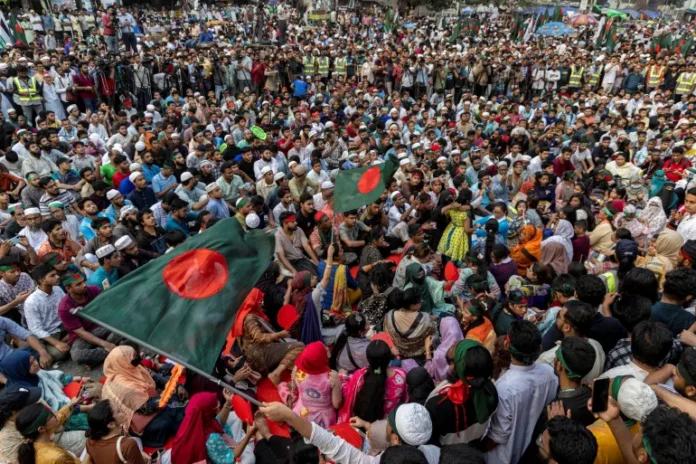
Bangladesh was founded in 1971 on the constitutional ideals of secularism, pluralism, and equality. Yet more than five decades later, these ideals remain under strain. Communal violence against religious minorities—particularly Hindus, Buddhists, and Christians—continues to erupt with alarming regularity. While such violence has deep historical roots in the subcontinent, the digital era has reshaped its mechanics, accelerating how fear is manufactured and how violence is mobilized. Beneath the surface of many of these incidents lies a motive that is rarely acknowledged openly but repeatedly revealed in practice: the systematic seizure of minority-owned land.
Conflicting Accounts of Sectarian Violence in 2025
29 January 2026, International outlets BBC News Bangla reported that at least 522 incidents of communal violence occurred in Bangladesh between January and December 2025, citing figures released by the Bangladesh Hindu Buddhist Christian Unity Council.
In a press release, the council said the data were compiled from reports published in national newspapers and other media outlets. The organization also stated that from Aug. 4, 2024—one day before a major political transition through December 2024, a total of 2,184 incidents of communal violence were reported nationwide.
According to the council’s breakdown of those incidents, there were at least 61 killings, 28 cases of violence against women, including rape and gang rape, 95 attacks on places of worship involving idol vandalism, looting, and arson, and 21 incidents related to the occupation or attempted occupation of land belonging to religious institutions.
The council’s figures contrast with a recent assessment by Bangladesh’s interim government, which reported 645 violent incidents in 2025, of which 71 were identified as having communal elements, while the remaining 574 were classified as non-communal.
The council said significant challenges remain to holding an inclusive election that ensures the spontaneous participation of citizens across all ethnic, religious, caste, and community backgrounds. It also warned that hate speech by communal groups, along with violence driven by religious differences, continues to undermine social cohesion and disproportionately harm religious and ethnic minorities and other marginalized communities.
Expressing further concern, the organization cautioned that a climate of fear and anxiety could discourage minority voters from participating in the electoral process.
Digital Rumors, Real Violence
Social media has become a powerful catalyst in recent communal incidents. Platforms such as Facebook have enabled the rapid spread of misinformation, hate speech, and inflammatory content. What once required weeks of planning and mobilization can now unfold in a matter of hours. Digitally altered images, fake accounts, and fabricated posts alleging insults to religious sentiment have repeatedly served as triggers for mob violence.
Investigations into these incidents often reveal a disturbing pattern. The alleged “offense” is frequently false or unverifiable, while the violence that follows is very real. The 2012 attacks in Ramu stand as a defining example. A Buddhist man was falsely accused of desecrating the Quran through a manipulated Facebook post. Before authorities could intervene, mobs destroyed temples, homes, and businesses. The post was later proven fake, but by then the damage—material, psychological, and communal—was irreversible.
Similar trajectories were observed in Brahmanbaria in 2016, Comilla in 2021, Gangachara in 2025, and numerous other locations. In each case, digital misinformation ignited fear, mobs enforced terror on the ground, and minority communities were left displaced and traumatized. Those who created or circulated the false information largely escaped accountability, while victims often faced arrests, intimidation, or pressure to abandon their property.
Digital platforms did not invent communal hatred, but they have dramatically lowered the cost and speed of converting prejudice into violence.
Land as the Hidden Currency of Communal Violence
Behind many of these outbreaks lies a less visible but persistent objective: land. Religious outrage frequently functions not as the true cause of violence but as a convenient pretext. By instilling fear and insecurity, attackers pressure minority families to sell land at throwaway prices or to flee altogether. In the aftermath, ownership quietly shifts to politically connected or economically powerful actors.
This dynamic is not confined to isolated incidents; it is structural. Independent research and media investigations have repeatedly linked communal violence in Bangladesh to land disputes. According to a report published by The Daily Star on May 15, 2008, Hindu communities lost approximately 26 lakh (2.6 million) acres of land between 1965 and 2006. These losses, often facilitated by discriminatory laws and political patronage, forced more than one crore people to migrate and caused economic devastation for over 12 lakh families.
More recently, a BBC News Bangla report published on August 27, 2024, cited findings by the Bangladesh Peace Observatory (BPO) of the Center for Alternatives (CfA), which analyzed incidents from 2013 to 2022. The study concluded that nearly 70 percent of violence against religious minorities in Bangladesh was land-related, frequently involving the destruction or seizure of minority-owned homes, businesses, and places of worship.
Sreemangal: A Local Portrait of Dispossession
The tea-growing region of Sreemangal in Moulvibazar district offers a stark illustration of how land grabbing operates at the local level. In villages such as Bhunobir, Rupsapur, and Noagaon, minority families describe a long history of encroachment, fraud, and intimidation.
The Mahadev Datta Choudhary family of Bhunobir, once prominent landholders, lost hundreds of acres after briefly fleeing to India during the 1965 Indo-Pak war. Upon their return, they found their land occupied by local power brokers who exploited the chaos of wartime displacement. Similar allegations surround the Indra Home Estate along Moulvibazar Road, where locals claim that an influential individual took over the property and later regularized the occupation through forged documents and unofficial payments.
Personal tragedies underscore the human cost of this process. The late Khirad Dev Choudhury, a respected educationist, built the Radhanath Cinema Hall in Sreemangal town. After his death, an adjacent plot was seized. When his daughter, Advocate Uttara Dev Choudhury, attempted to reclaim it, she was publicly assaulted by hired thugs. The incident shattered her sense of security and dignity; she withdrew from public life and died a few years later. Locally, her story is remembered as a warning about the risks of resistance.
In Noagaon village, land grabbing has become so normalized that entire clusters of minority families live under constant threat. Sangram Datta, son of former Union Parishad chairman Rasendra Datta Choudhary, has spent years trying to reclaim 15 decimals of family land occupied by individuals who, he says, hold no legal documents. Despite valid records and tax receipts, he has been unable to regain possession. In May 2023, associates of a local political figure allegedly removed soil from his land to devalue it, a tactic intended to force a distress sale. Fearing retaliation and the futility of legal action, he chose not to pursue the matter through the courts.
Even documented legal victories offer little protection. Rasendra Datta Choudhary himself won a district court case over 30 decimals of land near the Jagcherra Tea Estate road, only to see the property sold to a politically influential buyer during the appeal process. Although the Supreme Court later reaffirmed his ownership, the land remains out of reach. As one local observer put it, “The papers show victory, but the soil shows defeat.”
When Accusation Becomes a Death Sentence
The consequences of rumor-driven violence extend beyond land to the most basic right of all: life. In December 2025, Dipu Chandra Das, a Hindu garment worker in Valuka, Mymensingh, was beaten and burned to death by a mob following allegations that he had insulted religion. According to BBC News Bangla, investigators later found no evidence—no social media post, no eyewitness testimony—that he had made any such remark.
What existed instead was rumor, amplified by fear and collective irresponsibility. As tensions rose inside the factory where he worked, management reportedly pushed him outside rather than protecting him. Police intervention came too late. Neutrality and delay, in that moment, became fatal.
Dipu Chandra Das was the sole breadwinner for his family. He left behind a wife and a young child. His killing illustrates a grim reality: when accusation replaces evidence and mobs replace courts, no minority and no worker is safe. Justice cannot be limited to arrests alone; it must also address institutional failures and provide concrete support to victims’ families.
Historical Continuity and Institutional Failure
Communal violence in Bangladesh did not begin with social media. The Noakhali riots of 1946, the attacks on Hindus in East Pakistan after Partition, and the Enemy Property Act of 1965 all demonstrate how religious persecution and land dispossession have long been intertwined. The Liberation War of 1971, while a struggle for national freedom, also saw minorities—particularly Hindus—targeted for extermination and displacement.
Post-independence Bangladesh has not fully broken from this legacy. Anti-Hindu riots in 1990, 1992, 2001, and post-election violence in 2014 reveal a persistent pattern. Inquiry commissions, such as the one formed after the 2001 elections under Justice Md. Shahabuddin, collected thousands of complaints but resulted in virtually no prosecutions, reinforcing a culture of impunity.
Today, weak enforcement of cyber laws, selective application of justice, and political protection for perpetrators continue to embolden those who profit from violence. When stolen land is not restored and instigators are not punished, communal attacks become a low-risk path to economic gain.
The Way Forward
Addressing this crisis requires more than rhetorical commitment. It demands a comprehensive strategy that confronts both digital manipulation and land injustice. Stronger regulation of online platforms, community-based monitoring, and nationwide digital literacy campaigns are essential to prevent misinformation from escalating into violence. Equally crucial are legal and judicial reforms, including fast-track courts for communal hate crimes and effective prosecution of those who fabricate digital provocations.
Above all, land rights must be recognized as central to minority security. Without restoring stolen property and dismantling the economic incentives behind communal violence, no amount of online regulation will be sufficient.
The digital age promised transparency and connection. In Bangladesh, it has too often been weaponized against the vulnerable. The convergence of misinformation, political opportunism, land greed, and institutional weakness has created a volatile environment where rumor can destroy homes—and lives.
Protecting minorities in the digital era ultimately means protecting their right to remain, to belong, and to retain the land that anchors their citizenship. Unless Bangladesh confronts this reality with honesty and resolve, the secular and inclusive ideals that inspired its birth will continue to erode, one rumor, one mob, and one stolen plot at a time.
