


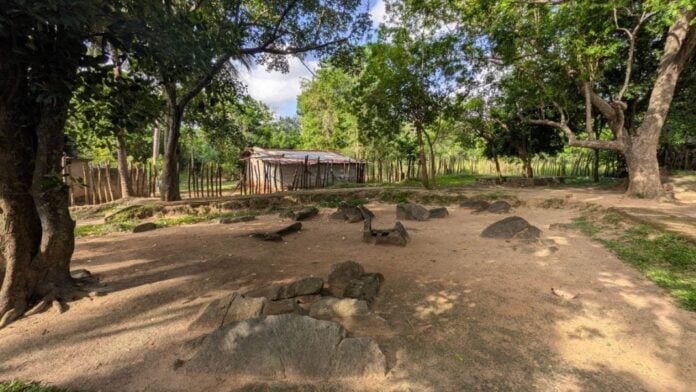
Summary: Ibbankatuwa, near Dambulla in Sri Lanka's Matale district, is the island's largest and best-preserved protohistoric megalithic cemetery, with over 42 clusters of granite cist tombs dated to c.750-500 BCE and carnelian and agate beads traded from Gujarat. Conserved and opened in 2017 with bamboo walkways, transparent information panels and replicas of pottery, it shows a site can be displayed without monumental visitor centres. Bharat's own megalithic sites, from Hire Benkal in Karnataka to Porunthal and Kadumanal in Tamil Nadu, and Arikamedu near Puducherry, are largely neglected, writes archaeologist Disha Ahluwalia in ThePrint.
Why it matters: The same cist burials, black-and-red ware and Gujarat-traded beads link Sri Lanka and peninsular Bharat in one Iron Age cultural world, an inheritance Bharat leaves to grazing goats and overgrown shrubs at sites like Arikamedu. Heritage care is not a question of crores, the archaeologist says, but of vision. Is a semi-autonomous ASI, freed from clutches of govt apathy and Nehruvian groupthink, the solution?
“Sri Lanka's Ibbankatuwa shows what India gets wrong about archaeology” — ThePrint, 6 Jul 2026
Sri Lanka welcomed about 2.3 million travellers in 2025. Indians accounted for around 23 per cent of the arrivals. While the coast remains Sri Lanka’s biggest tourist attraction, nearly one-third of Indian travellers also visit the ‘Cultural Triangle’, home to UNESCO World Heritage Sites including Anuradhapura, Dambulla, Sigiriya and Polonnaruwa. Yet, tucked away just beyond this celebrated circuit is a site that rarely finds mention in guidebooks.
On a summer morning, while driving to Dambulla, a modest roadside signboard caught my eye…
Read the full article at ThePrint →
