


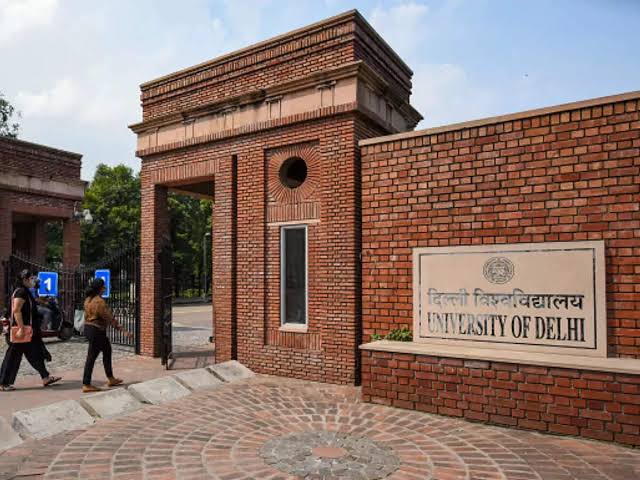
The University of Delhi witnessed chaos on the afternoon of 13th February, a day that should have been about dialogue, not violence. A demonstration in support of the now-stayed 2026 UGC Equity Regulations meant to curb caste-based discrimination, devolved into a dangerous sloganeering clash. Yet the real story was not just the protest, but what happened to journalist Ruchi Tiwari while covering it.
Tiwari, recounting the incident to ANI, revealed a horrifying scene: “Video is everywhere, people can judge for themselves who provoked whom. I was there to report. One of the media personnel called my name to get my attention. When I approached them, they demanded my full name and caste. Then the entire crowd turned on me. About 500 people attacked me. They levelled fake allegations and whispered rape threats just because I am a Brahmin. The girls around me held my arms and neck, whispering things like, ‘aaj tu chal, tera nanga parade niklega.’ The men threatened to ‘teach me a lesson.’ I fell unconscious. The police did nothing.”
Pause for a moment. These are the same people who march weekly, chanting slogans for women’s rights in faraway Palestine. They call themselves feminists. They claim to champion women’s safety. And yet, when a woman from their own country and yes, a Brahmin woman faces direct harassment, they are eerily silent. This is not just an isolated lapse. It is emblematic of a deeper malaise: selective feminism, a brand of advocacy that chooses its battles based on identity politics rather than principle.
India is a nation bound by the Constitution, where Article 14 guarantees equality before the law, and Article 21 protects the right to life. Every citizen, regardless of caste, religion, or background—deserves these protections. When a journalist is harassed for her caste while performing her duty, it is not merely a personal assault; it is an assault on the very principles of justice and equality. And yet, the silence from mainstream feminist voices has been deafening. Where is the outrage from the women’s rights activists who routinely flood social media with hashtags for distant conflicts? Where is the solidarity for Ruchi Tiwari? Perhaps, just perhaps, her Brahmin identity made her invisible to them.
Left-liberal circles often portray themselves as defenders of secularism, equality, and women’s rights. Yet the behaviour of some activists at Delhi University shows the opposite: They march for international causes but ignore harassment at home. They claim to oppose patriarchy yet propagate caste-based attacks themselves. They brandish the banner of feminism but fall silent when a woman is targeted for her caste. This selective morality does not just betray principles; it actively harms society. It normalizes mob violence under the guise of protest, and it teaches that harassment is acceptable if the victim is “the wrong caste” or “the wrong ideology.”
Feminism, in its truest form, is about standing for the safety, dignity, and rights of all women. It should not be a tool to amplify only the causes that fit a convenient narrative. When advocacy is selective, it becomes hypocrisy masquerading as principle. Consider this stark contradiction: protests erupt globally for the women of Gaza, yet Afghan women, Bangladeshi Hindu women, or even women issues in Indian districts like Murshidabad are largely ignored. The consistency is missing, and with it, the credibility of those who claim to champion women’s rights. What happened at Delhi University is not merely a “protest gone wrong.” It is a warning. When ideological fervour overrides respect for life and dignity, the result is not activism; it is mob justice. When selective empathy becomes the norm, feminism itself is hollowed out, reduced to a performative statement rather than a moral commitment.
We must confront this uncomfortable truth. Women’s rights are universal—they do not have an asterisk next to caste, religion, or political ideology. Our ancient Sanatani texts also say, “Yatra naryastu pujyante ramante tatra Devata, yatraitaastu na pujyante sarvaastatrafalaah kriyaah” (Manu Smriti 3.56) It means, where Women are honoured, divinity blossoms there, and where women are dishonoured, all action no matter how noble remains unfruitful.
True feminists must condemn harassment wherever it occurs, even when the victim does not fit a favoured demographic. To stay silent is to condone injustice. Ruchi Tiwari’s ordeal should have sparked nationwide outrage. Her identity as a Brahmin should not diminish the fact that she was assaulted. Her case should remind us that our commitment to equality and justice must be unwavering, even when inconvenient. Selective outrage is the enemy of justice; selective feminism is the enemy of progress.
We can no longer afford moral shortcuts. Feminism must be measured not by the hashtags it trends, but by the consistency of the principles it defends. It must stand for every woman, regardless of caste, creed, or geography. Anything less is hypocrisy, and in the long run, it erodes the very fabric of society we claim to protect. The Delhi University incident is a mirror, reflecting uncomfortable realities: that mob violence can happen under the guise of protest, that harassment can be caste-motivated, and that selective silence can amplify injustice more than the mob itself. If our feminists truly believe in women’s empowerment, they must break this pattern of selective advocacy. Justice delayed by ideology is justice denied.
Bharat is watching. And history will judge those who remained silent when it mattered most. Feminism is a noble cause, but it becomes corrosive when it chooses favourites. For the sake of equality, dignity, and the Constitution, let us demand a feminism that is universal, consistent, and fearless—a feminism that stands for every woman, everywhere.
