


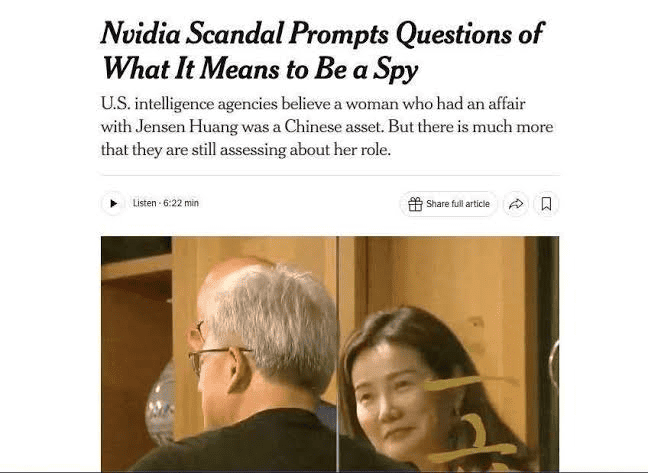
Summary: On 29 October, the New York Times reported that Nvidia chief Jensen Huang had been honeytrapped by a Chinese spy. Huang's company makes the chips that power the AI boom, and the story cost him his job. Independent journalist Ken Klippenstein says it rested on a leaked memo by US Secretary of State Marco Rubio, a China hawk. Rubio recast raw intercepts about Alice Huang, a former Beijing TV journalist whose Singapore firm bought billions of dollars of Nvidia chips, into a spy case. Since then, no senior US official has called her a spy, Singapore has released her, and on Monday Nvidia reinstated Huang. Klippenstein ties the leak to Rubio's feud with Commerce Secretary Howard Lutnick over chip sales to China.
Why it matters: If Klippenstein is right, the newspaper that lectures Bharat on press freedom brought down the head of America's most valuable company on a politically leaked memo. It is now backing away with essays asking "what even is a spy?" Either way, a front-page story built on unnamed officials and a cabinet feud deserves scrutiny. So do the NYT's reports on Bharat, which rest on the same kind of anonymous sourcing.
Source: “Jensen Huang Spy Story Is a Hoax”, Ken Klippenstein · 24 Nov 2026
U.S. intelligence never concluded that Alice Huang was a spy, sources tell me.
How, then, did the media get so spun up over a made-for-Hollywood story about Nvidia CEO Jensen Huang getting honeypotted by a Chinese spy?
Blame Marco Rubio.
He cooked the intelligence until it was charred beyond recognition, then served it to the press — just ahead of Pulitzer season.
Rubio, a China hawk and longtime foe of Huang’s, took creative liberties in describing preliminary intelligence and sent the media on a wild goose chase that ended with Huang ousted from Nvidia…
Read the full article at Ken Klippenstein →
