


“Dhurandhar: Dial D for Modi”, Open the magazine, March 27, 2026
“DHURANDHAR: THE REVENGE is more overtly political than its predecessor in its direct references to current politics as also in its disregard for criticism that it not only chooses a side but promotes a polarisation intrinsic to the Bharatiya Janata Party (BJP)-Hindutva playbook. In awarding predictably poor grades to the film, most mainstream film critics carefully dressed their reviews as cinematic appraisals after a tidal wave of popular approval brushed aside moralistic finger-wagging and elite condescension in the case of Dhurandhar (the first one). In its emphatic thumbs-up to the films, the viewing public validated theDhurandhar narrative that presents Narendra Modi as a contrast to the vote-bank politics that shackled India’s fight against terrorism.
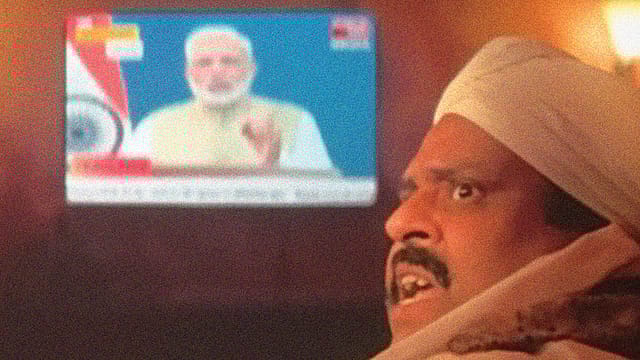
In a telling episode in the film, Pakistani Inter-Services Intelligence (ISI) Major Iqbal’s abusive, wheelchair-bound father, played with loathsome conviction by actor Suvinder Pal, explodes with rage when he sees Modi being sworn in as India’s prime minister on television. Consumed by his anger, the retired brigadier boasts of how he had raped dozens of Bangladeshi women in the 1971 war and how his inept son had “allowed” Modi to win. “You pumped American dollars into NGOs in India and you had said your people would win this time, didn’t you?” he yells. The imputation is clear enough, that Modi’s opponents were the ISI’s preferred option. The retired brigadier forgets his generation lost the 1971 war and he continues to berate his son, essayed by Arjun Rampal, who listens with a rising sense of anger and menace.
BJP’s decision to name Modi as its prime ministerial candidate for the 2014 Lok Sabha election was viewed with alarm in many quarters in Pakistan. The reasons lay not only in the selective accounts of the 2002 Gujarat riots consumed in Pakistan but also in the assessment that Modi might prove a different kettle of fish as compared to the Manmohan Singh government. As it happened, Modi began by trying what all his predecessors, including Atal Bihar Vajpayee did—reach out to Pakistan with a peace mission. Setting aside conventional calculations, Modi attended the wedding of then Pakistan Prime Minister Nawaz Sharif’s granddaughter in Lahore on December 25, 2015 on his way back from Afghanistan. There is reason to believe that Sharif did see the benefits of better relations by way of peaceful borders and trade. The Pakistani military establishment in Rawalpindi felt otherwise and a terrorist attack on the Pathankot Indian Air Force (IAF) base in January 2016 was followed by a strike on an Indian Army camp at Uri in September. It was the Pakistani military’s way of testing Modi.
The prime minister responded by reworking India’s anti-terror doctrine, doing away with self-imposed restraints. For decades, options for responding to Pakistan-sponsored terrorism appeared to swing between ineffective measures such as suspension of diplomatic contacts and outright war and nothing much in between. The surgical strikes of September 28-29, 2016, the bombing of a Jaish-e- Mohammed training camp at Balakot on February 26, 2019, and the May 7-10, 2025 Operation Sindoor marked a rising arc of retaliation that borrowed a page or two from Nobel-winning economist and foreign policy scholar Thomas Schelling’s “theory of compellence” that advocates proactive deterrence. Modi shed previous hesitation over using military force as it was apparent that the Pakistan army’s animosity towards India was unchanged. “The Pakistani army remains obsessed with India. It has been obsessed with India since Partition. It has lost every war with India and (after) losing every war it has come back even more obsessed. It sees no way of defeating India conventionally… it is building nuclear weapons and secondly what they euphemistically refer to as ‘asymmetric warfare’, a fancy term for supporting terrorists,” former Central Intelligence Agency (CIA) official Bruce Riedel said at a Brookings Institute event in 2013. He should know as he had a ringside view of US-India discussions after India’s 1998 nuclear test and is an authority on Pakistan’s jihadist groups…….”
Read full article at openthemagazine.com
