


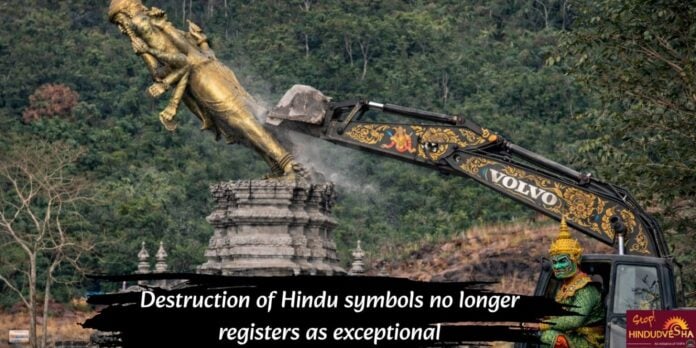
“How Hindu Civilizational Memory Is Slowly Being Erased, One Symbol at a Time”, Stop Hindu Dvesha, March 03, 2026
“Incidents involving the desecration or damage of Hindu religious symbols are routinely dismissed as isolated acts of vandalism, localized criminality, or incidental by-products of political unrest. Such framings, however, obscure a recurring and transregional pattern: Hindu symbology disproportionately becomes a target during periods of social stress, political transition, and ideological contestation. This pattern persists across majority and minority contexts alike, despite Hinduism’s exceptional civilizational longevity, geographic diffusion, and historical role as a foundational cultural force across Asia.
It is imperative to look at the reported damage to Hindu religious idols in Thailand as a diagnostic case within a broader comparative and civilizational framework. Rather than treating the incident as an aberration, it situates it within a structural condition in which Hindu symbols, icons, temples, and sacred geographies are rendered symbolically visible yet institutionally vulnerable.[1] Even in regions where Hindu cosmology once shaped kingship, law, aesthetics, and political theology, its material and symbolic presence today is increasingly treated as peripheral, negotiable, or politically expendable.
The central argument advanced here is that attacks on Hindu symbology are neither accidental nor merely opportunistic. They reflect a structural vulnerability produced by historical amnesia, postcolonial reconfigurations of identity, and the internal fragmentation of Hindu communities themselves. Together, these forces normalize symbolic injury, fragment collective response, and allow repeated acts of desecration to be absorbed without civilizational consequence. By placing the Thai incident within a comparative analysis spanning South Asia, Southeast Asia and the Hindu diaspora, this study argues that symbolic vulnerability, rather than demographic weakness, constitutes the defining challenge facing Hindu civilizational continuity in the contemporary world……”
Read full article at stophindudvesha.org
