


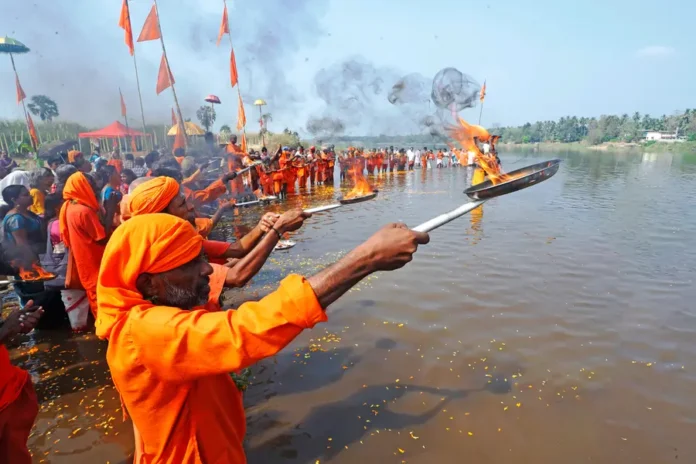
“From Suppression to Revival: Hindu Civilization Reclaims Mahamagha in Kerala”, India Facts, March 31, 2026
“The South Indian State of Kerala, the land that gave birth to Sri Adi Sankaracharya, the proponent of Advaita darshana, witnessed a remarkable revival of its civilizational memory when the sands of Bharatapuzha—Kerala’s venerable Nila—felt the weight of hundreds of thousands of people once again. It was more than a riverbank crowding; it was a recovery of a collective memory. After a hiatus of around two-and-a-half centuries, the Mahamagha Mahotsavam was revived at Thirunavaya on the Bharatapuzha, drawing pilgrims, ascetics, scholars, and ordinary devotees in numbers not seen there for generations. The 17-day Mahamagha Mahotsavam, held from January 18 to February 3, 2026, was described as the “Kumbh Mela of South India” and blended devotional bathing, Vedic rites, classical arts, spiritual discourses, and a complicated choreography of ritual, administration, and modern logistics.
Mahamagha — the great gathering in the lunar month of Magha — had ancient precedents across the Indian subcontinent. Historically, periodic congregations of tirthas (pilgrims), akharas (monastic orders), pandits, and traders turned riverbanks into living cosmologies of faith, discussions, and cultural exchange. Kerala’s medieval grand assembly, the Mamankam festival, revolved around Thirunavaya—a small temple town on the banks of the Nila that functioned as a major congregation site and a center of ritual authority. The revival now aimed to reconnect with that lineage: to re-establish a pan-South Indian ritual hub where sacred baths and mantra chanting came together.
Organisers said the revival was historic: the ritual had been discontinued roughly 250 years ago, and the present event sought to restore the tradition and its spiritual rhythms. The 2026 Mahotsavam — held from January 18 to February 3 — deliberately echoed the scale and pattern of large Hindu tirtha gatherings, with procession, akhara participation, ritual baths (snana), evening river aratis, and a program of talks, yajnas, and cultural offerings……”
Read full article at indiafacts.org.in
