


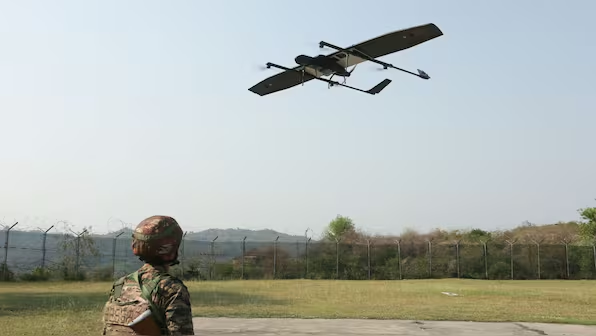
“Drone-age warfare: Why Indian Army must command the air littoral battlespace”, First Post, December 10, 2025
“In the evolving landscape of modern warfare, the air littoral—the vertical battlespace from ground level up to approximately 3,000 metres—has become the most contested zone. Saturated with drones, loitering munitions, and short-range air defence systems, it is the layer where ground forces are most vulnerable. For India, with the Army already engaged in active deployments along the Line of Control (LoC) and Line of Actual Control (LAC), the case for Army-led control of this battlespace is not just doctrinal—it is existential.
The Proximity Argument
Indian Army units deployed in forward areas are the first exposed to hostile drone swarms, loitering munitions, and aerial reconnaissance. These threats can materialise within seconds of escalation—often without a formal declaration of hostilities. Waiting for centralized airspace clearance or inter-service coordination could prove fatal.
-
- Force preservation becomes the first casualty if soldiers cannot respond instantly.
- A surprise ground thrust, supported by aerial ISR, could overwhelm defensive positions before countermeasures are authorised.
- Example: Along the LAC, a swarm of loitering munitions launched across the ridge could devastate Indian bunkers. If the Army lacks authority to engage autonomously, delays in clearance could result in catastrophic losses.
Tactical Autonomy: Decision at the Edge
Today’s soldier is not just a combatant but a node in a sensor–shooter network. Infantrymen and armoured crews are increasingly equipped with handheld or vehicle-mounted counter-UAV systems—jammers, kinetic interceptors, and drone-on-drone capabilities…..”
Read full article at firstpost.com
